
Buying a plot is an important financial decision. Location, price and future development are certainly important, but property approvals and documents deserve equal attention.
If you are searching for HMDA, DTCP, RERA approved plots in Hyderabad or Telangana, you may come across several different approval terms in property advertisements. Understanding what these terms mean can help you ask the right questions before purchasing land.
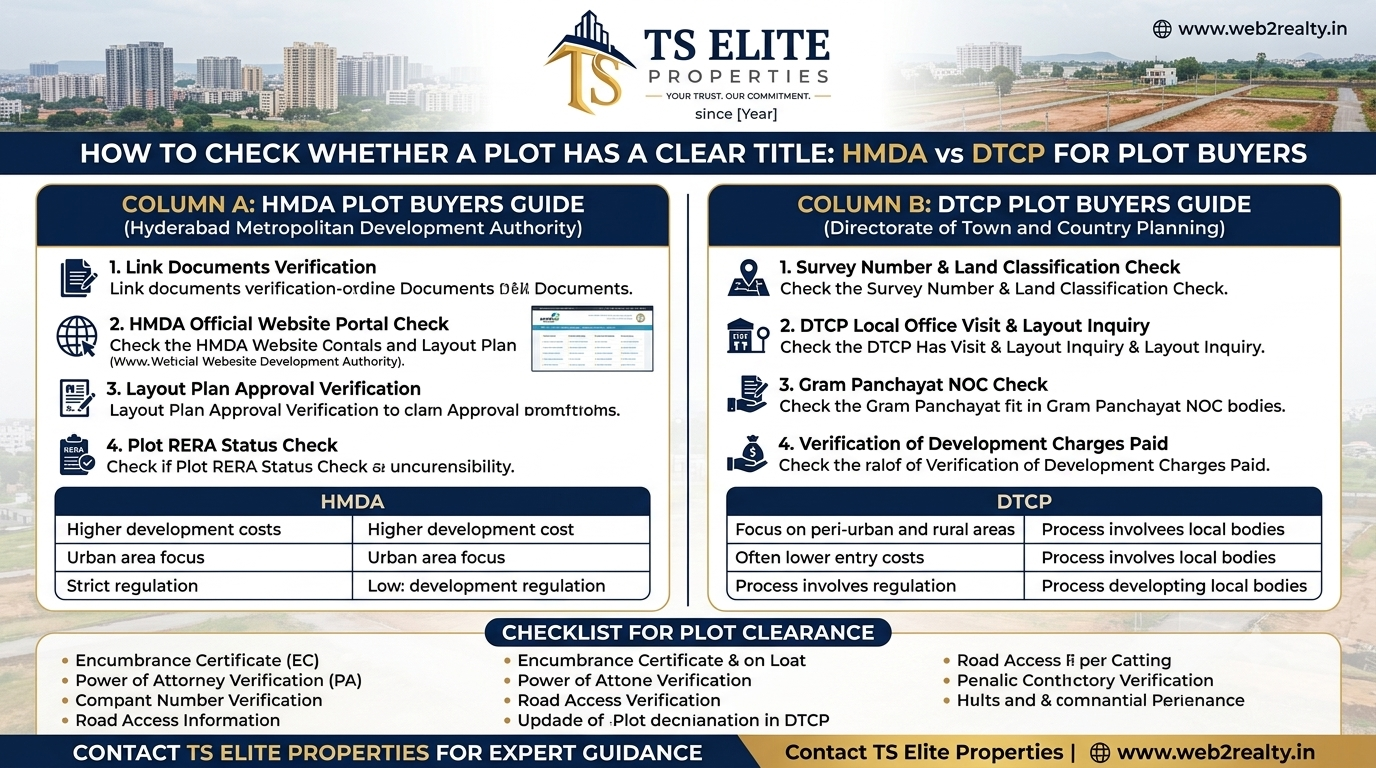
HMDA, DTCP and RERA do not serve exactly the same purpose. Planning authorities deal with development and layout permissions, while RERA focuses on regulating eligible real estate projects and improving transparency for buyers.
Another important document is the sanctioned layout plan. It shows how the land has been divided into plots, roads, open spaces and other designated areas.
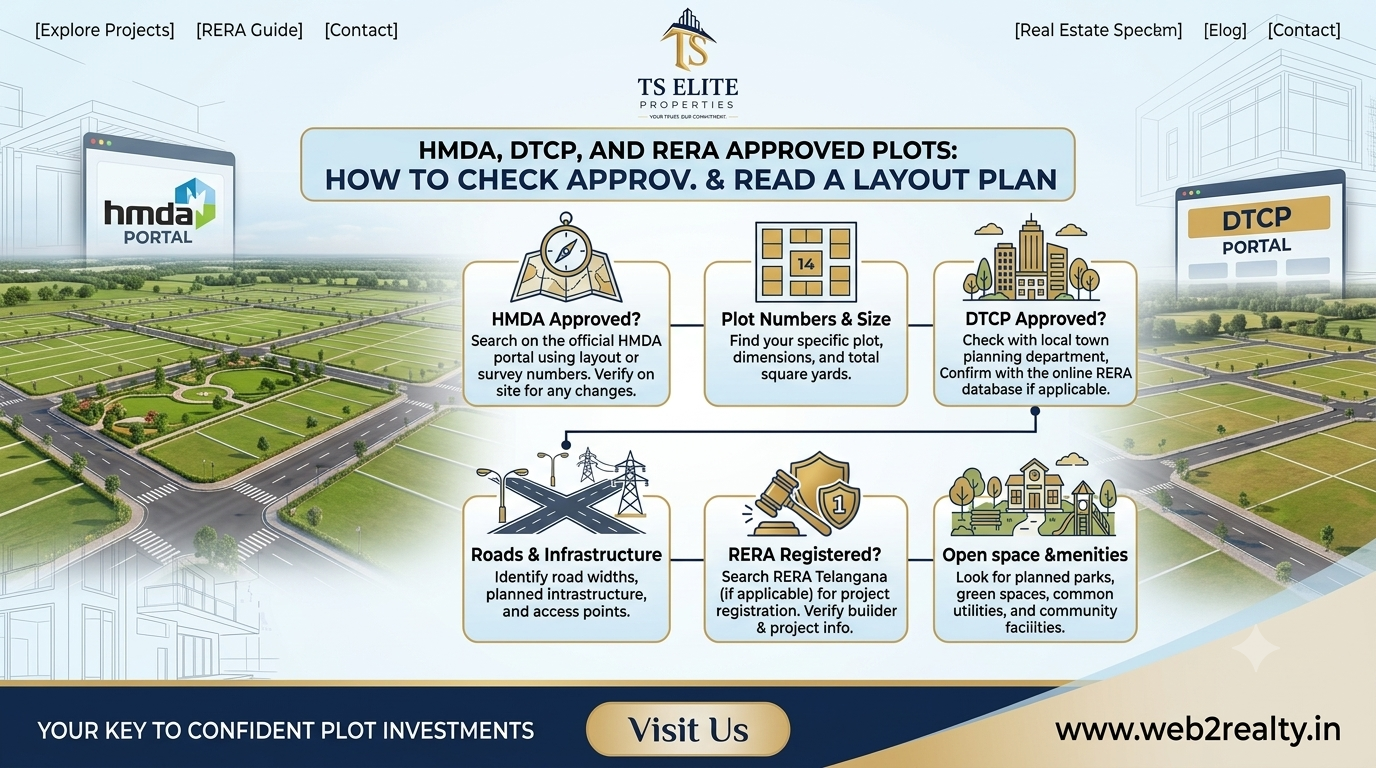
This guide explains the basic difference between HMDA, DTCP and RERA and shows you what to look for when examining a layout plan.
A property advertisement may describe a project as approved, premium or investment-ready. However, buyers should verify the underlying documents rather than depending only on promotional material.
Proper verification can help you understand:
This is why document verification should happen before making a major payment.
HMDA stands for Hyderabad Metropolitan Development Authority.
It is the metropolitan planning authority for its notified area around Hyderabad. Depending on the location and type of development, HMDA deals with development permissions and layout-related approvals.
For a plotted development, the approved layout can provide important information about the proposed arrangement of the site.
It may show:
If a project is advertised as an HMDA approved layout, ask the developer or seller to provide the actual approval reference and sanctioned drawing.
Do not consider a marketing brochure as a substitute for the official approval document.
DTCP means the Directorate of Town and Country Planning.
DTCP deals with planning and development matters in areas falling under its applicable jurisdiction.
A DTCP-approved layout is therefore different from an HMDA-approved layout mainly because the competent planning authority depends on the property’s location and applicable planning framework.
If you are considering HMDA, DTCP, RERA approved plots, first identify which planning authority is responsible for that particular property.
Ask for:
The key is to verify the actual approval instead of relying on a statement such as “DTCP approved” in an advertisement.
RERA refers to the Real Estate (Regulation and Development) Act, 2016.
RERA was introduced to improve transparency and accountability in the real estate sector. In Telangana, projects covered by the applicable provisions are registered with the Telangana Real Estate Regulatory Authority (TGRERA).
RERA information can help buyers review project-related details and disclosures.
Depending on the project, the information available can include:
However, one important point should be remembered:
RERA registration is not the same as layout approval.
Similarly, a planning approval should not be treated as a replacement for checking the property’s ownership and title documents.
Each verification serves a different purpose.
A simple way to understand these terms is:
Deals with planning and development permissions within its applicable metropolitan jurisdiction.
Deals with town and country planning and development permissions within its applicable jurisdiction.
Regulates covered real estate projects and provides a framework for registration, disclosures and buyer protections.
Therefore, when you see the phrase HMDA, DTCP, RERA approved plots, do not assume that the three terms represent one single approval.
They relate to different aspects of a real estate project.
A sanctioned layout plan is an approved drawing showing how a particular parcel of land is planned to be developed.
For a plot buyer, it is one of the most useful documents to examine.
A layout plan can help you understand where your plot is located in relation to:
The plan can also help you compare what was approved with what the developer is offering.
You do not need advanced technical knowledge to perform a basic review.
Start with the following points.
First, identify the approval information printed on the sanctioned plan.
Look for details such as:
Keep these details with your property documents so they can be independently verified.
Survey numbers are extremely important in land transactions.
Compare the survey numbers shown in the layout approval with those mentioned in:
If the survey numbers do not match, stop and seek clarification before proceeding.
A small difference in a survey number can represent a completely different parcel of land.
Once you have the layout plan, locate the plot you intend to purchase.
Suppose you are being offered Plot No. 145.
Find Plot No. 145 on the sanctioned drawing and check:
Never assume that the plot shown in a sales brochure is identical to the approved plot without comparing the documents.
The advertised plot area should be compared with the approved plan and sale documents.
For example, if a plot is advertised as 200 square yards, check whether its dimensions and calculated area reasonably correspond to that figure.
Remember:
1 square yard = 9 square feet
Therefore:
200 square yards = 1,800 square feet
Basic calculations can help identify obvious differences between the advertised property and the documents.
Roads are an important part of any plotted development.
Look carefully at the road shown in front of your plot.
The plan may identify different road widths, such as:
Compare the approved road width with the road visible at the property.
If a brochure promises a wider road but the sanctioned plan shows something different, ask for clarification.
Look at the portions of the layout marked as:
This can help you understand how the total land area is being distributed.
If a salesperson tells you that your plot is next to a permanent park, check the sanctioned plan to see what is actually designated in that location.
Do not rely only on verbal assurances.
Some approved layouts may contain plots or portions of land that are subject to mortgage arrangements or other development conditions.
This is an important point for buyers.
Before purchasing, ask:
“Is this particular plot free from any mortgage or development-related restriction?”
If the answer is no, request the relevant release documentation and have it reviewed before proceeding.
Look for the north direction on the layout drawing.
This helps you understand the orientation of the property.
You can then determine whether the plot faces:
If plot direction matters to you, verify it using the sanctioned drawing rather than relying on a salesperson’s description.
A plot should have proper access according to the approved layout.
Study the roads connecting your plot to the main entrance.
Ask yourself:
A site visit is particularly useful at this stage.
Documents tell you what has been approved.
A site visit shows you what exists on the ground.
Both are important.
During your site visit, compare:
Approved Layout vs Actual Site
Check the following:
What to Check | What to Compare |
Plot number | Plan vs site |
Plot size | Documents vs physical measurements |
Road | Approved width vs existing road |
Open space | Plan vs actual location |
Boundaries | Approved drawing vs site |
Access | Approved route vs actual access |
Surrounding development | Plan vs current situation |
If something appears different, ask the developer for an explanation and supporting documents.
This is one of the most important points for anyone buying land.
An approved layout does not remove the need to verify the property’s legal title.
Before purchasing, consider checking:
It is also advisable to have the documents examined by an independent property lawyer before making a substantial financial commitment.
Before buying a plot, keep this checklist handy.
☐ Identify the competent planning authority
☐ Obtain the approval number
☐ Verify the approval details
☐ Obtain the sanctioned layout plan
☐ Check the approval status
☐ Confirm plot number
☐ Confirm survey number
☐ Check plot dimensions
☐ Check plot area
☐ Verify road width
☐ Check plot location
☐ Check orientation
☐ Verify mortgage/release status
☐ Check ownership documents
☐ Review link documents
☐ Obtain and review the Encumbrance Certificate
☐ Check applicable land records
☐ Look for legal claims or disputes
☐ Obtain professional legal advice where necessary
☐ Check whether RERA registration applies
☐ Verify the project’s registration details
☐ Compare project information with the layout
☐ Review available project disclosures
An advertisement is a marketing tool. Always verify the underlying documents.
Layout approval is important, but title and ownership verification are also necessary.
Your plot should be connected to the correct land parcel. Always compare survey numbers.
The brochure may not show the complete approved layout. Ask for the sanctioned drawing.
RERA registration provides project-related regulatory information, but buyers should still conduct their own legal and property due diligence.
Always compare the approved layout with the actual ground situation.
A good location may attract you to a property, but proper documentation gives you the information needed to make a responsible purchase decision.
When comparing HMDA, DTCP, RERA approved plots, look at the complete picture:
Planning approval + sanctioned layout + plot details + title documents + encumbrance status + applicable RERA information + physical site
No single document should be considered sufficient by itself.
Buying an open plot requires more than checking the price per square yard.
Before choosing a property, understand which authority has approved the layout and examine the sanctioned plan carefully.
If you are considering HMDA, DTCP, RERA approved plots, verify the approval details, survey numbers, plot number, dimensions, road width and development conditions. At the same time, review the property’s title and other legal documents.
Most importantly, compare the paperwork with the actual property during a site visit.
A careful verification process can help you understand exactly what you are buying and reduce the possibility of unpleasant surprises later.
HMDA and DTCP are planning authorities involved in development and layout permissions within their respective jurisdictions. RERA is a regulatory framework for covered real estate projects that requires registration and specified disclosures.
No. They are associated with different planning authorities and jurisdictions. The applicable authority depends on the property’s location and planning framework.
Check the approval number, survey numbers, plot number, dimensions, plot area, road widths, open spaces, parks, access roads and any applicable mortgage or development conditions.
No. RERA registration and planning approval serve different purposes. Buyers should verify both where applicable.
Locate the exact plot number on the sanctioned layout and compare its survey number, dimensions, area and location with your property documents.
Survey numbers identify the underlying land parcel. A mismatch between the survey number in the approval documents and your sale documents should be investigated before purchasing.
Yes. Layout approval should not be treated as a substitute for title verification. Ownership, link documents and encumbrances should also be checked.
Yes. A site visit allows you to compare the sanctioned layout with the actual location, roads, boundaries and surrounding development.
If you are planning to buy an open plot in Hyderabad or nearby growth corridors, take time to understand the approval status, layout plan, documentation and location before making your decision.
Explore available properties with Web2Realty and get assistance with property details, documentation and site visits.