How to Check Mortgaged Plots in HMDA and DTCP Layouts Before Buying Land
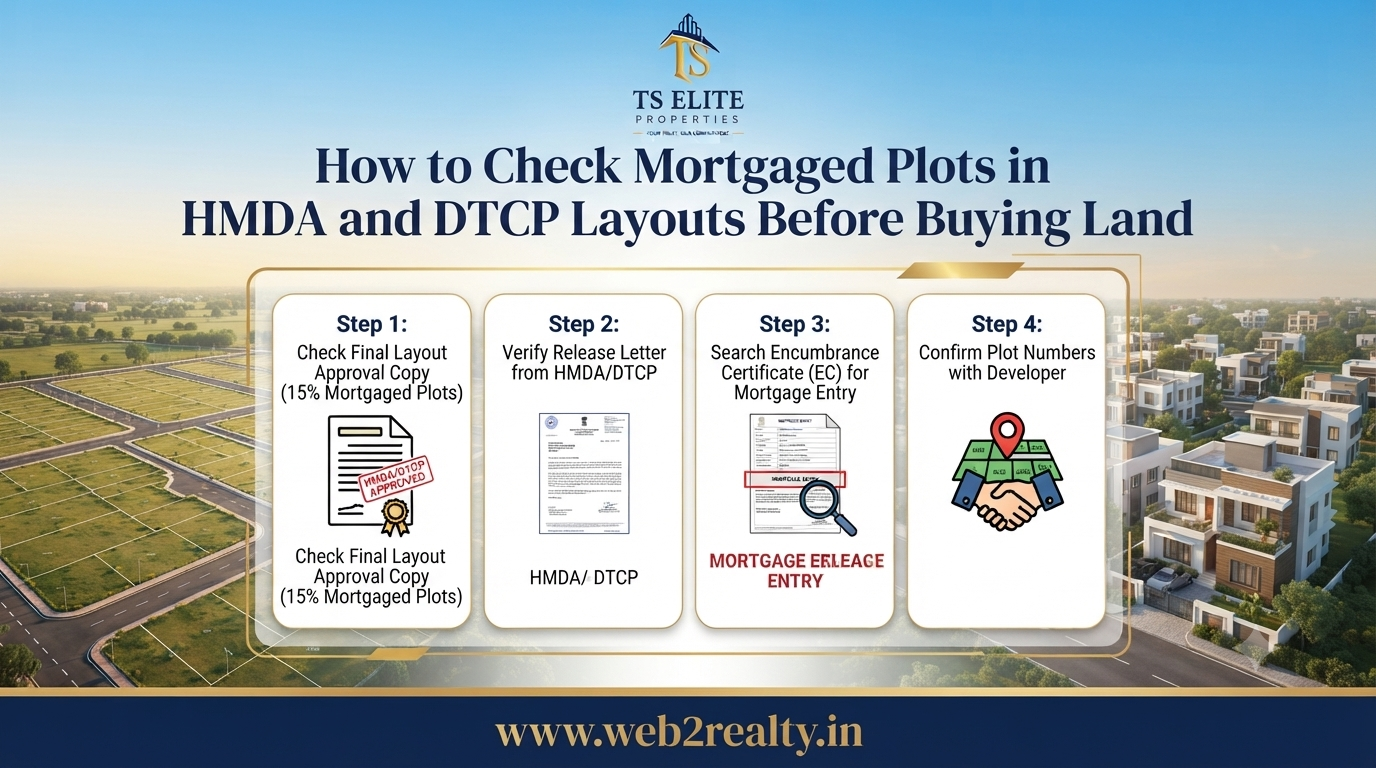
How to Check Mortgaged Plots in HMDA and DTCP Layouts Before Buying Land
Buying a plot in Hyderabad or the surrounding areas of Telangana can be an exciting step toward building a home or planning a long-term investment. With new roads, expanding residential areas, and growing demand for land, many buyers are exploring HMDA and DTCP-approved layouts.
But before booking a plot, there is one important question you should ask:
Is the plot I am purchasing free from mortgage restrictions, and have all the necessary documents been verified?
Many buyers focus on the location, price, road connectivity, and future development. These factors matter, but property documentation deserves equal attention. A layout may be approved while particular plots or portions of the layout remain subject to mortgage arrangements or other restrictions.
This is why HMDA layout verification should be an essential step before purchasing land.
In this guide, you will learn how to examine layout approvals, identify potential mortgage issues, check important documents, and prepare for a safer property purchase in Telangana.
What Does a Mortgaged Plot Mean?
A mortgaged plot is land provided as security for a financial obligation or development-related requirement. The mortgage may involve a financial institution, an authority, or another party, depending on the circumstances.
In certain approved layouts, a portion of the land may be mortgaged as security for completing development works. The existence of a mortgage arrangement does not automatically establish that every plot in the layout has the same status.
For a buyer, the key issue is whether the particular plot being offered is affected by a mortgage, restriction, or pending release.
For example, a developer may show a large plotted project in a brochure and describe it as approved. However, the plot number you have selected might need additional verification before you proceed.
Never assume that the approval of an entire project automatically confirms the sale status of every individual plot.
The applicable approval conditions and current records should be checked with the relevant authority.
Why HMDA Layout Verification Matters Before Buying Land
HMDA layout verification involves examining the approval records and related property details to determine whether a proposed plot corresponds with the sanctioned layout and applicable requirements.
This process can help buyers investigate several important questions:
- Is the layout approved by the competent planning authority?
- What is the current approval status?
- Does the plot appear in the approved plan?
- Does the survey number match the property documents?
- Is the plot affected by a mortgage or development restriction?
- Are mortgage release documents available, where required?
- Do the seller’s documents support their right to sell?
- Does the actual site match the approved layout?
These checks do not guarantee that a property has no legal risks, but they can help identify issues that require further investigation.
A property lawyer should review the title and relevant legal documents before a major purchase.
HMDA and DTCP Layouts: What Should Buyers Verify?
HMDA and DTCP are planning authorities or systems relevant to different areas and approval processes in Telangana. The competent authority depends on the location, jurisdiction, and nature of the development.
When examining a project, first identify which authority issued the approval and whether the documentation is genuine and applicable to the property.
For an HMDA-related project, examine the relevant HMDA records. For a DTCP or other local planning authority project, verify the approval through the applicable authority.
Do not rely exclusively on the wording used in advertisements.
A useful rule for buyers is:
Verify the approval authority, the sanctioned plan, and your exact plot not just the project’s name.
8 Practical Steps for HMDA Layout Verification
1. Request the Original Layout Approval Details
Begin by asking the seller or developer for the project’s approval documents.
A brochure, WhatsApp message, or marketing poster can help you identify a project, but it should not be the final basis for your decision.
Ask for the following information:
- Layout approval number
- Approval date
- Name of the approving authority
- Village, mandal, and district details
- Relevant survey numbers
- Approved layout plan
- Total project extent
- Plot number being offered
- Applicable approval conditions
The documents should be clear enough for you and your lawyer to examine.
If the seller refuses to share relevant approval details, ask why the information is unavailable before making a financial commitment.
2. Find Out the Current Approval Status
A layout’s approval status needs to be understood correctly.
Depending on the approval process, documents may refer to draft, provisional, final, or other stages. The legal significance of each stage depends on the applicable rules and the particular approval.
Do not assume that a preliminary or draft permission provides the same rights and assurances as a final approval.
Ask the seller to explain:
- Whether the approval is final
- Whether any conditions remain pending
- Whether development obligations have been completed
- Whether additional permissions are required
- Whether the documents provided are current
For projects within HMDA jurisdiction, verify the status using the relevant official records or by consulting the competent authority.
An approval number alone is not a substitute for understanding the approval’s conditions and present status.
3. Match Your Plot With the Sanctioned Layout Plan
One of the most useful steps in HMDA layout verification is comparing the plot you intend to buy with the approved plan.
Ask the seller to identify the exact plot on the sanctioned drawing.
Review the following:
Item | What to check |
Plot number | Matches the sale offer and documents |
Survey number | Corresponds with the relevant land records |
Dimensions | Length, width, and approximate area |
Boundaries | Adjacent plots, roads, and other boundaries |
Road access | Approved access and road location |
Open spaces | Whether the plot conflicts with designated areas |
Layout position | Whether it matches the sanctioned drawing |
A plot shown in a sales brochure may look different from the official sanctioned plan. If you find any discrepancy, ask for clarification and supporting documentation.
Do not proceed based on a verbal explanation alone when the property records do not match.
4. Identify Whether the Plot Is Part of a Mortgaged Area
This is a central part of checking mortgaged plots.
Ask the developer a direct question:
“Is the plot being offered included in any mortgaged portion of the approved layout?”
The answer should be supported by appropriate documentation.
Some layout approval processes require mortgage arrangements as security for development obligations. The exact conditions, affected land, and release process depend on the approval and applicable rules.
Ask for information about:
- The area covered by the mortgage
- The relevant mortgage document
- The plots or survey numbers affected
- Whether the plot has been released
- The authority or institution responsible for the release
- Any pending conditions
Avoid assuming that a plot is available for unrestricted sale simply because the project is marketed as approved.
5. Obtain Proof of Mortgage Release, If Applicable
If your plot was previously part of a mortgage arrangement, request documentation showing its current status.
Depending on the circumstances, the relevant documents may include:
- Mortgage deed or related instrument
- Mortgage release order or proceedings
- Release certificate or supporting authority record
- Updated layout records
- Bank release documentation, if a bank mortgage is involved
- Other documents required by the competent authority
The exact paperwork depends on the type of mortgage and the authority or institution involved.
A seller’s statement that the mortgage “will be released soon” is not equivalent to documentary proof that the release has already occurred.
If the release is pending, consult an independent property lawyer about the risks, conditions, and appropriate contractual safeguards before committing funds.
6. Review the Encumbrance Certificate and Title History
An Encumbrance Certificate, commonly called an EC, is an important document in property due diligence.
It can help you examine registered transactions reflected in the relevant records for the period searched. Depending on the records and search scope, it may provide information about transactions such as registered sales or mortgages.
However, an EC should not be treated as a complete guarantee of clear title.
A broader title review may be necessary to investigate:
- Previous ownership transfers
- Parent or link documents
- Registered mortgages
- Relevant court or legal issues
- Inheritance and partition claims
- Property descriptions and boundaries
- Other potential interests or restrictions
The scope of the search matters. An independent property lawyer can help determine which records and time periods should be examined.
For a major land purchase, do not rely only on a seller-provided EC or a verbal claim that the property has a clear title.
7. Confirm the Seller’s Right to Sell the Plot
The person offering the plot should have the legal authority to transfer it.
Review the documents relevant to the seller’s ownership and the proposed transaction. These may include the current sale deed, previous link documents, inheritance or partition records, and other supporting papers, depending on the property’s history.
Check whether the following details match:
- Seller’s name
- Survey number
- Plot number
- Land extent
- Property boundaries
- Relevant ownership records
If the seller is acting through a power of attorney, development agreement, or another arrangement, ask a lawyer to review the authority and scope of the transaction.
A mismatch between the seller’s identity and the property documents deserves careful investigation before you pay an advance.
8. Visit the Site and Compare the Actual Property
Document verification and physical inspection should work together.
Visit the property and compare the location with the approved plan and the documents provided.
Look at:
- Access roads
- Road width
- Plot boundaries
- Nearby development
- Open spaces and parks
- Drainage arrangements
- Electricity and water infrastructure
- The location of the plot in relation to surrounding properties
Use the sanctioned plan to understand whether the physical site appears consistent with the approved layout.
If the actual road, boundary, or plot position differs from the documents, request an explanation and investigate the issue before continuing.
A site visit is useful, but it does not replace legal and official record verification.
HMDA Layout Verification: Documents Buyers Should Prepare
The following list can help you organize the documents for your property review.
Layout and Approval Documents
- Official layout approval
- Sanctioned layout plan
- Relevant approval conditions
- Survey number details
- Current approval status
Plot and Ownership Documents
- Current sale deed
- Parent or link documents
- Relevant revenue records
- Seller’s identity and authority documents
- Development agreement or power of attorney, where applicable
Mortgage and Encumbrance Records
- Mortgage documents, where applicable
- Mortgage release records, where applicable
- Encumbrance Certificate
- Other relevant registered transaction records
The list is a starting point, not a complete legal checklist for every transaction. Your lawyer may require additional documents depending on the property’s history and the proposed sale.
Common Mistakes to Avoid When Buying a Plot
Mistake 1: Believing Every Marketing Claim
Words such as “approved,” “clear title,” and “ready for registration” should be supported by relevant documentation.
Mistake 2: Checking the Project but Not the Plot
The approval of a layout does not eliminate the need to verify the individual plot’s identity, location, and status.
Mistake 3: Ignoring Pending Mortgage Release
If a plot is subject to a mortgage arrangement, ask for the relevant release documentation and understand any remaining conditions.
Mistake 4: Treating an EC as Complete Title Verification
An EC is one part of due diligence. It should be considered alongside the title chain and other relevant records.
Mistake 5: Paying Before Reviewing the Documents
Avoid rushing into a major advance payment without understanding the documents, terms, and risks.
Mistake 6: Skipping Independent Legal Advice
A property lawyer can review the transaction from a legal perspective and identify issues that a buyer may not notice.
A Simple Checklist for Buyers
Use this checklist before booking a plot.
Approval
- Approval authority identified
- Approval number and date checked
- Current approval status confirmed
- Sanctioned layout plan obtained
Plot Details
- Plot number verified
- Survey number checked
- Dimensions compared
- Boundaries examined
- Site location inspected
Mortgage
- Mortgage status investigated
- Affected area or plot identified, if applicable
- Release documentation checked, where applicable
- Pending conditions reviewed
Legal Review
- Sale deed examined
- Link documents reviewed
- EC obtained and examined
- Seller’s authority verified
- Independent lawyer consulted
How to Make a More Informed Plot Purchase
Buying land involves more than selecting an attractive location or negotiating a price. The documents, approval status, legal title, and actual site conditions should be examined together.
A practical approach is to follow these steps:
First, collect the documents.
Ask the seller for the approval records, sanctioned plan, ownership documents, and relevant mortgage information.
Next, compare the details.
Check whether the plot number, survey number, boundaries, and other information match across the documents.
Then, seek professional advice.
If you identify a mortgage, a title discrepancy, or an unclear approval status, consult an independent property lawyer before proceeding.
Finally, make a decision based on verified information.
Do not let urgency, limited-time offers, or verbal assurances replace the checks necessary for a significant property purchase.
Conclusion: Verify Before You Invest
Purchasing an open plot in Hyderabad or Telangana requires careful planning and document review. Whether you are considering an HMDA-approved project or a DTCP-approved layout, it is important to understand the approval status and examine the specific plot you intend to purchase.
HMDA layout verification can help you organize the approval and plot checks, but it should be part of a wider property due-diligence process.
Before signing an agreement or paying a substantial amount, investigate the layout plan, ownership documents, EC, mortgage status, and any applicable release records. Where legal questions arise, seek independent professional advice.
A clear process can help you identify questions early and make your property purchase with greater understanding.
Looking for Open Plots in Hyderabad?
At Web2Realty, we help property seekers explore open-plot opportunities in Hyderabad and developing areas of Telangana.
If you are searching for HMDA-approved plots, DTCP-approved plots, or suitable land investment opportunities, connect with our team to discuss your preferred location, plot size, and budget.
We encourage buyers to request and review relevant property documents before making a purchase decision.
Your next property investment deserves careful verification.
Visit www.web2realty.in to explore property opportunities and get in touch with our team.
Frequently Asked Questions (FAQs)
1. What is HMDA layout verification?
HMDA layout verification is the process of examining relevant approval records, the sanctioned layout plan, plot details, and other applicable documents to check whether a property corresponds with the approved development.
2. How do I find out whether a plot is mortgaged?
Ask the developer or seller for the applicable mortgage information and supporting documents. Identify whether the specific plot is affected and request evidence of release if the mortgage has been discharged.
3. Does HMDA approval guarantee that a plot is free from mortgage?
No. Approval and mortgage status are separate matters that may require individual verification. The applicable layout conditions and the status of the particular plot should be examined.
4. What should I do if the seller says the mortgage will be released later?
Ask for written documentation, understand the pending conditions, and consult an independent property lawyer before making a substantial payment or committing to the transaction.
5. Is checking the EC enough before buying land?
No. An EC is an important part of the verification process, but it does not replace a comprehensive title review and examination of other relevant documents.
6. Why should I compare the plot with the sanctioned layout plan?
The comparison helps you check whether the plot number, survey details, dimensions, and location are consistent with the approved development. It may also highlight discrepancies requiring further investigation.
7. Is DTCP layout verification necessary for DTCP-approved plots?
Yes. Buyers should check the applicable DTCP or competent planning authority approval, sanctioned layout plan, and the specific plot’s documentation.
8. Can I verify the property without a lawyer?
You can collect documents and perform preliminary checks yourself. However, an independent property lawyer can help examine legal title, transaction history, and potential risks before a significant purchase.
9. What is the first thing to check before booking a plot?
Start by obtaining the relevant approval documents and identifying the exact plot. Then investigate the ownership, mortgage status, and other legal details before committing funds.
10. How can Web2Realty help me explore open plots?
You can visit www.web2realty.in to explore the company’s property offerings and contact the team about your location, plot size, and budget requirements. Request the relevant project documents and carry out independent due diligence before purchasing.
Recent post

- November 17, 2026

- November 14, 2026