
Buying a plot is a major financial decision. Whether you are planning to build a home or looking for a long-term investment, choosing the right property requires careful research.
One of the first things buyers should understand is the approval status of the layout. In Hyderabad and Telangana, you may commonly hear about HMDA approval and DTCP approval when looking at residential plots.
But what do these approvals actually mean? Is HMDA approval better than DTCP approval? Can a DTCP-approved plot be a good investment? What should you check before buying?
These are important questions for anyone searching for the best open plots in Hyderabad.
HMDA and DTCP are different planning authorities with different areas of jurisdiction. The approval itself is important, but it is not the only factor that determines whether a plot is suitable for investment.
Location, connectivity, legal title, infrastructure, price, development potential, and future demand should also be considered.
This article explains the difference between HMDA and DTCP approval in simple language and provides practical tips for choosing the right plot.
HMDA stands for Hyderabad Metropolitan Development Authority.
It is responsible for planning and development within the Hyderabad Metropolitan Region. HMDA plays an important role in regulating layouts and supporting planned urban development within its jurisdiction.
When a layout receives the relevant HMDA approval, it indicates that the layout has gone through the applicable planning and approval process.
However, buyers should remember that approval of a layout does not mean that every legal aspect of an individual property is automatically guaranteed.
Before purchasing the best open plots in Hyderabad, buyers should still verify ownership, title, encumbrances, survey details, land use, and other relevant documents.
DTCP stands for Directorate of Town and Country Planning.
DTCP is involved in planning and regulating development in areas covered by the applicable town and country planning framework, particularly outside the jurisdiction of metropolitan development authorities.
A DTCP-approved layout has received the relevant planning approval under the applicable rules.
For buyers considering plots in developing areas of Telangana, DTCP approval can be an important factor to check.
However, just like HMDA approval, DTCP approval should not be treated as the only measure of a property’s quality or investment potential.
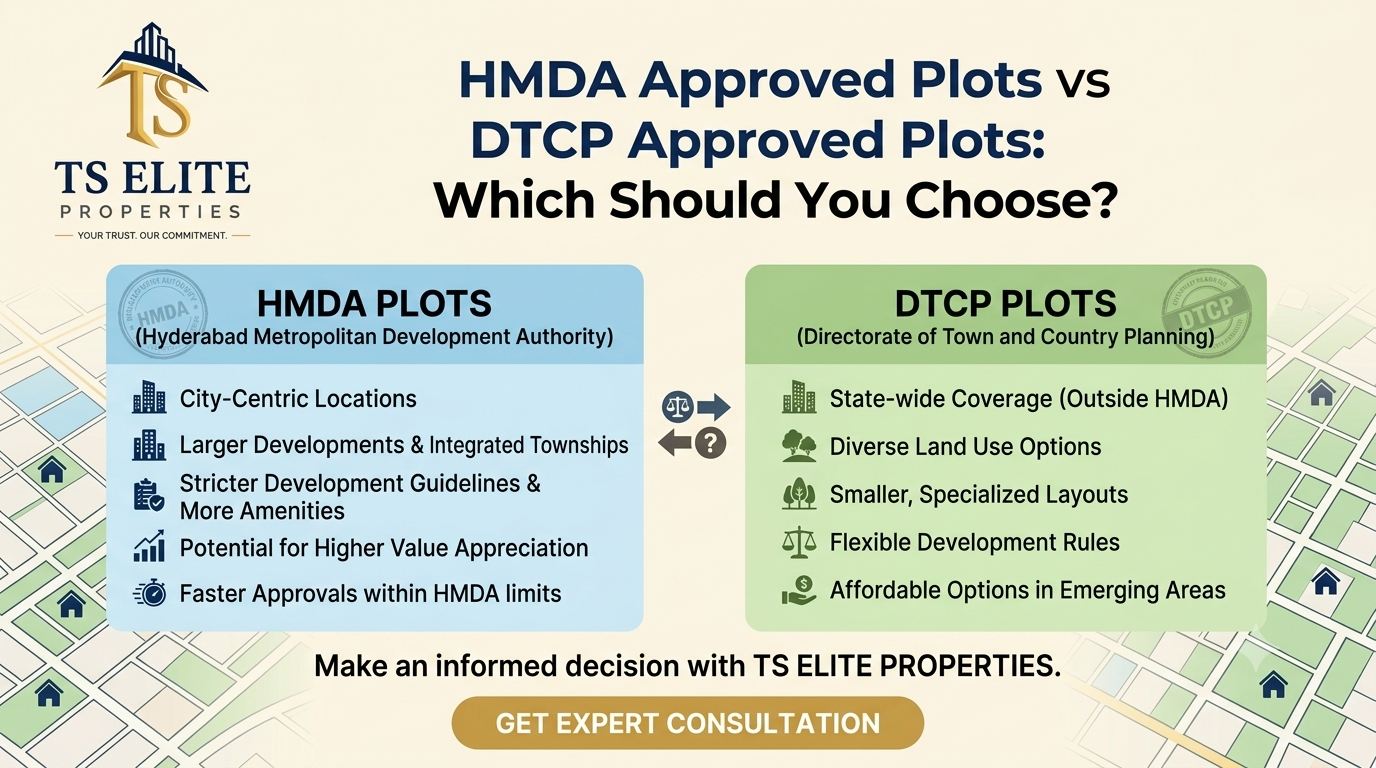
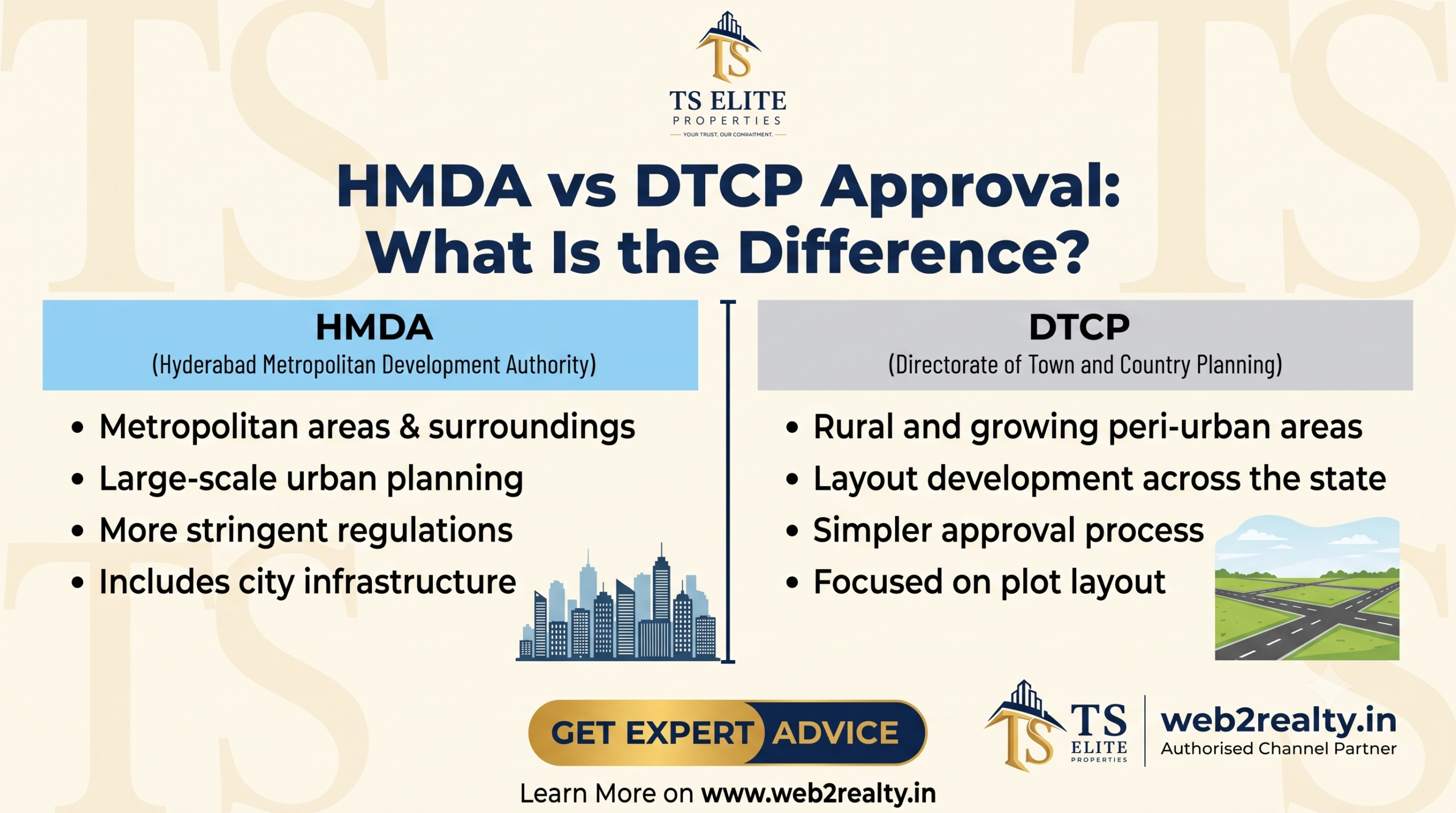
The easiest way to understand the difference is to look at jurisdiction.
Factor | HMDA | DTCP |
Full Form | Hyderabad Metropolitan Development Authority | Directorate of Town and Country Planning |
Main Role | Metropolitan planning and development | Town and country planning |
Coverage | Areas within HMDA jurisdiction | Areas covered by the applicable DTCP planning framework |
Layout Approval | HMDA-approved layouts where applicable | DTCP-approved layouts where applicable |
Common Buyer Focus | Hyderabad Metropolitan Region | Areas outside relevant metropolitan authority limits |
Importance | Planning compliance within HMDA jurisdiction | Planning compliance within DTCP jurisdiction |
The key point is that HMDA and DTCP are not simply “better” and “worse” versions of approval.
The relevant approval depends on where the property is located and which planning authority has jurisdiction.
This is one of the most common questions asked by property buyers.
The answer is: not necessarily.
HMDA approval and DTCP approval serve different areas and planning jurisdictions.
If a property falls within an area where HMDA is the applicable authority, HMDA approval may be relevant.
If a property is outside HMDA’s jurisdiction and falls under the applicable DTCP planning framework, DTCP approval may be relevant.
Therefore, buyers should first determine which authority has jurisdiction over the property.
For someone searching for the best open plots in Hyderabad, the focus should not be only on whether the property has HMDA or DTCP approval.
Instead, consider:
Correct Approval + Clear Title + Good Location + Strong Connectivity + Fair Price + Future Demand
This combination provides a much better basis for evaluating a property.
Buying an approved layout can provide buyers with greater clarity about the planning status of the development.
Depending on the specific approved layout, planning considerations may include:
An approved layout can therefore provide greater confidence than buying land without understanding its planning status.
However, approval does not eliminate the need for legal verification.
This is an important point that every buyer should understand.
An HMDA or DTCP layout approval does not automatically guarantee:
Real estate investment always involves risk.
Before purchasing the best open plots in Hyderabad, buyers should examine the complete property situation rather than relying on approval status alone.
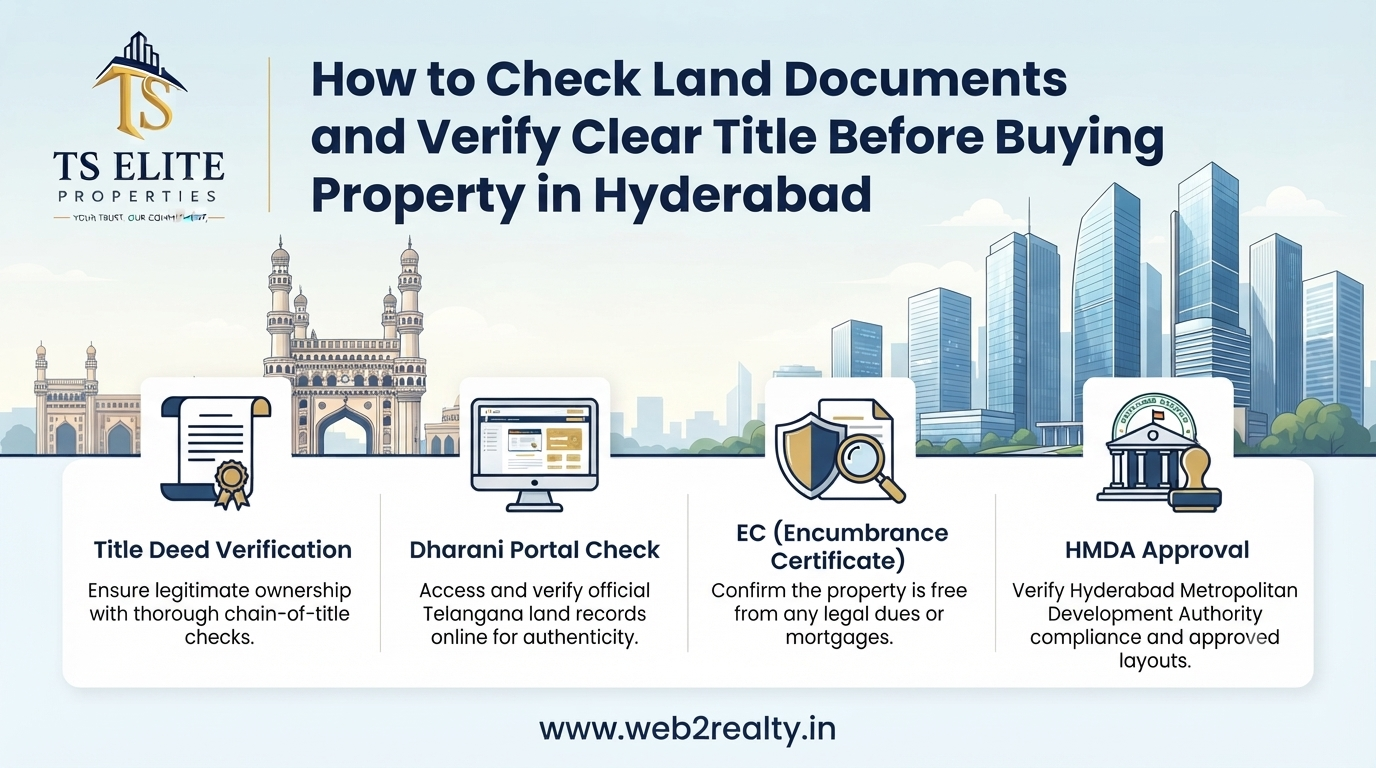
Whether you are considering an HMDA-approved or DTCP-approved plot, proper documentation is essential.
Verify who owns the land and whether the seller has the legal right to sell it.
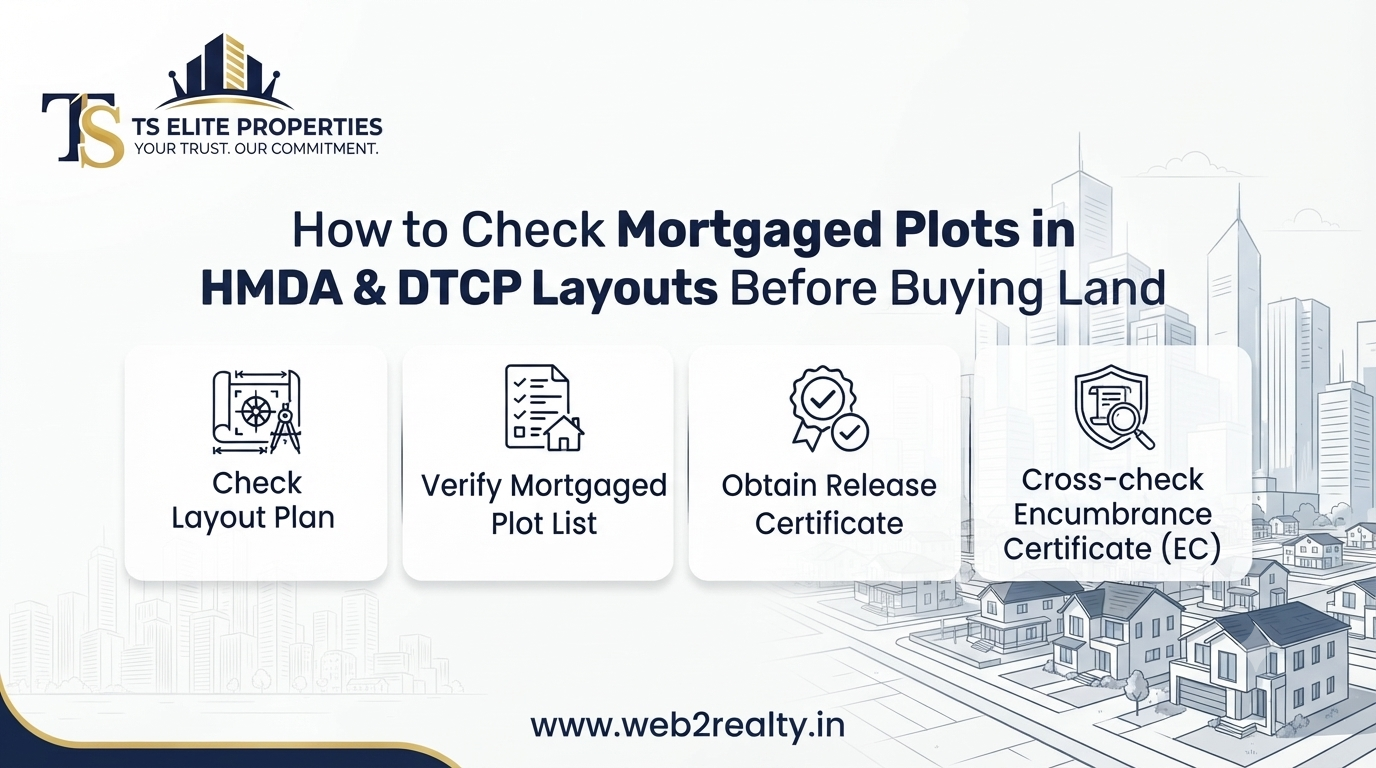
An Encumbrance Certificate can help identify registered transactions, mortgages, or other recorded claims associated with the property.
Ask for the approved layout plan and compare it with the actual plot being offered.
Check:
Check whether the land is permitted for the intended purpose under applicable planning and zoning rules.
The survey number and other property details should match across the relevant documents.
Review applicable tax records and registration-related documents as part of the overall due diligence.
For a significant investment, professional legal verification is strongly advisable.
A plot can have the correct approval and still not be the right investment for your needs.
Location is one of the most important factors in real estate.
When searching for the best open plots in Hyderabad, study the surrounding area carefully.
Look at:
A well-connected plot with good surrounding development may have stronger long-term potential than a plot that is simply cheaper.
Infrastructure can influence the future demand for land.
When roads, transportation systems, employment centres, and social infrastructure improve, a location can become more attractive to residents and businesses.
Before buying, research the area’s:
However, be careful with claims about future infrastructure.
Do not purchase a plot simply because someone says that a highway, airport, metro line, or major project is coming nearby.
Verify important information through reliable and official sources.
There is no universal answer.
Your choice should depend on the location and your investment goals.
First identify where the property is located and which planning authority has jurisdiction.
Look at current development rather than relying only on future promises.
Compare the price per square yard with similar properties nearby.
A plot with better access to major roads and employment centres may have stronger demand.
Never compromise on title and documentation.
Land investment usually requires patience. Consider whether you are comfortable holding the property for several years.
If your goal is to find the best open plots in Hyderabad, use a simple checklist.
Decide how much you can invest without creating financial pressure.
Are you buying for:
Compare locations based on accessibility, development, and pricing.
Confirm whether HMDA or DTCP is the relevant authority and verify the approval details.
Review ownership, title, encumbrance, survey details, and other relevant documents.
Check the actual surroundings, roads, access, utilities, and nearby development.
Do not make a decision based on a single project. Compare several options.
Before making a major investment, have the documents reviewed by a qualified property lawyer.
The cheapest plot may not be the best plot.
HMDA approval is relevant to its jurisdiction. DTCP approval may be appropriate in areas under the applicable DTCP planning framework.
Approval cannot compensate for poor connectivity or weak demand.
Always ask for important claims in writing and verify them independently.
Never assume that approval alone means there are no other legal issues.
Visit the property before making a major financial commitment.
For many buyers, the biggest advantage of an approved layout is greater clarity about the planned development.
A properly planned layout can make it easier to understand:
This information can help buyers make more informed decisions.
Still, buyers should always review the actual approval documents rather than relying only on marketing material.
The main difference is jurisdiction. HMDA is responsible for planning and development within the Hyderabad Metropolitan Region, while DTCP applies to areas covered by the applicable town and country planning framework outside the relevant metropolitan authority jurisdiction.
Not necessarily. The relevant approval depends on where the property is located and which authority has jurisdiction.
A DTCP-approved layout can be considered for investment if the property also has clear ownership, proper documentation, suitable location, good connectivity, and reasonable pricing.
Check the approval, title, ownership, Encumbrance Certificate, survey details, approved layout plan, road access, land use, location, connectivity, and other applicable documents.
No. HMDA or DTCP approval does not guarantee future appreciation. Property values depend on many factors, including location, infrastructure, demand, market conditions, and development.
HMDA and DTCP approvals are both important concepts for anyone purchasing land in Hyderabad and Telangana.
The main difference is their planning jurisdiction. HMDA operates within the Hyderabad Metropolitan Region, while DTCP applies to areas covered by the relevant town and country planning framework outside the applicable metropolitan authority jurisdiction.
Neither approval should automatically be considered superior in every situation.
For buyers looking for the best open plots in Hyderabad, the smarter approach is to look at the complete picture.
Check the approval. Verify the title. Study the location. Examine connectivity. Research infrastructure. Compare prices. Visit the site. And most importantly, get the property documents reviewed before completing the purchase.
Remember:
A good plot should combine proper documentation, suitable approval, a strong location, reasonable pricing, good connectivity, and realistic long-term potential.
By following a careful due-diligence process, buyers can make more informed decisions and choose properties that match their financial goals and future plans.