Day: August 11, 2026

Buying Land vs Gated Community Flat: What’s Better for 5-Year Appreciation?
Best property investment opportunities

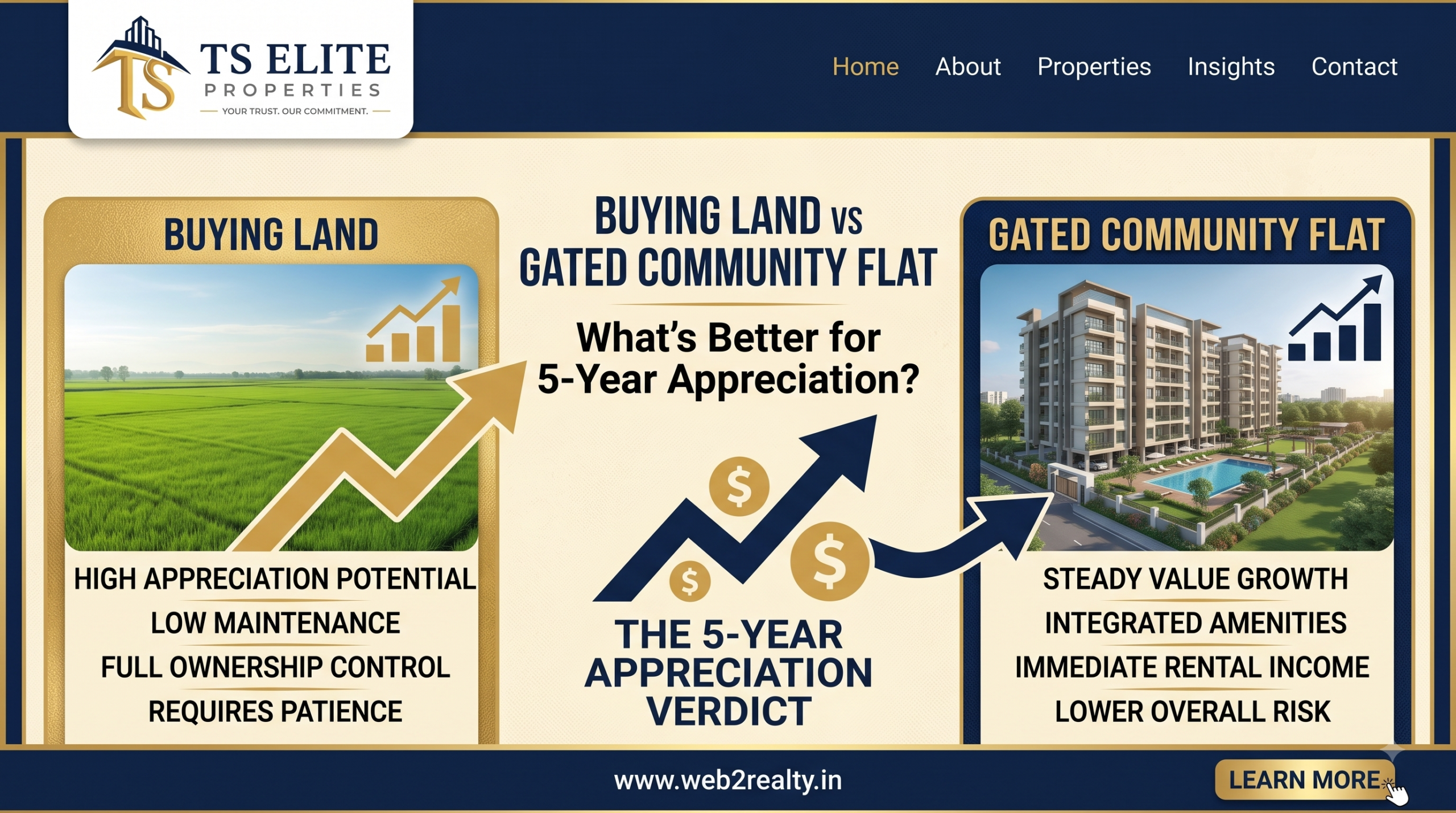
Buying Land vs Gated Community Flat: What’s Better for 5-Year Appreciation?

Real estate has always been considered a popular long-term investment option in India. But when you have a limited budget and want to invest for the next five years, an important question comes up: Should you buy land or invest in a gated community flat?

Both options have their own advantages. A flat can provide modern amenities, security, convenience, and the possibility of rental income. Land, on the other hand, offers flexibility, lower maintenance, and the potential for appreciation as an area develops.

If you are searching for the best property investment, you should not choose only based on what is popular in the market. Your decision should depend on your budget, investment goal, location, expected appreciation, maintenance costs, and how long you plan to hold the property.

In this article, let us compare buying land vs a gated community flat and understand which option could be better for 5-year appreciation.

What Does 5-Year Property Appreciation Mean?

Property appreciation means an increase in the value of a property over time.

For example, suppose you purchase a property for ₹40 lakh today. If its value increases to ₹55 lakh after five years, the property has appreciated by ₹15 lakh.

However, appreciation is never guaranteed. Real estate values depend on several factors, including:

  • Location
  • Infrastructure development
  • Road connectivity
  • Employment opportunities
  • Demand and supply
  • Nearby commercial development
  • Government projects
  • Neighborhood development
  • Property quality
  • Legal approvals

Therefore, when looking for the best property investment, it is important to study the future potential of the location instead of focusing only on today’s price.

Buying Land: Why Is It Considered a Good Investment?

Land is a limited natural resource. Unlike buildings, land does not depreciate physically with age.

If you purchase land in a developing location with good connectivity and infrastructure potential, its value may increase as the surrounding area develops.

1. Land Has Lower Maintenance

One of the biggest advantages of land investment is relatively low maintenance.

A flat requires regular maintenance of the building, common areas, lifts, security systems, parking areas, amenities, and other facilities. Land generally does not require the same level of recurring maintenance.

This can make land attractive for investors who want to hold a property for several years.

2. Land Offers Flexibility

With land, you have more flexibility regarding future use, subject to applicable laws and permissions.

Depending on the land type and approvals, you may eventually build a house or other permitted development.

This flexibility can be an advantage for long-term investors.

3. Development Can Increase Land Value

When roads, highways, educational institutions, hospitals, shopping areas, offices, and residential communities develop around a location, demand for nearby land can increase.

This is one reason investors often consider land when looking for the best property investment for long-term appreciation.

4. No Building Depreciation

A flat includes both land and a constructed building. The building itself ages over time and may require repairs and renovations.

With land, there is no building structure that physically gets older.

However, this does not mean every plot will automatically appreciate. Location, title, approvals, accessibility, and demand remain critical.

Gated Community Flats: Why Are They Attractive?

Gated community flats have become popular among families and working professionals because they combine housing, security, amenities, and convenience.

If your objective is both investment and personal use, a flat can offer benefits that vacant land cannot provide immediately.

1. Ready-to-Use Property

A completed flat can be occupied immediately after possession and required formalities.

You do not need to wait for years to construct a home.

This makes flats particularly useful for buyers who want a property for personal living.

2. Rental Income Potential

One major advantage of flats is the possibility of rental income.

A flat in a location with strong rental demand can potentially generate regular rental income while you hold the property.

For example, properties near IT hubs, business districts, educational institutions, hospitals, and transportation corridors may attract tenants.

Therefore, investors should consider both capital appreciation and rental potential when deciding on the best property investment.

3. Amenities and Security

Modern gated communities often provide amenities such as:

  • Security systems
  • Clubhouses
  • Swimming pools
  • Gyms
  • Children’s play areas
  • Walking tracks
  • Landscaped gardens
  • Community spaces
  • Parking facilities

These facilities can make flats attractive to families and tenants.

4. Easier Financing for Some Buyers

Home loans are commonly available for eligible residential flats, subject to lender policies and the buyer’s financial profile.

A loan can make it easier for some buyers to purchase a flat without paying the entire purchase price upfront.

However, buyers should consider interest costs and their long-term repayment capacity before taking a loan.

Land vs Gated Community Flat: Which Appreciates More?

There is no universal answer.

The best property investment depends heavily on the location and the specific property.

A well-located plot in a rapidly developing area could outperform a flat in a location with limited growth.

Similarly, a flat in a high-demand location near employment centers could perform better than land located far from infrastructure.

Therefore, rather than asking whether land or flats are always better, ask:

Which specific property has stronger long-term demand and better fundamentals?

5-Year Comparison: Land vs Flat

Let’s compare the two options from an investment perspective.

Factor

Land

Gated Community Flat

Maintenance

Usually low

Regular maintenance required

Rental income

Usually not immediate

Possible

Construction

Future construction possible

Already constructed/under construction

Amenities

Usually limited

Multiple amenities

Flexibility

Higher, subject to permissions

Limited to apartment use

Building depreciation

Not applicable

Building ages over time

Security

Depends on location

Usually managed by community

Loan availability

Depends on property and lender

Commonly available for eligible properties

Personal use

Requires construction if vacant

Can be ready to occupy

Appreciation

Strongly location-dependent

Strongly location and project-dependent

Which Is Better for 5-Year Appreciation?

If your primary objective is capital appreciation, land can be an attractive option when purchased in a location with strong future development potential.

Suppose an area is currently developing but has planned infrastructure, improving connectivity, and increasing residential demand. Land in such an area may benefit as the location matures.

However, you should never invest solely because someone promises that a plot will double in five years.

Real estate returns depend on actual market conditions.

A gated community flat can also appreciate, especially when it is located near employment hubs and established infrastructure.

The difference is that a flat can potentially provide rental income during the holding period, while land generally does not generate regular rental income unless it is used for a permitted purpose.

Location Is More Important Than Property Type

Whether you choose land or a flat, location is one of the biggest factors affecting appreciation.

Before investing, study:

Connectivity

Check access to major roads, highways, public transportation, and important destinations.

Employment

Areas close to major employment centers can have sustained housing demand.

Infrastructure

Look for existing and credible upcoming infrastructure projects.

Social Infrastructure

Schools, hospitals, shopping centers, restaurants, and recreational facilities can improve an area’s attractiveness.

Future Development

Study how the surrounding area is changing.

An investment made before significant development can sometimes offer better appreciation potential than buying after prices have already increased significantly.

What Should You Check Before Buying Land?

If you decide that land is the best property investment for your goals, do proper due diligence before making a payment.

Check:

  • Ownership and title
  • Previous sale deeds
  • Encumbrance details
  • Survey number
  • Land classification
  • Layout approval, where applicable
  • Road access
  • Property boundaries
  • Applicable government restrictions
  • Registration eligibility
  • Local development plans
  • Physical location of the property

Never rely entirely on brochures or verbal promises.

It is advisable to have the property’s documents reviewed by a qualified property lawyer before purchase.

What Should You Check Before Buying a Gated Community Flat?

For a flat, your due diligence should include:

  • Project approvals
  • Developer track record
  • RERA registration, where applicable
  • Sale agreement
  • Carpet area
  • Possession timeline
  • Maintenance charges
  • Parking arrangements
  • Amenities
  • Construction quality
  • Loan and payment terms
  • Location and connectivity
  • Resale demand
  • Rental demand

Do not select a flat only because it has a beautiful clubhouse or attractive interiors.

The surrounding location and the financial health and reputation of the project matter significantly for long-term investment.

Land or Flat: Which Is Better for You?

Choose land if:

  • Your primary goal is long-term appreciation.
  • You do not need immediate rental income.
  • You can wait several years for the location to develop.
  • You want lower property maintenance.
  • You prefer flexibility for future development, subject to permissions.
  • You have identified a legally clear property in a promising location.

Choose a gated community flat if:

  • You want a home for personal use.
  • You want the possibility of rental income.
  • You prefer ready-made amenities.
  • You value security and community facilities.
  • You want a property that can potentially serve both lifestyle and investment purposes.

How to Find the Best Property Investment?

Finding the best property investment requires more than comparing prices.

Start by identifying your objective.

Are you investing for appreciation?

Do you want rental income?

Are you planning to build a home?

Do you need a property for immediate use?

Once your goal is clear, compare suitable properties based on location, legal status, infrastructure, demand, affordability, and future potential.

Do not rush because of limited-time offers or pressure from salespeople.

A good property investment should fit your financial plan and long-term objectives.

Final Verdict: Land or Gated Community Flat?

So, what’s better for 5-year appreciation land or a gated community flat?

There is no guaranteed winner.

For investors primarily focused on long-term capital appreciation, a well-located plot can be an attractive choice because land is limited and does not physically depreciate like a building.

For buyers who want a combination of personal use, rental income, amenities, and potential appreciation, a gated community flat can be a practical option.

Ultimately, the best property investment is the property that matches your budget, purpose, risk tolerance, and investment timeline.

The key is not simply choosing between land and a flat. The real key is choosing the right property in the right location at the right price.

Frequently Asked Questions (FAQs)

1. Is land better than a flat for 5-year appreciation?

Land can offer strong appreciation potential in developing locations, but appreciation is not guaranteed. A flat in a high-demand location can also appreciate significantly. Location, price, infrastructure, and demand are important factors.

2. Is buying a flat a good property investment?

A flat can be a good property investment for buyers looking for a combination of potential appreciation, rental income, personal use, and modern amenities. The project and location should be carefully evaluated.

3. Why do investors consider land one of the best property investments?

Land is limited in supply and generally requires less maintenance than a constructed property. If purchased in a developing location with strong fundamentals, it can have good long-term appreciation potential.

4. Can a flat generate rental income?

Yes. A flat located near employment hubs, educational institutions, hospitals, commercial centers, and good transportation can have rental demand. Actual rental returns depend on the location and property.

5. What factors affect land appreciation?

Location, infrastructure, connectivity, development, employment opportunities, demand, accessibility, legal clarity, and surrounding projects can influence land appreciation.

6. What should I check before buying land?

Verify title, ownership, survey details, encumbrances, land classification, applicable approvals, access roads, boundaries, restrictions, and registration eligibility. A professional legal review is recommended.

7. What should I check before buying a gated community flat?

Check project approvals, RERA registration where applicable, developer reputation, construction quality, carpet area, possession schedule, maintenance charges, amenities, connectivity, resale potential, and rental demand.

8. Which is better for rental income: land or flat?

A flat is generally more suitable if your investment goal includes regular rental income. Vacant land typically does not provide regular rental income unless used for a permitted income-generating purpose.

9. Is location more important than property type?

In many cases, yes. A property in a strong location with good connectivity, infrastructure, demand, and future development can perform better than a similar property in a weaker location.

10. How can I choose the best property investment?

Define your goal first, then compare the location, property type, price, legal status, infrastructure, demand, potential appreciation, rental prospects, and your ability to hold the investment for the required period.

Looking for the Best Property Investment?

Whether you are interested in open plots, residential properties, or gated community projects, take the time to compare your options before investing.

Looking for the best property investment opportunities? Contact our real estate team today to explore available properties, compare locations, understand your options, and find a property that suits your budget and long-term goals.

Your next investment could be the foundation of your future. Start exploring the right property today!

Related Post

Can Non-Agriculturists Buy Agriculture Land in Telangana?

Buying agricultural land in Telangana

Can Non-Agriculturists Buy Agriculture Land in Telangana?

Buying land is one of the most popular ways to build long-term wealth. In Telangana, agricultural land is especially attracting buyers who are looking for larger parcels, peaceful surroundings, and future investment opportunities. But one common question comes up before making a purchase: Can non-agriculturists buy agricultural land in Telangana?

The simple answer is that being a non-agriculturist does not automatically mean you cannot purchase agricultural land. However, agricultural land transactions in Telangana are subject to several legal restrictions, land classifications, title conditions, and government regulations. Therefore, buyers should not assume that every agricultural parcel can be freely purchased or used for any purpose.

If you are searching for the best lands in Telangana, understanding these rules can help you make a safer and more informed investment decision.

What Is Agricultural Land?

Agricultural land is land primarily classified and recorded for farming and related agricultural activities. It may be used for growing crops, horticulture, orchards, or other permitted agricultural purposes.

The classification of land is important because buying agricultural land is not the same as buying a residential plot. If your intention is to construct a house, resort, commercial building, or other non-agricultural development, you may need the required permissions and land-use conversion.

Telangana has a formal land-record and registration system through which ownership, transactions, mutations, and other land-related information are maintained. Government information describes Dharani as an integrated system for agricultural land records and registration services.

Can a Non-Agriculturist Buy Agricultural Land in Telangana?

In general, a person does not become automatically disqualified from purchasing agricultural land simply because they are not an agriculturist. However, this does not mean every agricultural property is freely transferable.

The buyer must first check whether the particular land is legally transferable.

Several restrictions may apply depending on the property’s history and classification. For example, Telangana government sale-deed documentation requires verification that the property is not prohibited under Section 22A of the Registration Act and is not in violation of laws relating to assigned lands, land ceilings, or Scheduled Area land transfers.

This is why anyone searching for the best lands in Telangana should focus on legal verification rather than simply choosing land based on price or location.

Important Laws and Restrictions to Check

Before purchasing agricultural land, buyers should understand some of the important legal areas that can affect the transaction.

1. Telangana Land Reforms Laws

Agricultural land holdings can be subject to land-ceiling regulations. A buyer should verify that the proposed purchase does not violate applicable provisions of the Telangana Land Reforms (Ceiling on Agricultural Holdings) Act.

Government documentation used in land transactions specifically requires declarations concerning compliance with land-ceiling provisions.

2. Assigned Land Restrictions

Assigned lands can have restrictions on their transfer. Telangana’s Assigned Lands (Prohibition of Transfers) Act, 1977 is particularly important when checking agricultural property.

A buyer should confirm that the land being offered for sale is not assigned land or otherwise restricted from transfer. Government sale documentation specifically requires verification of this point.

3. Scheduled Area Land

Special restrictions can apply to land located in Scheduled Areas. The Telangana Scheduled Area Land Transfer Regulation, 1970 is one of the laws identified in official transaction documentation that must be considered before a transfer.

Therefore, buyers looking for the best lands in Telangana should not make a decision based only on the location and market price.

4. Prohibited Properties

Some properties may appear attractive but may fall under prohibited categories.

The government registration system provides services related to prohibited properties, while official Telangana information has also highlighted issues involving prohibited-list properties and land-record discrepancies.

Before paying an advance, verify whether the survey number is clear for registration.

Can Agricultural Land Be Used for a House or Commercial Purpose?

This is another important question for non-agriculturist buyers.

Buying agricultural land does not automatically give you permission to use it for residential or commercial development.

Telangana has a land-conversion framework for converting agricultural land to non-agricultural use. The Hyderabad District administration explains that the Non-Agricultural Lands Assessment Act regulates the conversion of agricultural land for non-agricultural purposes.

So, if your plan is to purchase agricultural land and later build a farmhouse, commercial property, resort, or other structure, you should first understand the applicable land-use and building permissions.

Never assume that agricultural land can automatically be converted simply because you own it.

What Should You Check Before Buying Agricultural Land?

If you are searching for the best lands in Telangana, legal verification should be your first priority.

Here is a simple checklist to follow.

1. Verify the Seller’s Ownership

Check whether the seller is the genuine owner of the property.

Ask for the original title documents and previous link documents. The ownership history should be clear and consistent.

2. Check the Survey Number

The survey number is one of the most important details when buying land.

Verify the survey number, extent, boundaries, village, mandal, and district against the official land records.

3. Check Land Records

Government land-record services provide facilities such as mutation, land conversion, encumbrance search, certified copies, land valuation information, and other registration-related services.

Use the available official records to cross-check the property details before proceeding.

4. Obtain an Encumbrance Check

An encumbrance search can help identify registered transactions or charges affecting the property.

Do not rely only on documents provided by the seller. Conduct an independent verification wherever possible.

5. Check for Court Cases

Make sure the property is not involved in litigation, injunctions, or ownership disputes.

Official Telangana transaction documentation includes a declaration that there is no court order or injunction restricting the transfer.

6. Check Whether the Land Is Assigned or Restricted

Confirm that the property is not assigned land, government land, forest land, endowment land, Wakf land, or another restricted category.

This step is especially important when evaluating the best lands in Telangana.

7. Check the Land Use

Ask yourself what you actually want to do with the property.

If you want agricultural use, verify that the land is suitable for farming.

If you want residential or commercial development, find out whether conversion and development permissions are legally possible.

Why Are People Interested in Agricultural Land in Telangana?

Telangana offers a wide range of land options, from agricultural parcels and farm properties to approved residential plots and developing investment locations.

Many buyers are attracted to agricultural land because it may offer:

  • Larger land parcels
  • Lower entry prices in selected areas
  • Peaceful surroundings
  • Agricultural use
  • Long-term investment potential
  • Opportunities close to developing regions

However, investment potential depends heavily on location, accessibility, infrastructure, legal status, demand, and future development.

That is why the best lands in Telangana should not be judged only by the lowest price per acre.

A property with proper documentation, good road access, clear ownership, and strong location fundamentals may be more valuable than a cheaper property with legal or access issues.

What Makes the Best Lands in Telangana?

If you are planning to invest in land, consider these factors before choosing a property.

Good Road Connectivity

Land located near major roads, highways, or important transportation corridors may have better accessibility.

Future Development

Look for areas where infrastructure, residential communities, educational institutions, commercial activity, or other development is expanding.

Clear Documentation

This should be one of your highest priorities. A low-priced property is not a good investment if its title is unclear.

Water Availability

For agricultural land, water availability can have a major impact on the land’s usefulness.

Nearby Facilities

Check the distance from towns, markets, schools, hospitals, banks, and other essential facilities.

Legal Approvals and Land Classification

Always understand whether the land is agricultural, residential, commercial, or part of an approved layout.

If land has been divided into plots, buyers should also check the applicable layout approval. Telangana’s official LRS information explains that unauthorized layouts can include land subdivided without approval from the competent authority.

Agricultural Land vs Open Plots: Which Is Better?

There is no single answer because it depends on your investment objective.

If you want land for farming or agricultural purposes, agricultural land may be suitable.

If your primary objective is to build a house in the future, an appropriately approved residential plot may be more convenient.

For buyers who want to invest without immediately taking up farming, approved open plots can sometimes provide a simpler investment structure, provided the layout and title are properly verified.

Therefore, when looking for the best lands in Telangana, first identify your purpose and then select the appropriate type of property.

Common Mistakes to Avoid

Many land buyers make mistakes because they focus only on price.

Avoid these common problems:

Do not buy based only on a brochure. Verify the actual land records.

Do not pay a large advance before verification. First check ownership, restrictions, and registration eligibility.

Do not assume agricultural land can automatically be used for construction. Land conversion and development permissions may be required.

Do not ignore access roads. Confirm that the property has legally usable access.

Do not rely only on verbal promises. Get important commitments documented.

Do not skip professional legal verification. A qualified property lawyer can help identify issues that may not be obvious to a first-time buyer.

FAQs

1. Can non-agriculturists buy agricultural land in Telangana?

In many cases, being a non-agriculturist does not automatically prevent a person from purchasing agricultural land. However, the specific property must be legally transferable and comply with applicable Telangana laws and restrictions.

2. What should I check before buying agricultural land in Telangana?

Check the ownership, title documents, survey number, land records, encumbrances, court cases, land classification, access road, and whether the property falls under any restricted or prohibited category.

3. Can agricultural land be converted into residential land in Telangana?

Agricultural land may require the applicable land-use conversion process before it can legally be used for non-agricultural purposes. Buyers should verify the current requirements with the relevant authorities.

4. Is agricultural land a good investment in Telangana?

Agricultural land can be a long-term investment option, but its potential depends on location, connectivity, water availability, development, legal status, and market demand.

5. How can I find the best lands in Telangana?

When searching for the best lands in Telangana, compare location, road connectivity, title clarity, land classification, surrounding development, water availability, and future growth potential rather than focusing only on price.

6. Can I construct a house on agricultural land?

Not necessarily. Agricultural land cannot automatically be used for residential construction simply because you own it. Applicable conversion and building permissions should be checked before construction.

7. What are assigned lands in Telangana?

Assigned lands are lands granted by the government under specific conditions. Their transfer can be restricted under applicable laws, so buyers should verify the land’s status before purchasing.

8. Why is title verification important when buying land?

Title verification helps establish whether the seller has the legal right to sell the property and whether there are potential disputes, claims, encumbrances, or restrictions affecting the land.

9. What makes the best lands in Telangana for investment?

Good accessibility, clear title, suitable land classification, nearby infrastructure, development potential, availability of basic facilities, and reasonable pricing are important factors when evaluating the best lands in Telangana.

10. Should I consult a lawyer before buying agricultural land?

Yes. Agricultural-land transactions can involve different legal restrictions and documentation requirements. A qualified property lawyer can help verify the title and identify potential legal issues before purchase.


Final Thoughts

So, can non-agriculturists buy agriculture land in Telangana? In many situations, being a non-agriculturist by itself does not automatically prevent a person from purchasing agricultural land. However, the specific property must be legally transferable and free from applicable restrictions.

Land laws and records can be complicated. Restrictions relating to assigned lands, prohibited properties, land ceilings, Scheduled Areas, title disputes, and land-use conversion can significantly affect a purchase.

If you are searching for the best lands in Telangana, take your time, verify the records, inspect the property, understand its classification, and obtain professional legal advice before completing the transaction.

The right land investment is not simply about finding a cheap property. It is about finding legally clear land in the right location with good long-term potential.

Looking for the Best Lands in Telangana?

Searching for the best lands in Telangana for investment, agriculture, or future development? Explore suitable land opportunities based on your budget, preferred location, and investment goals.

Contact our real estate team today to learn about available land options, check property details, and find a property that matches your requirements.

Your ideal land investment could be closer than you think start your search today!

Related Post