
Real estate has always been considered a popular long-term investment option in India. But when you have a limited budget and want to invest for the next five years, an important question comes up: Should you buy land or invest in a gated community flat?
Both options have their own advantages. A flat can provide modern amenities, security, convenience, and the possibility of rental income. Land, on the other hand, offers flexibility, lower maintenance, and the potential for appreciation as an area develops.
If you are searching for the best property investment, you should not choose only based on what is popular in the market. Your decision should depend on your budget, investment goal, location, expected appreciation, maintenance costs, and how long you plan to hold the property.
In this article, let us compare buying land vs a gated community flat and understand which option could be better for 5-year appreciation.
Property appreciation means an increase in the value of a property over time.
For example, suppose you purchase a property for ₹40 lakh today. If its value increases to ₹55 lakh after five years, the property has appreciated by ₹15 lakh.
However, appreciation is never guaranteed. Real estate values depend on several factors, including:
Therefore, when looking for the best property investment, it is important to study the future potential of the location instead of focusing only on today’s price.
Land is a limited natural resource. Unlike buildings, land does not depreciate physically with age.
If you purchase land in a developing location with good connectivity and infrastructure potential, its value may increase as the surrounding area develops.
One of the biggest advantages of land investment is relatively low maintenance.
A flat requires regular maintenance of the building, common areas, lifts, security systems, parking areas, amenities, and other facilities. Land generally does not require the same level of recurring maintenance.
This can make land attractive for investors who want to hold a property for several years.
With land, you have more flexibility regarding future use, subject to applicable laws and permissions.
Depending on the land type and approvals, you may eventually build a house or other permitted development.
This flexibility can be an advantage for long-term investors.
When roads, highways, educational institutions, hospitals, shopping areas, offices, and residential communities develop around a location, demand for nearby land can increase.
This is one reason investors often consider land when looking for the best property investment for long-term appreciation.
A flat includes both land and a constructed building. The building itself ages over time and may require repairs and renovations.
With land, there is no building structure that physically gets older.
However, this does not mean every plot will automatically appreciate. Location, title, approvals, accessibility, and demand remain critical.
Gated community flats have become popular among families and working professionals because they combine housing, security, amenities, and convenience.
If your objective is both investment and personal use, a flat can offer benefits that vacant land cannot provide immediately.
A completed flat can be occupied immediately after possession and required formalities.
You do not need to wait for years to construct a home.
This makes flats particularly useful for buyers who want a property for personal living.
One major advantage of flats is the possibility of rental income.
A flat in a location with strong rental demand can potentially generate regular rental income while you hold the property.
For example, properties near IT hubs, business districts, educational institutions, hospitals, and transportation corridors may attract tenants.
Therefore, investors should consider both capital appreciation and rental potential when deciding on the best property investment.
Modern gated communities often provide amenities such as:
These facilities can make flats attractive to families and tenants.
Home loans are commonly available for eligible residential flats, subject to lender policies and the buyer’s financial profile.
A loan can make it easier for some buyers to purchase a flat without paying the entire purchase price upfront.
However, buyers should consider interest costs and their long-term repayment capacity before taking a loan.
There is no universal answer.
The best property investment depends heavily on the location and the specific property.
A well-located plot in a rapidly developing area could outperform a flat in a location with limited growth.
Similarly, a flat in a high-demand location near employment centers could perform better than land located far from infrastructure.
Therefore, rather than asking whether land or flats are always better, ask:
Which specific property has stronger long-term demand and better fundamentals?
Let’s compare the two options from an investment perspective.
Factor | Land | Gated Community Flat |
Maintenance | Usually low | Regular maintenance required |
Rental income | Usually not immediate | Possible |
Construction | Future construction possible | Already constructed/under construction |
Amenities | Usually limited | Multiple amenities |
Flexibility | Higher, subject to permissions | Limited to apartment use |
Building depreciation | Not applicable | Building ages over time |
Security | Depends on location | Usually managed by community |
Loan availability | Depends on property and lender | Commonly available for eligible properties |
Personal use | Requires construction if vacant | Can be ready to occupy |
Appreciation | Strongly location-dependent | Strongly location and project-dependent |
If your primary objective is capital appreciation, land can be an attractive option when purchased in a location with strong future development potential.
Suppose an area is currently developing but has planned infrastructure, improving connectivity, and increasing residential demand. Land in such an area may benefit as the location matures.
However, you should never invest solely because someone promises that a plot will double in five years.
Real estate returns depend on actual market conditions.
A gated community flat can also appreciate, especially when it is located near employment hubs and established infrastructure.
The difference is that a flat can potentially provide rental income during the holding period, while land generally does not generate regular rental income unless it is used for a permitted purpose.
Whether you choose land or a flat, location is one of the biggest factors affecting appreciation.
Before investing, study:
Check access to major roads, highways, public transportation, and important destinations.
Areas close to major employment centers can have sustained housing demand.
Look for existing and credible upcoming infrastructure projects.
Schools, hospitals, shopping centers, restaurants, and recreational facilities can improve an area’s attractiveness.
Study how the surrounding area is changing.
An investment made before significant development can sometimes offer better appreciation potential than buying after prices have already increased significantly.
If you decide that land is the best property investment for your goals, do proper due diligence before making a payment.
Check:
Never rely entirely on brochures or verbal promises.
It is advisable to have the property’s documents reviewed by a qualified property lawyer before purchase.
For a flat, your due diligence should include:
Do not select a flat only because it has a beautiful clubhouse or attractive interiors.
The surrounding location and the financial health and reputation of the project matter significantly for long-term investment.
Choose land if:
Choose a gated community flat if:
Finding the best property investment requires more than comparing prices.
Start by identifying your objective.
Are you investing for appreciation?
Do you want rental income?
Are you planning to build a home?
Do you need a property for immediate use?
Once your goal is clear, compare suitable properties based on location, legal status, infrastructure, demand, affordability, and future potential.
Do not rush because of limited-time offers or pressure from salespeople.
A good property investment should fit your financial plan and long-term objectives.
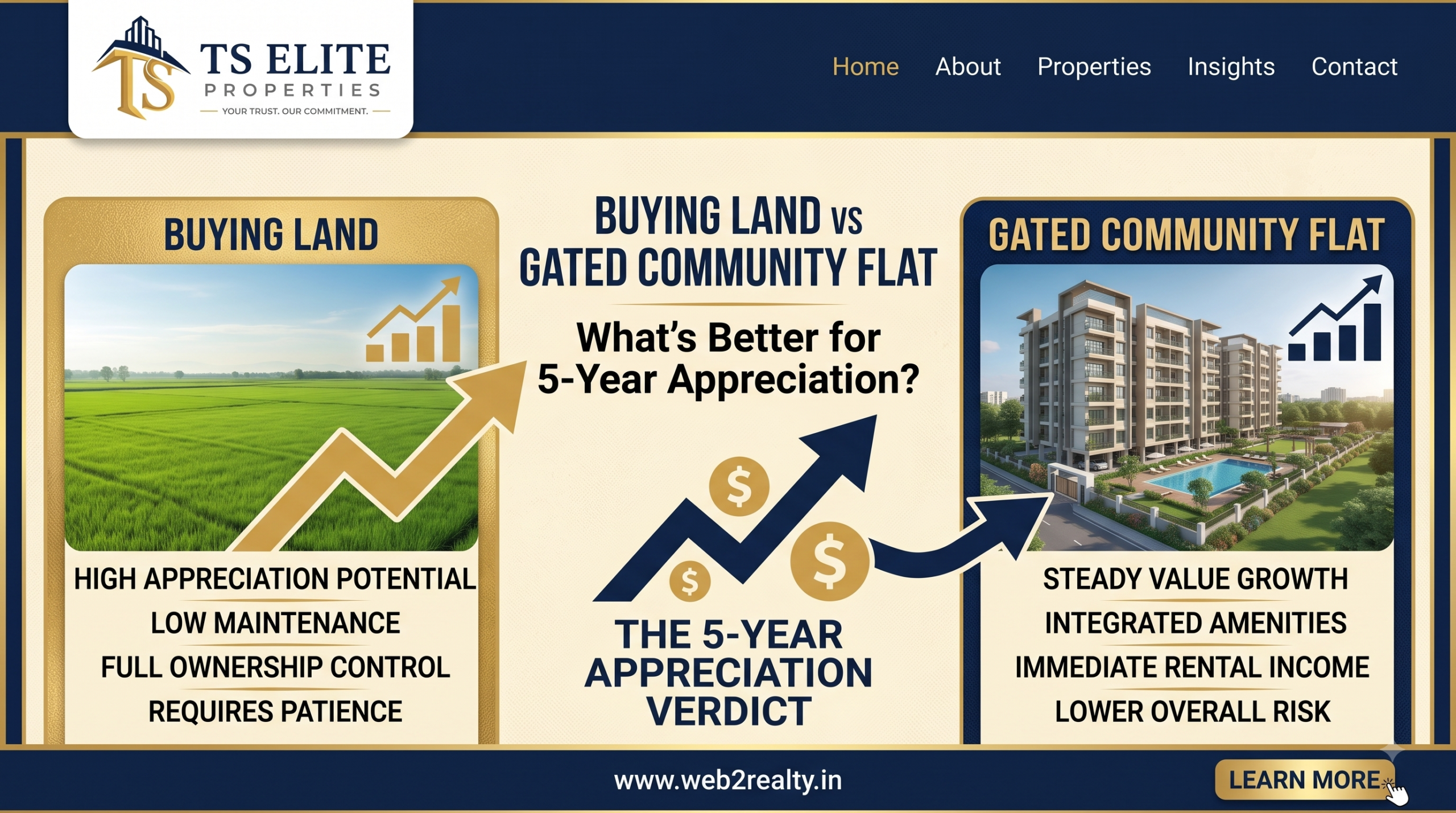
So, what’s better for 5-year appreciation land or a gated community flat?
There is no guaranteed winner.
For investors primarily focused on long-term capital appreciation, a well-located plot can be an attractive choice because land is limited and does not physically depreciate like a building.
For buyers who want a combination of personal use, rental income, amenities, and potential appreciation, a gated community flat can be a practical option.
Ultimately, the best property investment is the property that matches your budget, purpose, risk tolerance, and investment timeline.
The key is not simply choosing between land and a flat. The real key is choosing the right property in the right location at the right price.
Land can offer strong appreciation potential in developing locations, but appreciation is not guaranteed. A flat in a high-demand location can also appreciate significantly. Location, price, infrastructure, and demand are important factors.
A flat can be a good property investment for buyers looking for a combination of potential appreciation, rental income, personal use, and modern amenities. The project and location should be carefully evaluated.
Land is limited in supply and generally requires less maintenance than a constructed property. If purchased in a developing location with strong fundamentals, it can have good long-term appreciation potential.
Yes. A flat located near employment hubs, educational institutions, hospitals, commercial centers, and good transportation can have rental demand. Actual rental returns depend on the location and property.
Location, infrastructure, connectivity, development, employment opportunities, demand, accessibility, legal clarity, and surrounding projects can influence land appreciation.
Verify title, ownership, survey details, encumbrances, land classification, applicable approvals, access roads, boundaries, restrictions, and registration eligibility. A professional legal review is recommended.
Check project approvals, RERA registration where applicable, developer reputation, construction quality, carpet area, possession schedule, maintenance charges, amenities, connectivity, resale potential, and rental demand.
A flat is generally more suitable if your investment goal includes regular rental income. Vacant land typically does not provide regular rental income unless used for a permitted income-generating purpose.
In many cases, yes. A property in a strong location with good connectivity, infrastructure, demand, and future development can perform better than a similar property in a weaker location.
Define your goal first, then compare the location, property type, price, legal status, infrastructure, demand, potential appreciation, rental prospects, and your ability to hold the investment for the required period.
Whether you are interested in open plots, residential properties, or gated community projects, take the time to compare your options before investing.
Looking for the best property investment opportunities? Contact our real estate team today to explore available properties, compare locations, understand your options, and find a property that suits your budget and long-term goals.
Your next investment could be the foundation of your future. Start exploring the right property today!