How to Select a Plot for Building Your Future Home & Plan Your Budget.

How to Select a Plot for Building Your Future Home & Plan Your Budget.
Buying an open plot and constructing a customized home is one of the most fulfilling investments you can make. Unlike buying an apartment where layout, room dimensions, and common facilities are fixed by a builder, owning land gives you complete control. You choose the architectural style, room layouts, garden spaces, and interior finishes that reflect your personal vision.
In expanding metropolitan markets like Hyderabad, open plots also serve as powerful financial growth engines. Plotted land does not depreciate over time; instead, it gains substantial value as surrounding roads, employment centers, and commercial hubs mature.
However, buying land requires careful planning. Selecting the wrong plot can lead to legal complications, construction delays, or budget overruns. Success depends on two crucial steps: knowing how to evaluate the physical land and planning your complete budget before making a deposit.
This guide provides a step-by-step walkthrough of plot selection, breaks down the hidden costs of land purchases, and highlights the best open plots in Hyderabad across top growth corridors.
How to Select a Plot for Building Your Future Home
Selecting a plot involves balancing legal security, structural practicality, and everyday convenience. Before signing an agreement or paying an advance, evaluate these critical factors:
1. Legal Due Diligence & Regulatory Approvals
Legal verification is the single most important step when buying land. In Telangana, unapproved or illegal layouts can prevent you from securing building permits, water connections, or bank loans.
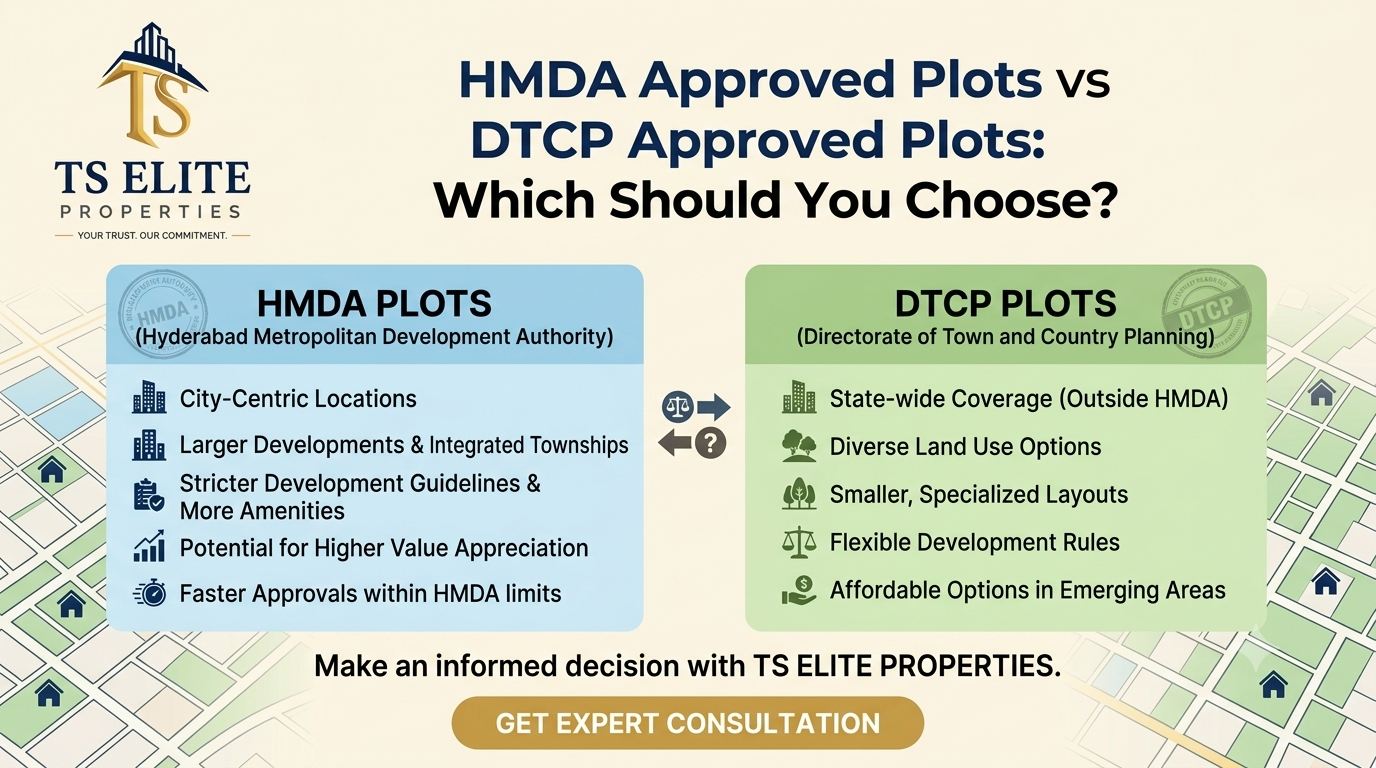
- Layout Approvals: Ensure the plot is officially approved by urban planning authorities such as the HMDA (Hyderabad Metropolitan Development Authority) or the DTCP (Directorate of Town and Country Planning). Approved layouts guarantee dedicated space for public roads, parks, and utility reserves.
- TRERA Registration: For modern plotted layouts, check whether the project is registered under the Telangana Real Estate Regulatory Authority (TRERA).
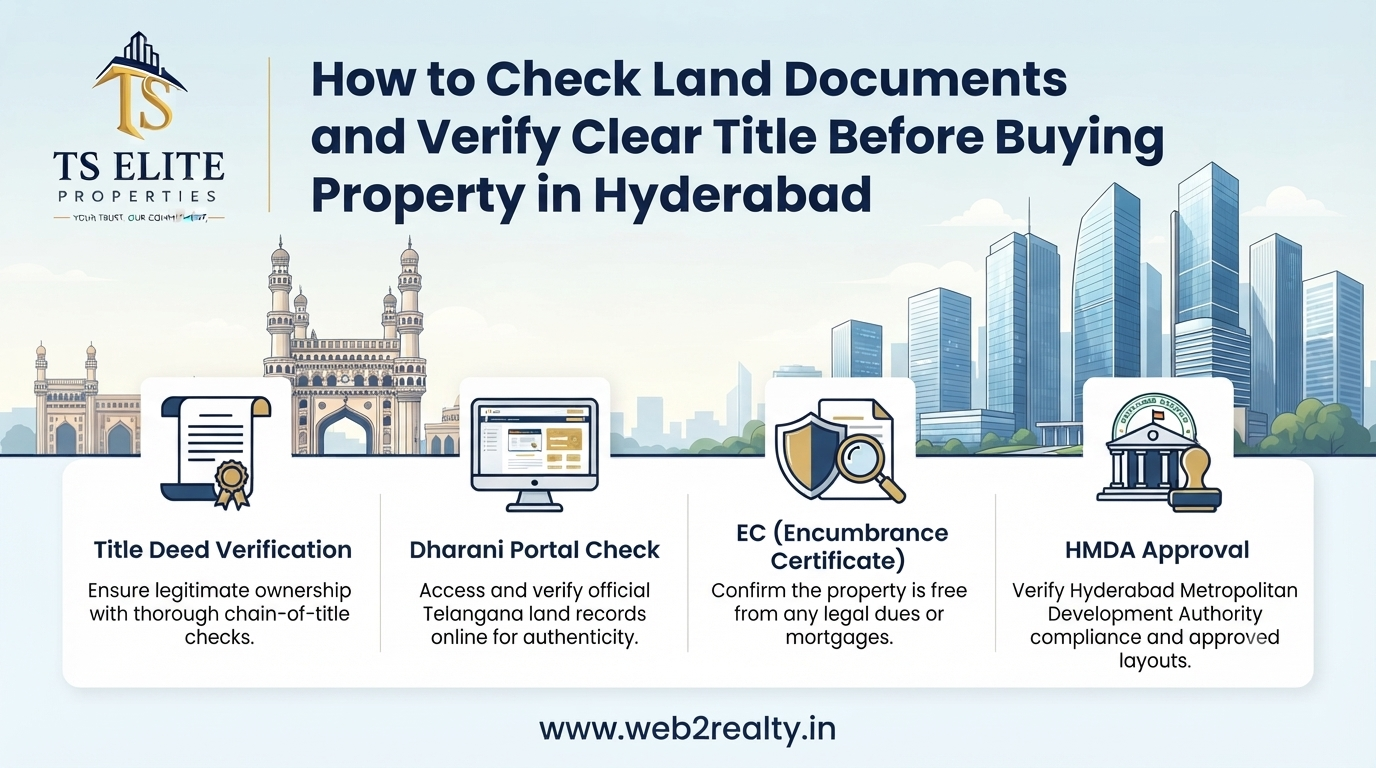
- Clear Title Deed: Work with an independent legal professional to review ownership records for the past 30 years. Confirm that the seller holds a clear, marketable title without pending family disputes or co-owner litigation.
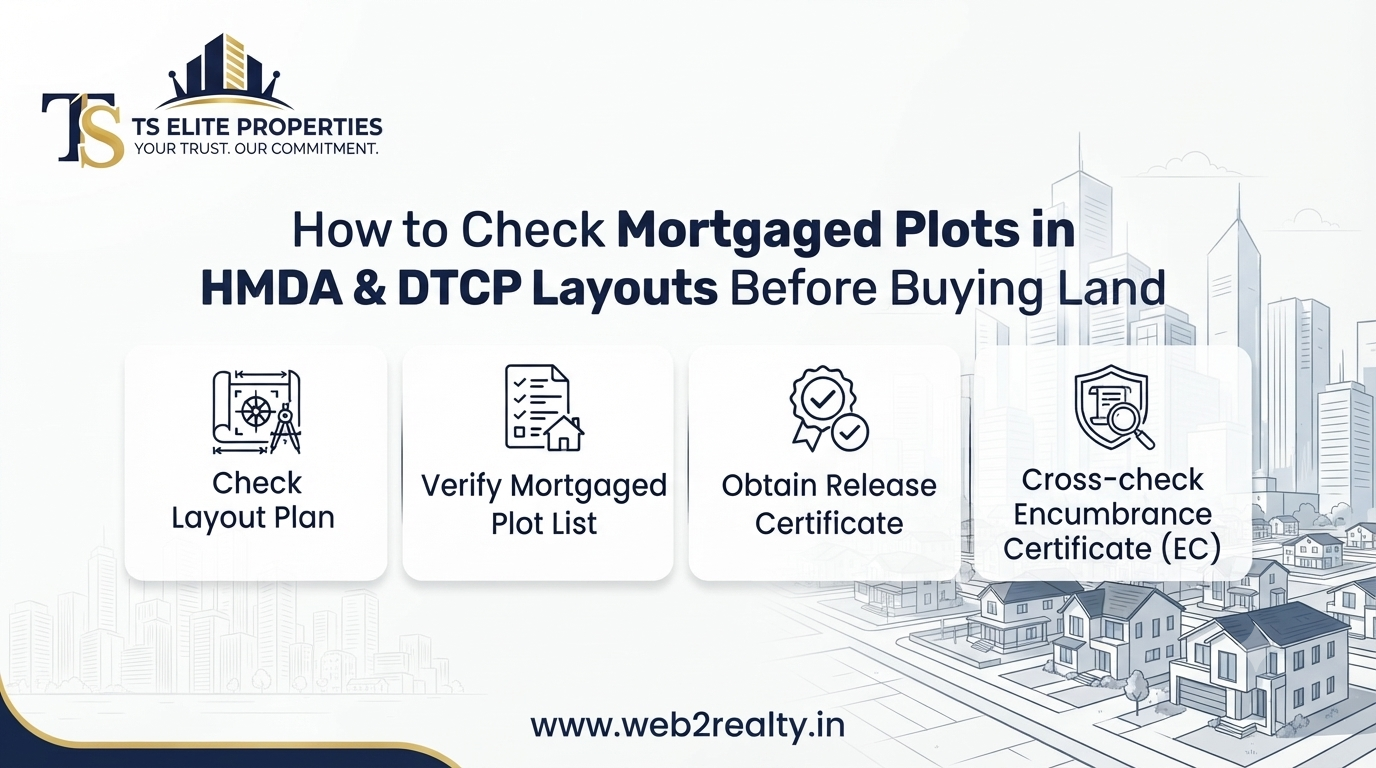
- Encumbrance Certificate (EC): Obtain an EC from the sub-registrar’s office covering 13 to 30 years to confirm the plot is free from mortgages, court attachments, or bank liens.
2. Soil Quality, Elevation, and Topography
The physical condition of the ground directly impacts your construction costs and the long-term safety of your home:
- Soil Bearing Capacity: Conduct a basic soil test before finalizing the purchase. Hard, gravelly, or rocky soil provides a strong base, reducing foundation costs. Soft clay or black cotton soil expands when wet and shrinks when dry, requiring deeper and more expensive foundation engineering.
- Elevation & Drainage: Choose a plot that is at the same level as, or slightly higher than, the adjacent approach road. Plots situated in low-lying pockets or valley dips face severe waterlogging during monsoon downpours.
3. Plot Geometry, Orientation, and Vastu Compliance
The shape and direction of a plot affect natural light, air circulation, and structural layout efficiency:
- Shape: Rectangular or square plots are ideal. They allow architects to design functional floor plans with zero wasted space. Avoid irregular, triangular, or L-shaped plots, which result in awkward corners and restricted construction boundaries.
- Orientation: East-facing and North-facing plots are highly preferred across India due to morning sunlight and traditional Vastu Shastra principles.
- Corner Plots: Plots with roads on two sides offer superior natural ventilation, increased natural light, and flexible entrance design options.
4. On-Site Physical Infrastructure
Examine the immediate surroundings to ensure the plot is ready for construction:
- Internal Road Width: The approach road in front of the plot should be at least 30 to 40 feet wide. This ensures smooth movement for construction vehicles, personal cars, and emergency services.
- Utilities Availability: Confirm access to municipal water lines (such as HMWS&SB), underground sewage systems, electricity grids, and high-speed internet cables right at the plot boundary.
Pro-Tip for Buyers: Visit the site at different times of the day preferably once during the day and once in the evening and inspect the area after heavy rain to evaluate traffic, ambient noise, and drainage performance.
Planning Your Budget Before Buying an Open Plot
A common mistake among land buyers is budgeting only for the sticker price of the plot per square yard. Purchasing open land involves several mandatory legal, administrative, and development fees. Failing to account for these extra costs can strain your finances.
1. The True Cost Breakdown of Buying an Open Plot
To avoid financial surprises, break down your overall budget into distinct categories:
|
Budget Component |
Estimated Cost Percentage / Range |
Description |
|
Base Land Cost |
75% – 80% of total budget |
The agreed purchase rate per square yard. |
|
Stamp Duty & Registration |
~6% of property market value |
Statutory government charges in Telangana (4% Stamp Duty + 0.5% Registration + 1.5% Transfer Duty). |
|
Legal & Title Verification Fees |
₹15,000 – ₹35,000 (flat fee) |
Payment to an independent property lawyer for title search reports and document checks. |
|
Layout Development Charges |
Variable (₹100 – ₹300 per sq. yd) |
Charges collected by developers for underground cables, tar roads, water tanks, and park landscaping. |
|
Surveying & Fencing Costs |
₹20,000 – ₹50,000 |
Professional land surveying, boundary demarcation, and temporary boundary wall creation. |
|
Loan Processing & Administrative Fees |
0.5% – 1% of loan amount |
Processing fees charged by banks or housing finance companies. |
|
Emergency Contingency Buffer |
5% of total plot budget |
Reserve fund set aside for unexpected administrative or document processing expenses. |
2. Financing Strategy: Plot Loans vs. Home Loans
If you plan to fund your purchase using a bank loan, keep these key financial rules in mind:
- Lower Loan-to-Value (LTV) Ratio: Banks typically offer an LTV ratio of 70% to 80% for open plot loans, compared to 85% to 90% for built residential homes. This means you must arrange a higher down payment (20% to 30% of the plot value) from your personal savings.
- Construction Timelines: Many banks mandate that construction on the plot must begin within 2 to 5 years of loan disbursal. If you plan to hold the land as an investment without immediate construction, check the loan terms carefully with your lender.
- Separate Construction Budget: Maintain a distinct financial reserve if you plan to construct your home within 12 to 24 months. Construction costs depend heavily on structural design, material selection, and labor rates.
Corridor Breakdown — Best Open Plots in Hyderabad
Hyderabad’s urban expansion is guided by the 158-kilometer, 8-lane Outer Ring Road (ORR) and the upcoming Regional Ring Road (RRR). Choosing the right location depends on your investment goal, budget, and construction timeline.
Here is an analysis of the top growth corridors offering the best open plots in Hyderabad:
1. Western Growth Corridor (Kollur, Tellapur, Mokila & Shankarpally)
- Target Audience: High-net-worth investors, IT professionals, and buyers planning premium villa construction.
- Key Highlights: Situated near the Financial District, Gachibowli, and Hitec City. This corridor features well-planned gated layouts with underground utilities, international schools, and sports academies.
- Appreciation Potential: High. Proximity to major employment clusters drives steady long-term appreciation and strong resale demand.
2. Airport & Future City Corridor (Tukkuguda, Shamshabad, Srisailam Highway & Maheshwaram)
- Target Audience: Mid-to-long-term investors and buyers looking for land near industrial, aerospace, and commercial hubs.
- Key Highlights: Positioned in South Hyderabad near Rajiv Gandhi International Airport (RGIA). The region benefits from ongoing commercial investments, hardware parks, and proximity to Telangana’s proposed Future City initiative.
- Appreciation Potential: Excellent. Rapid infrastructure development along the Srisailam Highway (NH-765) makes it a popular choice for high capital returns.
3. Eastern Industrial Corridor (Bibinagar, Bhongir & Warangal Highway)
- Target Audience: Budget-conscious buyers, first-time plot investors, and long-horizon wealth creators.
- Key Highlights: Anchored by the 6-lane Warangal Highway (NH-163), AIIMS Bibinagar, and industrial parks. Offers entry-level price points for HMDA and DTCP-approved layouts.
- Appreciation Potential: Steady. The upcoming Regional Ring Road alignment through this belt improves regional connectivity to key employment zones.
4. Northern Residential Belt (Kompally, Medchal & Kallakal)
- Target Audience: Families seeking established social infrastructure, peaceful residential neighborhoods, and seamless access to Secunderabad.
- Key Highlights: Situated along the Nagpur Highway (NH-44). The area offers mature social infrastructure, including multispecialty hospitals, colleges, and shopping centers.
- Appreciation Potential: Stable and low-risk, making it ideal for immediate home construction.
Buyer’s Quick Checklist Before Handing Over an Advance.
Before transferring a booking deposit for an open plot in Hyderabad, verify these four core items:
- LP Number Verification: Confirm the layout’s LP (Layout Permission) number directly on the official HMDA or DTCP portal.
- Master Plan Zoning: Ensure the land falls within a designated “Residential Zone” or “Multiple Use Zone” on the official master plan. Avoid land marked under conservation or green buffers.
- FTL & Buffer Zone Boundaries: Verify that the plot is safely outside the Full Tank Level (FTL) and buffer zones of lakes, streams, and natural drains (Nalas).
- Physical Demarcation: Check that the plot number, survey boundaries, and dimensions match the master layout plan provided by the seller.
Frequently Asked Questions (FAQs).
1. What is the difference between HMDA and DTCP approved plots in Hyderabad?
HMDA (Hyderabad Metropolitan Development Authority) layouts fall within the core urban and suburban metropolitan regions of Hyderabad. They follow strict planning guidelines with wider internal roads, dedicated parks, and ready municipal infrastructure. DTCP (Directorate of Town and Country Planning) layouts cover areas outside the HMDA jurisdiction, typically along emerging highway corridors. DTCP plots generally offer lower entry prices and high long-term appreciation.
2. What is an LP Number, and why is it important when buying a plot?
An LP (Layout Permission) Number is a unique identification code issued by the HMDA or DTCP when a developer’s layout master plan receives official government sanction. Verifying the LP number on the official planning authority portal ensures the plot layout is legal, non-agricultural, and safe from municipal demolition or legal disputes.
3. What hidden or extra costs should I budget for besides the land price?
When budgeting for an open plot, expect to spend an extra 15% to 20% above the base plot price to cover:
-
Government Charges: Stamp duty, registration fees, and transfer duty (~6% in Telangana).
-
Legal Fees: Independent lawyer fees for 30-year title verification (₹15,000 – ₹35,000).
-
Development Charges: Infrastructure/amenity fees charged by layout developers.
-
Property Services: Land surveying, boundary fencing, and bank loan processing fees.
4. How much down payment do banks require for an open plot loan?
Unlike home loans (which cover up to 85%–90% of property cost), banks typically offer a Loan-to-Value (LTV) ratio of 70% to 80% for open plot purchases. This means you must prepare a minimum down payment of 20% to 30% of the land value from personal savings.
5. Is there a timeline restriction to start home construction after buying a plot?
If you purchase the plot with cash/savings, there is no time limit to begin construction. However, if you take a plot-plus-construction loan from a bank, most financial institutions mandate that house construction must commence within 2 to 5 years from the date of loan disbursal.
6. Which growth corridors offer the best open plots in Hyderabad for investment?
-
For Luxury & Fast Appreciation: Western corridor (Kollur, Tellapur, Mokila, Shankarpally Road).
-
For High Capital Returns & Commercial Expansion: Southern corridor (Tukkuguda, Srisailam Highway, Maheshwaram near RGIA Airport).
-
For Affordable Entry-Level Investment: Eastern corridor (Warangal Highway, Bibinagar, Bhongir).
What specific aspect of plot buying or budget planning would you like to explore further?
Secure Your Ideal Open Plot with www.web2realty.in
Selecting the ideal open plot for your future home requires combining thorough physical inspection, legal verification, and realistic budget planning. By calculating total acquisition costs upfront and choosing high-growth corridors in Hyderabad, you build a foundation for both a comfortable residence and a high-yielding financial asset.
At Web2Realty.in, we simplify land buying by offering verified, 100% legal, HMDA- and DTCP-approved open plot listings across Hyderabad’s top investment corridors. Whether you are looking for a luxury villa plot near Tellapur and Mokila or high-growth investment land along the ORR, our real estate specialists support you through site visits, legal title verification, and complete registration assistance.
Explore premium open plot options in Hyderabad today at www.web2realty.in!
What specific growth corridor or plot budget range are you evaluating for your property investment?
Recent post
- September 18, 2026