Day: August 22, 2026

How Road Development and Employment Growth Shape Land Prices in Telangana.

road infrastructure and employment growth shape land prices in Telangana

How Road Development and Employment Growth Shape Land Prices in Telangana.

Real estate in Telangana has moved far beyond the traditional boundaries of central Hyderabad. Today, open plots, gated communities, and commercial layouts are expanding rapidly across suburban fringes, rural corridors, and satellite towns.

Two powerful engines drive this widespread real estate expansion: modern road connectivity and decentralized employment generation.

When modern expressways slash daily travel times and new industrial corridors generate steady local jobs, property valuations climb quickly. Understanding how transport routes and employment hubs interact provides practical clarity on what determines land prices in Telangana and where future growth is heading.


1. The Infrastructure Catalyst: How Expressways Unlock Land Value

In real estate, raw land holds potential, but physical connectivity unlocks its financial value. An isolated parcel of land often yields modest agricultural returns; the moment a multi-lane highway, bypass, or radial corridor reaches its boundary, accessibility instantly transforms its market appeal.


Growth Phase

Infrastructure Trigger

Real Estate Impact

Phase 1: Announcement & Survey

Government notifies road alignments (e.g., RRR, Radial Corridors).

Speculative buying begins; initial upward movement in land prices in Telangana.

Phase 2: Construction & Land Acquisition

Earthworks start; arterial links and underpasses take physical shape.

Institutional developers acquire large land banks for gated layouts.

Phase 3: Operational Connectivity

Expressways open to traffic; commute times drop by 40% to 60%.

End-users buy residential plots; commercial, retail, and schooling hubs emerge.

The Outer Ring Road (ORR) Template

The 158-kilometer Outer Ring Road demonstrated how ring-road infrastructure shifts urban geography. Two decades ago, locations such as Kokapet, Nanakramguda, Tellapur, and Puppalguda were quiet rural pockets. Once the 8-lane expressway became fully functional:


  • Commute times between the airport and tech parks dropped significantly.
  •  
  • Major commercial complexes and high-rise apartments moved outward.
  •  
  • Land prices in Telangana across western ORR exits rose exponentially, setting a benchmark for future projects.
  •  

The Regional Ring Road (RRR) Expansion

The 340-kilometer Regional Ring Road is applying that same growth model on a wider regional scale. Spanning beyond the ORR, the RRR connects key satellite towns:


  • Northern Corridor: Sangareddy, Narsapur, Toopran, Gajwel, Yadadri, and Choutuppal.
  •  
  • Southern Corridor: Shadnagar, Chevella, Ibrahimpatnam, Kandukur, and Amangal.
  •  

By linking major national highways (NH-44, NH-65, NH-163, and NH-765), the RRR allows goods and commuters to bypass inner-city bottlenecks. As access to outer districts improves, land prices in Telangana around proposed junction interchanges are gaining steady appreciation.


Radial Roads and Arterial Linkages

Expressways require effective feeder networks to function at their best. Upgrades to state highways, radial roads connecting the inner ring to the outer ring, and elevated corridors along the Medchal and Srisailam routes ensure that interior agricultural pockets transform into viable residential and warehousing locations.

2. Employment Growth: The Sustained Fuel for Land Demand

Roads provide the physical route, but local employment creates the steady population influx that sustains property demand. When multinational firms, research facilities, and manufacturing plants hire at scale, workers look for housing nearby, driving up demand for open plots and apartments.

 Global Capability Centers (GCCs) and the Tech Ecosystem

Hyderabad’s reputation as a prime hub for Global Capability Centers and enterprise technology firms continues to draw skilled professionals. As technology campuses expand along the Financial District, Gachibowli, and outer western corridors like Mokila and Shankarpally, adjacent plotted developments experience strong buyer interest.

Life Sciences, Pharma, and Biotech Parks

Telangana produces a significant share of global vaccines and pharmaceuticals. Specialized industrial belts such as Genome Valley in Shamirpet and mega-pharma clusters along the southern corridors employ thousands of technical and operational specialists. This sustained employment base drives demand for:


  • Affordable plotted layouts for mid-level staff.
  • Gated villa communities for senior executives.
  • Supporting commercial developments, including grocery centers, clinics, and banks.

Aerospace, Defense, and Hardware Manufacturing

Special Economic Zones (SEZs) in Adibatla, Maheshwaram, and Shamshabad house global aerospace, precision engineering, and hardware manufacturing facilities. As multinational supply chains expand operations here, residential plotting ventures nearby experience healthy appreciation.


3. High-Growth Corridors in Telangana: Where Roads and Jobs Intersect

When major highway projects and large-scale employment hubs develop in the same corridor, land appreciation accelerates.


The Southern Highway Belt (Shamshabad – Maheshwaram – Kandukur)

  • Connectivity: Srisailam Highway (NH-765), Bengaluru Highway (NH-44), ORR Exit 14, and the upcoming RRR Southern loop.
  •  
  • Economic Catalysts: Adibatla Aerospace Park, hardware technology zones, logistics parks, and quick access to Rajiv Gandhi International Airport.
  •  
  • Market Outlook: Once strictly agricultural, this corridor has become a preferred destination for plotted layouts and long-term land investments.
  •  

The Western Industrial & Residential Arc (Patancheru – Sangareddy)

  • Connectivity: Mumbai Highway (NH-65) and RRR Northern loop intersections.
  •  
  • Economic Catalysts: Established manufacturing zones, pharmaceutical production hubs, and steady residential expansion spilling over from Hitec City.
  •  
  • Market Outlook: Land prices in Telangana across this stretch have shown consistent year-on-year gains due to a balanced mix of industrial jobs and residential demand.
  •  

4. Key Factors Influencing Land Valuation in Telangana

Evaluating land appreciation requires looking at several core real estate fundamentals:


  1. Travel Time vs. Physical Distance: Modern home buyers evaluate location based on transit time rather than raw kilometer distance. A location 35 km away connected by a high-speed expressway is often preferred over a location 15 km away caught in heavy urban traffic.
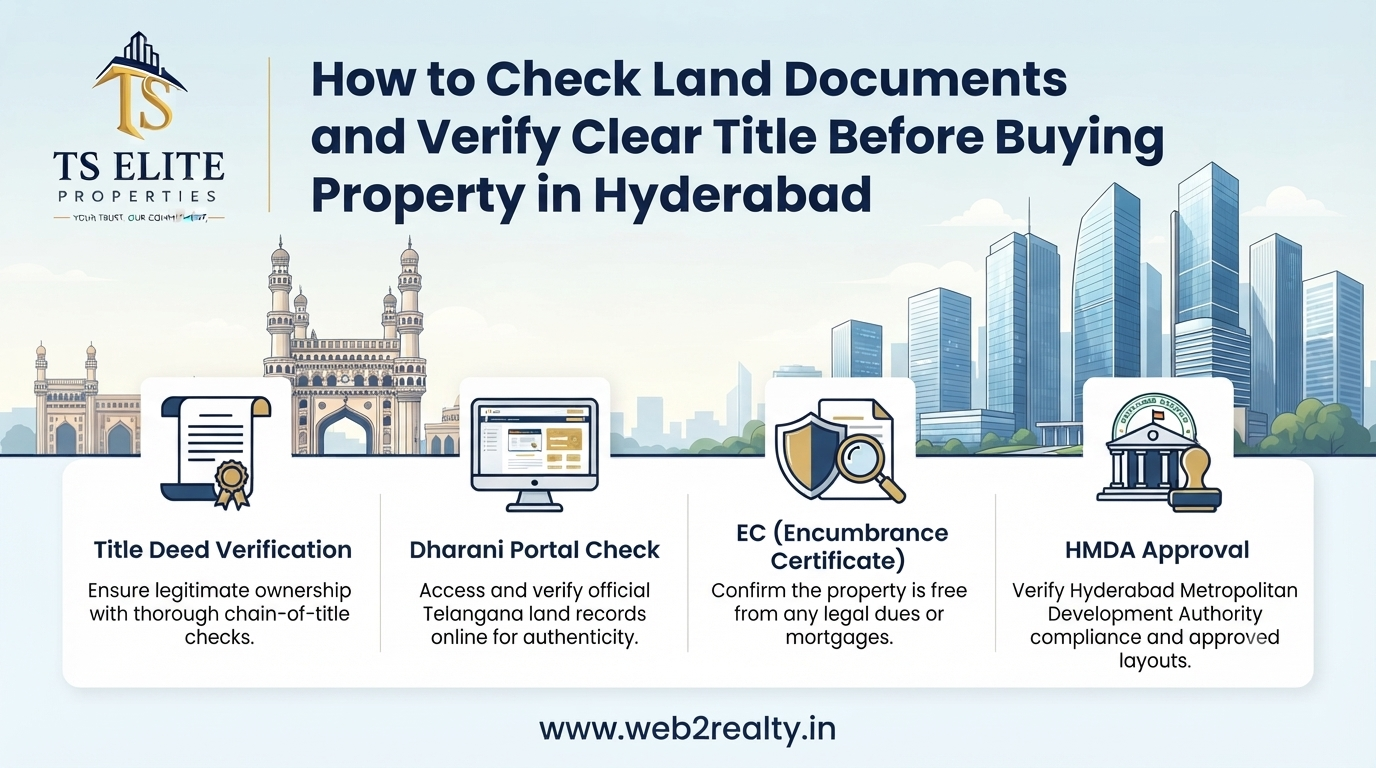
  2. Statutory Approvals (HMDA, DTCP, and TG-RERA): Clear legal standing significantly influences valuation. Layouts holding Hyderabad Metropolitan Development Authority (HMDA) or Directorate of Town and Country Planning (DTCP) sanction, along with TG-RERA registration, command premium prices over unapproved parcels.
  3. Transit-Oriented Development (TOD): The proposed expansion of Metro Rail phases, Multi-Modal Transport System (MMTS) suburban trains, and designated bus rapid transit corridors adds long-term value to surrounding land parcels.
  4. Social Infrastructure Development: Plots located near established international schools, multi-specialty hospitals, and organized retail centers transition faster from speculative investments into functional residential neighborhoods.

5. Due Diligence Checklist for Buying Plots and Land

Before committing capital to land investments along expanding road corridors, follow these key verification steps:


  • Inspect Layout Sanctions: Verify that the plot layout holds valid HMDA or DTCP final approval letters and an authentic TG-RERA registration number.
  •  
  • Check Title History: Obtain an Encumbrance Certificate (EC) covering at least 30 years to verify that the property has an unbroken ownership chain with zero legal disputes.
  • Review Land Classification: Cross-check the master plan to confirm the plot falls under a residential or commercial zone rather than conservation, bio-zone, or agricultural preservation belts.
  • Verify Alignment Buffer Zones: Ensure the plot does not fall inside government acquisition corridors, proposed highway widening strips, or water body protection buffers (FTL/Buffer zones).
  • Plan for a 3-to-7 Year Investment Horizon: Infrastructure-led appreciation takes time to mature as roads are paved, utilities are installed, and companies open their facilities.

Frequently Asked Questions (FAQs)

Q1: Why do land prices in Telangana increase faster near highway exits?


A: Highway exits offer seamless access for daily commuting and commercial transport. Developers prioritize these nodes for townships, commercial hubs, and logistics parks, which concentrates buyer demand and lifts land valuations.


Q2: How does the Regional Ring Road (RRR) affect real estate investments?


A: The RRR connects secondary towns directly to national highways, allowing commuters and freight to bypass city traffic. This creates opportunities for warehousing, manufacturing, and affordable plotted housing, driving up land values across peripheral towns.


Q3: Which employment sectors create the highest demand for residential land?


A: The Information Technology (IT/GCC), Pharmaceutical, Aerospace, Defense, and Logistics industries are the largest employment generators in Telangana, creating steady demand for housing and plotted layouts near these employment clusters.


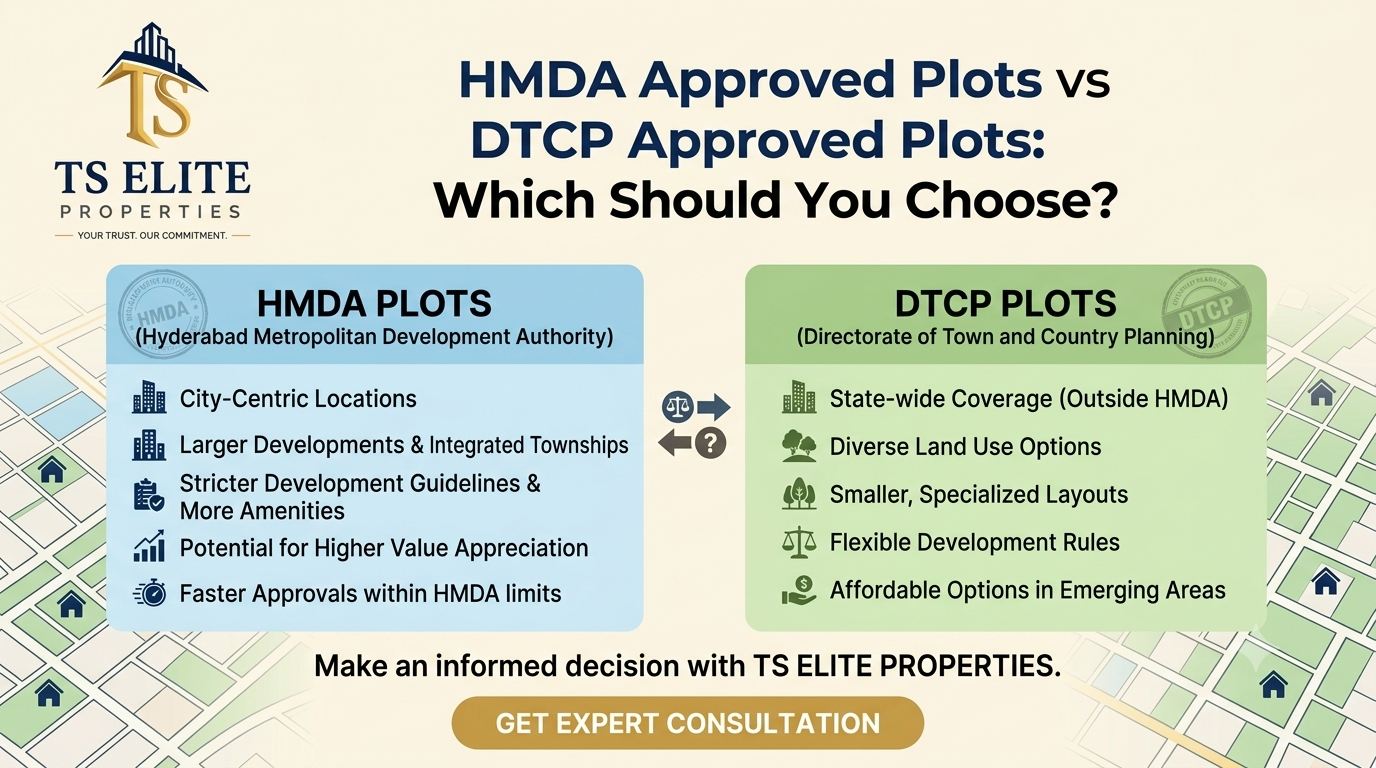
Q4: What is the main difference between HMDA-approved and DTCP-approved plots?


A: HMDA approves layouts within the Hyderabad metropolitan limits, where urban infrastructure and civic services develop faster. DTCP oversees planned layouts outside HMDA limits in developing towns and rural districts, generally offering lower entry costs with a longer-term growth horizon.


Start Your Land Investment Journey Today

Telangana’s property market continues to expand as new expressways and industrial corridors open across the state. Investing early in strategically located plots along high-growth road networks offers a clear path toward sustainable, long-term capital appreciation.


Whether you are looking for an HMDA-approved villa plot, a DTCP layout near the upcoming Regional Ring Road, or commercial land near an industrial hub, choosing verified projects in well-connected locations is key.


Explore verified, clear-title plotted layouts across Telangana’s top highway corridors today. Contact www.web2realty.in for our real estate advisory team for detailed master plan maps, legal document checks, and guided on-site visits.


Related Post

What Is a Layout Plan and How to Check Whether a Plot Is Legally Approved?

Property title verification before buying a plot

What Is a Layout Plan and How to Check Whether a Plot Is Legally Approved?

Buying land is one of the biggest financial decisions you can make. Whether you want to build a home, hold land for future growth, or search for approved plots for investment, checking the legal status of a property is essential.

A plot may have a great location, an attractive price, and strong future development potential. However, these factors alone do not make it a safe investment. Before paying an advance or signing a sale agreement, you should understand the layout plan and verify the approvals related to the property.

For buyers looking for approved plots for investment, proper legal verification can reduce the risk of ownership disputes, unauthorized layouts, unclear titles, construction restrictions, and resale problems.

In this guide, we explain what a layout plan is, why it matters, what documents you should check, and how to verify whether a plot is legally approved.

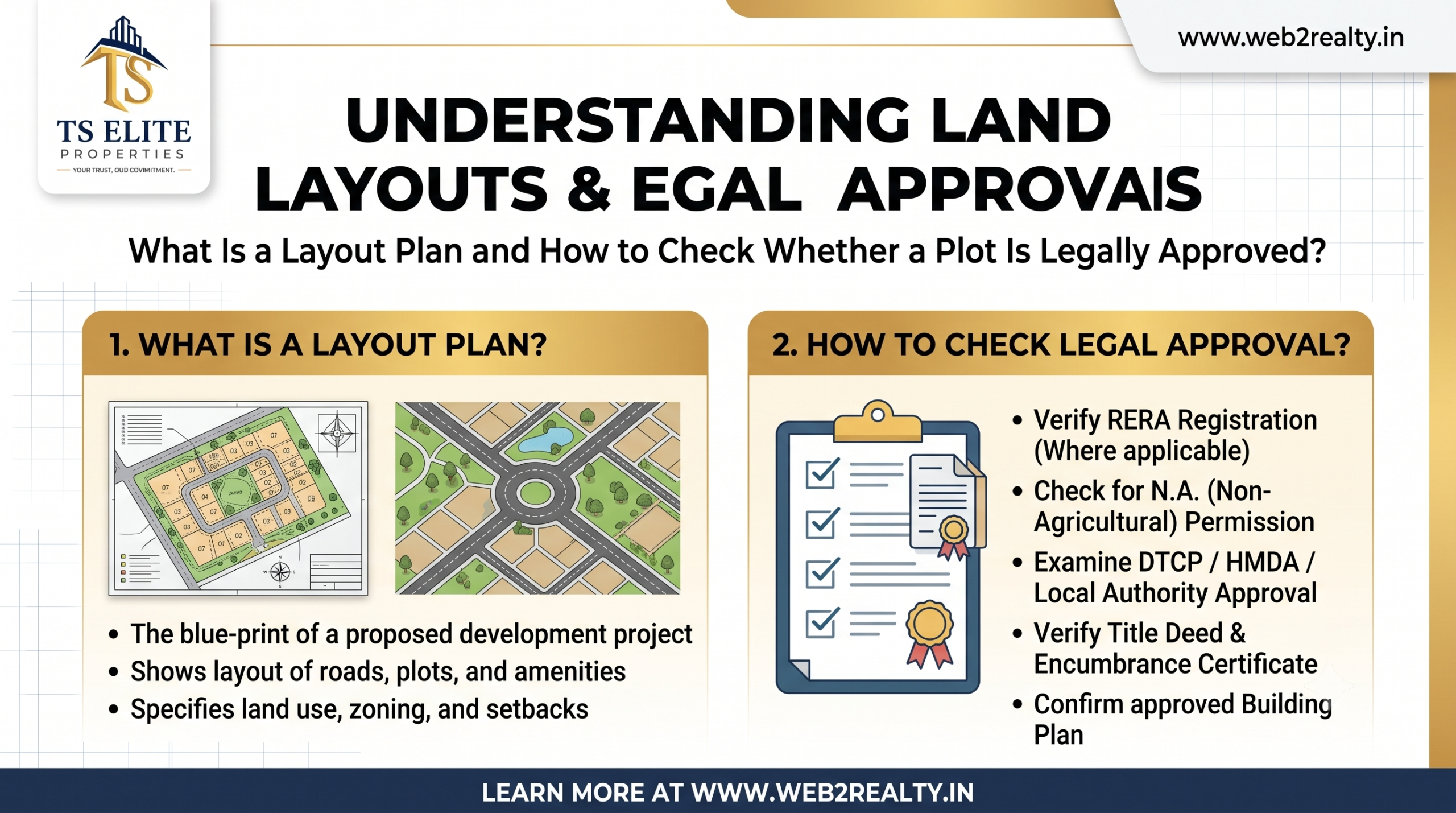
What Is a Layout Plan?

A layout plan is an official drawing that shows how a larger piece of land has been divided into individual plots and common areas.

A typical layout plan may show:

  • Individual plot numbers
  • Plot dimensions
  • Internal roads
  • Open spaces
  • Parks
  • Utility areas
  • Drainage arrangements
  • Common areas
  • Access roads
  • Layout boundaries

In simple terms, a layout plan shows how the land has been divided and how the entire development is planned.

For people searching for approved plots for investment, the layout plan is an important document. It allows buyers to compare the property being offered with the details approved by the relevant planning authority.

Why Is a Layout Plan Important?

A layout plan is more than just a map. It provides important information about the development of the entire property.

For example, a developer may advertise a 200-square-yard plot. However, the advertisement alone may not tell you whether the plot is part of an approved layout or whether its dimensions match the approved plan.

By checking the layout plan, you can verify:

  • Whether the plot exists in the approved layout
  • Whether the plot number is correct
  • Whether the plot dimensions match
  • Whether roads are shown correctly
  • Whether open spaces are properly marked
  • Whether the layout boundaries match the documents

This is especially important when purchasing approved plots for investment, as the legal status of a property can affect construction, registration, financing, resale, and future development.

What Does “Approved Plot” Mean?

An approved plot generally means that the plot is part of a layout that has received the required approval from the relevant planning authority, subject to applicable laws and conditions.

However, buyers should not rely only on the word “approved” in an advertisement.

Before making a decision, ask the seller or developer:

  1. Which authority approved the layout?
  2. What is the approval number?
  3. When was the layout approved?
  4. What is the approved land extent?
  5. Does the exact plot number appear in the approved plan?
  6. Do the survey numbers match?
  7. Are there any conditions attached to the approval?

These checks are particularly important when evaluating approved plots for investment.

Layout Plan vs Sale Deed: What Is the Difference?

A layout plan and a sale deed are two different documents, and both have an important role in a property transaction.

A layout plan shows how the larger land parcel has been divided into plots, roads, open spaces, and other areas.

A sale deed is the legal document used to transfer ownership of a specific property from the seller to the buyer.

One document cannot replace the other.

For example, a plot may appear on an approved layout plan, but you still need to verify whether the seller has a valid and transferable title to that plot.

Similarly, having a sale deed does not automatically prove that the entire layout has received all required planning approvals.

This is why buyers should complete both title verification and layout approval verification before purchasing land.

How to Check Whether a Plot Is Legally Approved

Before buying a plot, follow a systematic verification process. The following steps can help you identify potential issues before making a major financial commitment.

1. Identify the Approving Authority

First, find out which planning authority has jurisdiction over the property.

Different locations may come under different planning or local authorities. Properties around Hyderabad and other parts of Telangana may therefore have different approval requirements depending on their location.

Ask the seller or developer for:

  • Name of the approving authority
  • Approval number
  • Approval date
  • Survey numbers
  • Approved land extent

Do not accept statements such as government approved without asking for supporting documents.

2. Ask for the Approved Layout Plan

Always request a copy of the approved layout plan.

Do not rely only on:

  • Marketing brochures
  • Social media advertisements
  • WhatsApp images
  • Google Maps
  • Developer-created maps

The official approved plan should help you identify the plot number, roads, open spaces, boundaries, and other important details.

If you are considering approved plots for investment, confirm that the exact plot you are purchasing appears in the approved layout.

3. Verify the Approval Number

The approval number is an important reference when checking the legal status of a layout.

Ask for the:

  • Approval number
  • Approval date
  • Approving authority
  • Approved extent
  • Survey numbers
  • Approved plot numbers
  • Conditions of approval, if any

Where online verification is available, check the details through the relevant official government portal.

If the information cannot be verified, consider consulting a qualified property lawyer before proceeding.

4. Match the Survey Numbers

Survey numbers are extremely important in land transactions.

The survey numbers mentioned in the approved layout should correspond with the land being offered for sale.

A mismatch between the advertised property and official records can create serious legal and ownership issues.

Ask a qualified property lawyer or document professional to review the survey numbers and related land records.

This step is especially important for buyers looking for approved plots for investment in developing locations.

5. Check the Plot Number

Never assume that every plot shown in a brochure is approved.

Compare the plot number across:

  • Approved layout plan
  • Sale deed
  • Sale agreement
  • Property records
  • Developer documents

Also check whether the plot dimensions and survey details match.

If there is a discrepancy, do not ignore it. Ask the seller to explain the difference and verify the answer independently.

6. Check Road Access

Road connectivity is another important factor when buying a plot.

A property may look attractive on paper, but you should also confirm that it has proper access.

Check whether:

  • The road is shown on the approved layout
  • The road exists physically
  • The plot has proper access
  • The road width matches the approved plan where applicable
  • The property connects to a recognized road

Good road access can improve the usability, convenience, and future resale potential of a property.

7. Verify Open Spaces and Parks

Approved layouts may include designated areas for roads, parks, open spaces, utilities, and other common purposes according to applicable planning rules.

Compare the approved layout with the actual development on the ground.

For example, if an area is marked as an open space or park in the approved plan, it should not be presented to buyers as a private residential plot.

This comparison can help identify potential irregularities when evaluating approved plots for investment.

8. Check the Land Title

Layout approval does not automatically prove that the seller has a clear and transferable title.

Title verification is therefore one of the most important steps in the property-buying process.

Depending on the property, a legal professional may review:

  • Current sale deed
  • Parent documents
  • Previous sale deeds
  • Encumbrance records
  • Revenue records
  • Mutation details
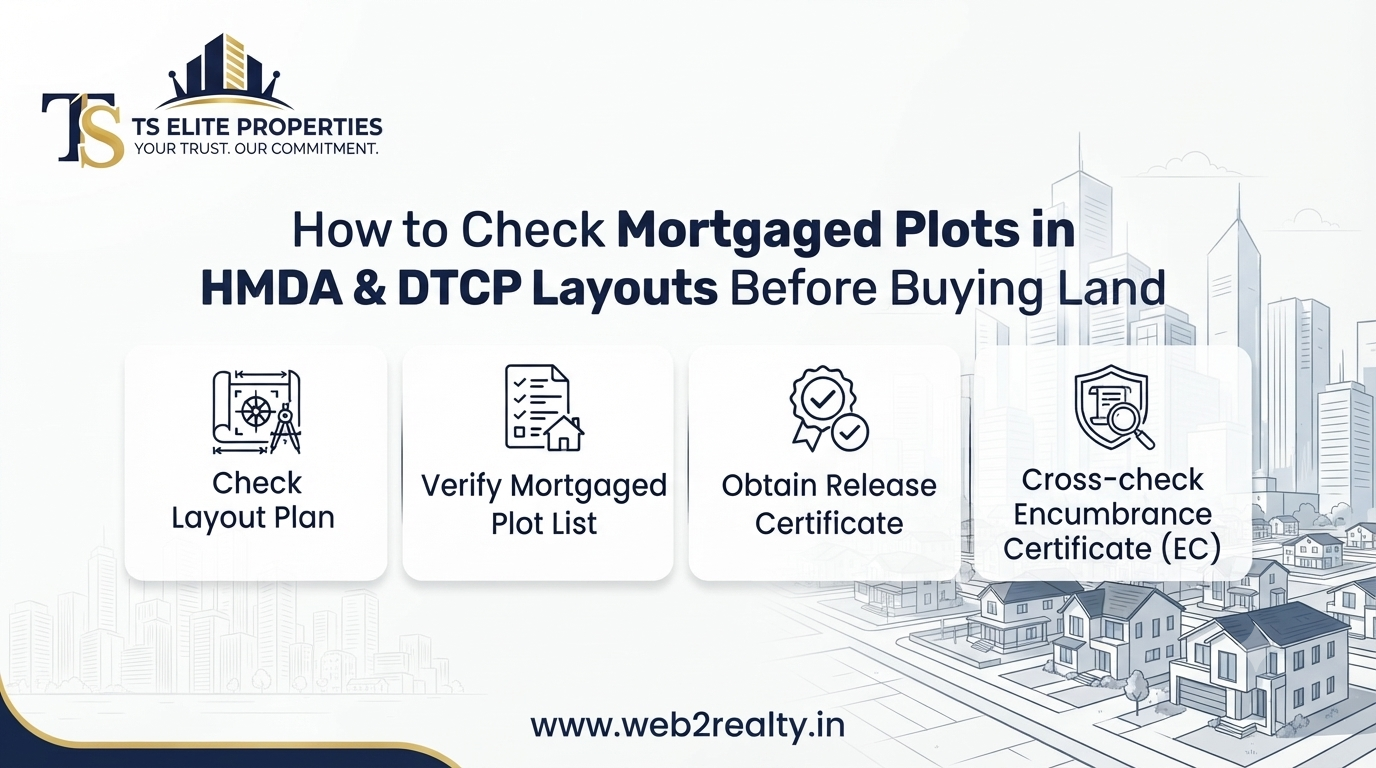
  • Mortgage details
  • Court cases
  • Inheritance claims
  • Other registered claims

A property lawyer can help determine whether the seller has the legal right to sell the property.

9. Check Encumbrance Details

An encumbrance check can help identify registered transactions, mortgages, or other recorded claims connected to the property.

Buyers should obtain the relevant records and have them reviewed carefully.

If the property has an existing loan, mortgage, or registered charge, make sure the matter is properly resolved before completing the purchase.

A low price is not necessarily a good deal if the property has unresolved legal issues.

10. Check Whether RERA Applies

For applicable real estate projects, buyers should check whether the project is registered with the relevant RERA authority.

RERA requirements can depend on factors such as the type, size, and nature of a project. Therefore, buyers should determine whether the particular project falls within the applicable requirements.

If a developer claims that a project is RERA registered, ask for the registration details and verify them through the official authority.

For buyers searching for approved plots for investment, checking applicable regulatory requirements is an important part of due diligence.

11. Check Land Use and Conversion Requirements

Not every parcel of land can automatically be used for every purpose.

Land-use regulations may determine whether land can be used for:

  • Residential purposes
  • Commercial purposes
  • Agricultural activities
  • Industrial purposes
  • Other permitted uses

If you plan to construct a home, confirm that the land and layout have the permissions required for the intended use.

This is particularly important when considering plots in developing and peripheral areas.

12. Visit the Property Personally

Documents are important, but a physical site visit is equally useful.

Visit the property and check:

  • Plot boundaries
  • Road access
  • Surrounding development
  • Nearby properties
  • Electricity availability
  • Water availability
  • Drainage
  • Existing structures
  • Possible encroachments
  • Distance from major roads

If possible, visit the property more than once and at different times.

A site visit can reveal issues that may not be visible in advertisements, brochures, or online maps.

Red Flags to Watch Out for When Buying a Plot

If you are searching for approved plots for investment, be careful when you come across the following situations.

“Approval Is Coming Soon”

If the approval has not yet been granted, do not treat the property as an approved plot.

Ask for the current approval status and verify it independently.

“Only a Few Plots Are Left”

Limited-stock offers can create pressure to make a quick decision.

Do not allow sales urgency to replace legal verification.

Take enough time to check the documents before paying.

“Government Approved” Without Details

A genuine approval should have supporting documentation.

Ask:

  • Which authority approved it?
  • What is the approval number?
  • When was it approved?
  • Does the plot appear in the approved layout?

The Price Is Much Lower Than Nearby Properties

A very low price may be attractive, but it can sometimes indicate issues related to:

  • Title
  • Location
  • Road access
  • Approvals
  • Development
  • Ownership
  • Land use

Investigate the reason before assuming you have found a bargain.

Plot Number Is Missing From the Approved Plan

This is an important warning sign.

If the plot number being sold does not appear on the approved layout, ask for clarification and obtain independent legal advice before proceeding.

Seller Is Pressuring You to Pay Immediately

Do not make a large payment simply because you are told that the price will increase tomorrow.

A good property investment decision requires proper due diligence.

Why Approved Plots Can Be Attractive for Investment

Once all relevant documents have been properly verified, approved plots for investment may offer several potential advantages.

Flexibility

A plot can potentially be held for future use or construction, subject to applicable laws and permissions.

Long-Term Growth Potential

Land located in areas with improving infrastructure, connectivity, employment opportunities, and population growth may have long-term appreciation potential.

However, appreciation is never guaranteed.

Lower Maintenance

Vacant land generally does not require the same level of maintenance as a completed building or apartment.

Future Construction

Depending on applicable regulations and permissions, buyers may be able to construct a home or another permitted property in the future.

Before planning construction, always check the applicable building and land-use rules.

Tips for First-Time Plot Buyers

Buying land for the first time can feel complicated. These simple rules can help you make a more informed decision:

  • Do not buy only because the location looks promising.
  • Do not rely only on a brochure or advertisement.
  • Verify the layout approval.
  • Check the plot number and survey numbers.
  • Verify the seller’s title.
  • Check encumbrance records.
  • Confirm land use and applicable permissions.
  • Visit the property personally.
  • Do not make a major payment before checking the documents.
  • Consult a qualified property lawyer when required.

Most importantly, understand exactly what you are buying before signing any agreement.

Frequently Asked Questions

1. What is a layout plan?

A layout plan is an official plan showing how a larger piece of land is divided into individual plots, roads, open spaces, parks, and other common areas.

2. What are approved plots for investment?

Approved plots for investment are plots that form part of a layout that has received the required approval from the relevant planning authority, subject to applicable laws and regulations.

3. How can I check whether a plot is legally approved?

Ask for the approved layout plan, approval number, survey numbers, and details of the approving authority. Where online verification is available, check the information through the relevant official government portal.

4. Is a sale deed enough to prove that a plot is approved?

No. A sale deed documents the transfer of ownership, but it does not by itself prove that the entire layout has received the required planning approvals.

Both title and layout approval should be verified.

5. Why should I check the survey number before buying a plot?

Survey numbers help identify the specific land parcel. Matching the survey numbers in the title documents, approved layout plan, and property records can help identify discrepancies before purchase.

6. What documents should I check before buying an approved plot?

Depending on the property, important documents may include the approved layout plan, approval proceedings, sale deed, parent documents, encumbrance records, survey details, land-use permissions, tax records, and applicable RERA registration details.

7. Does layout approval guarantee clear ownership?

No. Layout approval and property ownership are separate matters.

Buyers should independently verify the seller’s title and ownership history.

8. Should I check RERA before buying a plot?

If the project falls within the scope of applicable RERA requirements, buyers should check the registration details with the relevant RERA authority.

RERA applicability depends on the type and size of the project and other applicable conditions.

9. Is buying approved plots a good investment?

Approved plots for investment can be suitable for long-term investors because land can provide flexibility and potential appreciation.

However, returns are not guaranteed. Location, purchase price, infrastructure, demand, development, and legal status should all be considered.

10. What are the biggest red flags when buying a plot?

Be cautious about unclear approvals, missing plot numbers, survey-number mismatches, unclear title, disputed ownership, poor road access, unusually low prices, and sellers who pressure you to make an immediate payment.

11. Should I hire a lawyer before buying a plot?

It is advisable to consult a qualified property lawyer before completing a major land transaction.

A lawyer can review title documents, ownership history, encumbrances, approvals, and other legal records.

12. Can an approved plot be used for construction immediately?

Not necessarily.

Construction is subject to applicable building rules, land-use permissions, development regulations, and required approvals.

Always confirm the permitted use and construction requirements before planning a building.

Final Thoughts

A layout plan provides valuable information about how a property development is organized, but it is only one part of the complete property verification process.

If you are searching for approved plots for investment, check the layout approval, plot number, survey numbers, ownership, title, encumbrance details, land use, applicable RERA requirements, road access, and other relevant documents.

A legally verified plot in a well-connected and developing location can become a valuable long-term asset. However, the best investment is not necessarily the property with the lowest price or the most attractive advertisement.

A better approach is to evaluate the location, legal documents, approvals, connectivity, pricing, infrastructure, and future demand together.

Take your time, verify the documents, and make an informed decision.

Ready to Explore Approved Plots for Investment?

Looking for approved plots for investment in promising locations?

Explore suitable properties, compare locations and prices, review the available property information, and seek professional legal advice before making a major investment.

Visit Web2Realty.in to explore real estate opportunities and get started with your property search.

Do not invest based on an advertisement alone. Verify the property. Understand the documents. Compare your options. Then invest with confidence.

Your land investment journey can start with Web2Realty.in.


Related Post