Author: sabasultanatsi@gmail.com

How Much Does an Open Plot Cost in Hyderabad? A Buyer’s Guide
Open Plot Price in Hyderabad

How Much Does an Open Plot Cost in Hyderabad? A Buyer’s Guide

Buying an open plot in Hyderabad can be a smart option for people who want to build a home in the future or invest in land for long-term growth. However, one of the first questions buyers usually ask is: How much does an open plot cost in Hyderabad?

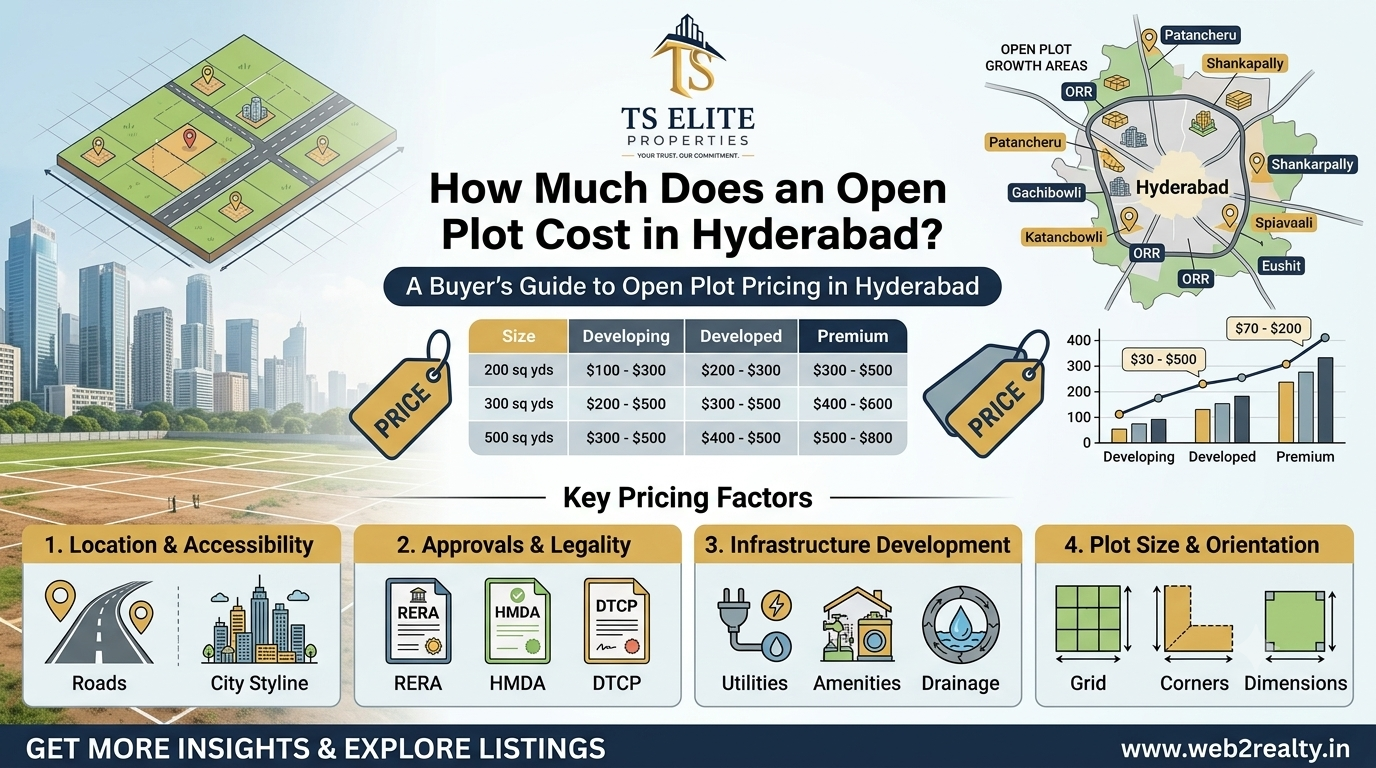
There is no single price for every plot. The open plot price in Hyderabad can change significantly depending on the location, road connectivity, approvals, nearby infrastructure, plot size, development, and future growth potential.

For example, a plot in an established premium locality can cost much more than a plot in an emerging growth corridor. Recent HMDA e-auctions demonstrate this difference clearly. In 2026, residential plots in Mokila recorded bids as high as ₹1.095 lakh per square yard, while another recent HMDA auction recorded average prices of about ₹63,511 per square yard in Mokila and ₹51,991 per square yard in Bachupally. These auction prices should not be treated as universal market rates, but they show how strongly location and demand can influence land values.

So, instead of looking only at the price per square yard, buyers should understand what they are actually paying for.

What Is the Open Plot Price in Hyderabad?

The open plot price in Hyderabad varies from one locality to another. There can be a major difference between plots located in the established parts of the city and those situated in developing suburbs or future growth corridors.

Some areas command higher prices because they already have:

  • Strong road connectivity
  • Employment hubs nearby
  • Established residential communities
  • Schools and hospitals
  • Shopping and commercial facilities
  • Metro or major transport connectivity
  • Better social infrastructure
  • Strong demand for residential properties

Emerging areas may have lower entry prices but can offer opportunities for buyers who are willing to hold the property for several years.

This is why buyers should not simply ask, “What is the price of a plot in Hyderabad?”

A better question is:

“What is the right price for an approved plot in the location I want, considering its current development and future potential?”

Factors That Affect Open Plot Prices in Hyderabad

Several factors influence the price of an open plot. Understanding these factors can help you compare properties more effectively.

1. Location

Location is one of the biggest factors affecting land prices.

Plots closer to established business districts, major roads, IT corridors, educational institutions and commercial areas generally command higher prices.

On the other hand, developing areas may have relatively lower entry prices.

When comparing the open plot price in Hyderabad, look beyond today’s surroundings. Check what is being developed around the location and how easily the area connects to important parts of the city.

2. Road Connectivity

Good connectivity can have a major impact on property demand.

Before buying a plot, check its access to:

  • Major highways
  • ORR
  • Radial roads
  • Airport routes
  • Public transport
  • Nearby towns and employment centres
  • Proposed infrastructure projects

A plot with a good approach road can be more attractive to both homebuyers and future investors.

However, buyers should verify whether the road shown in promotional material actually exists on the approved layout plan.

3. HMDA or DTCP Approval

Approval is an important consideration when buying an open plot.

Buyers should verify whether the layout has valid approval from the relevant planning authority.

HMDA itself states that transactions should not take place in a layout unless there is valid approval from the authority. HMDA also provides information regarding layout permissions and development procedures.

Therefore, don’t choose a plot simply because it has a low price.

A cheaper plot without proper approvals can create legal and development problems later.

Always ask the developer for the approval number and verify the documents independently.

4. RERA Registration

If the plotted development falls under the applicable provisions of RERA, buyers should check the project’s RERA registration details.

RERA registration can provide buyers with additional information about the project and developer.

However, RERA registration and layout approval are not the same thing. Buyers should understand what each approval or registration covers instead of treating one as a substitute for another.

5. Plot Size

The size of the plot naturally affects the total purchase price.

For example, if a plot is priced at ₹10,000 per square yard:

  • 150 sq yd = ₹15 lakh
  • 200 sq yd = ₹20 lakh
  • 300 sq yd = ₹30 lakh
  • 400 sq yd = ₹40 lakh

These are simple examples based only on the quoted plot rate. Actual purchase costs may include registration, taxes, development charges and other applicable expenses.

This is why buyers should calculate the total acquisition cost, rather than looking only at the advertised price per square yard.

6. Infrastructure and Development

Infrastructure can influence both present demand and future appreciation.

When evaluating a plot, check whether the project provides or has access to:

  • Internal roads
  • Drainage
  • Electricity
  • Water supply
  • Street lighting
  • Parks or open spaces
  • Security
  • Boundary arrangements
  • Nearby residential development

A well-planned layout with good infrastructure can be more attractive than an isolated plot offered at a slightly lower price.

7. Current and Future Demand

Property prices are influenced by demand.

Areas experiencing new residential development, employment growth, improved connectivity and infrastructure investment may attract more buyers over time.

For example, HMDA continues to conduct land and plot auctions across different parts of the metropolitan region, including locations such as Mokila, Bachupally and Medipally.

This does not mean every nearby plot will automatically appreciate. Buyers should conduct location-specific research before investing.

How to Estimate Your Plot Budget

One of the easiest ways to understand your budget is to start with the required plot size.

Suppose your target plot is 200 square yards.

If the quoted rate is ₹8,500 per square yard:

200 × ₹8,500 = ₹17,00,000

If the rate is ₹10,000:

200 × ₹10,000 = ₹20,00,000

If the rate is ₹12,500:

200 × ₹12,500 = ₹25,00,000

These examples show why comparing the open plot price in Hyderabad is important before making a decision.

But remember: the plot price is not necessarily your final cost.

You may also need to budget for:

  • Stamp duty
  • Registration charges
  • Applicable taxes
  • Documentation expenses
  • Legal verification
  • Development or maintenance charges
  • Loan-related costs, if applicable

Always ask the seller or developer for a complete cost sheet before booking.

Should You Buy a Low-Priced Plot?

A low price can be attractive, but it should not be the only reason to purchase land.

A very low-priced plot may be located farther from developed areas, have limited connectivity, or require additional development.

Before choosing a low-cost plot, ask:

Why is this plot cheaper than similar plots nearby?

Check:

  1. Layout approval
  2. Title documents
  3. Encumbrance records
  4. Approach road
  5. Land-use status
  6. Development status
  7. Nearby infrastructure
  8. Developer’s track record
  9. RERA registration, where applicable
  10. Future development plans

A slightly higher price for a properly documented and well-connected plot may provide better value than choosing a cheaper property with unclear documentation.

How to Compare Open Plot Prices in Hyderabad

Don’t compare properties only by their advertised price.

Use a simple comparison method.

Step 1: Compare the Price Per Square Yard

Check the quoted rate for each property.

Step 2: Compare Location

Look at the distance from major roads, employment hubs and essential services.

Step 3: Check Approvals

Verify the relevant HMDA, DTCP and other applicable approvals.

Step 4: Check Documentation

Ask for title documents, link documents and encumbrance-related records.

Step 5: Visit the Site

Never depend entirely on brochures, photographs or online advertisements.

Visit the actual location.

Step 6: Check Development

Look at roads, electricity, drainage, water and surrounding development.

Step 7: Calculate Total Cost

Include registration and other applicable charges before comparing two properties.

Step 8: Think About Your Holding Period

Land investment generally works better when buyers have a suitable long-term perspective rather than expecting immediate returns.

Open Plot Price in Hyderabad: Established Areas vs Growth Corridors

Hyderabad’s real estate market includes both established localities and developing growth corridors.

Established areas usually have:

  • Better infrastructure
  • Stronger existing demand
  • More developed neighbourhoods
  • Higher land prices

Growth corridors may offer:

  • Lower entry prices in some locations
  • New infrastructure
  • Expanding residential development
  • Future connectivity improvements
  • Long-term investment opportunities

However, future development should never be treated as a guaranteed increase in property prices.

Buyers should verify proposed infrastructure from reliable sources and assess whether the project is actually progressing.

Why Buying an Approved Open Plot Matters

An open plot is a long-term asset. Therefore, documentation and approvals should be treated as seriously as the price.

Before booking, ask the seller for:

  • Layout approval documents
  • Title deed
  • Previous link documents
  • Encumbrance Certificate
  • Latest ownership documents
  • Property tax details, where applicable
  • RERA details, if applicable
  • Approved layout plan
  • Survey and plot details
  • Sale agreement

It is also advisable to have property documents reviewed by an independent property lawyer.

Do not rely only on verbal assurances such as “clear title,” “government approved,” or “future development nearby.”

Ask for documentary proof.

Is an Open Plot a Good Investment in Hyderabad?

For buyers with a long-term investment horizon, open plots can be an attractive real estate option.

Land has the advantage of being a limited physical asset. If an area develops over time and demand increases, land values may benefit.

However, appreciation is never guaranteed.

The right property depends on:

  • Purchase price
  • Location
  • Documentation
  • Approval status
  • Connectivity
  • Infrastructure
  • Demand
  • Development potential
  • Your investment horizon

Therefore, focus on value rather than simply choosing the cheapest plot.

Tips to Get Better Value When Buying a Plot

Here are some practical tips for buyers:

Set a Clear Budget

Decide your maximum budget before starting your property search.

Compare Multiple Locations

Don’t restrict your search to one locality. Compare nearby growth corridors.

Negotiate Carefully

Ask whether there are discounts for upfront payments or specific payment plans.

Visit During Different Times

Visit the location during daytime and, if possible, at different times to understand traffic and surroundings.

Check the Approach Road

A good plot should have legally accessible road connectivity.

Verify Documents

Never skip legal verification to save time or money.

Avoid Pressure Buying

Don’t book a plot just because a salesperson says that the price will increase tomorrow.

Take time to verify the property.

Frequently Asked Questions

1. What is the open plot price in Hyderabad?

There is no single open plot price in Hyderabad. Prices vary widely depending on location, connectivity, approvals, plot size, infrastructure and demand. Premium locations can command substantially higher prices than developing areas.

2. What is the price of a 200 square yard plot in Hyderabad?

The price depends on the location and rate per square yard. For example, at ₹10,000 per square yard, a 200 sq yd plot would cost ₹20 lakh before applicable registration and other charges.

3. Which factors affect open plot prices in Hyderabad?

Location, road connectivity, HMDA or DTCP approval, RERA registration where applicable, infrastructure, plot size, surrounding development and market demand can all influence the price.

4. Is it better to buy an HMDA-approved plot?

An approved layout can provide greater confidence regarding planning compliance, but buyers should still independently verify title, ownership, encumbrances and other documents.

5. Should I buy a plot in a developing area?

A developing area may offer a lower entry price and potential for long-term growth. However, buyers should carefully research infrastructure, connectivity, approvals and actual development before investing.

6. How can I verify a plot before buying?

Ask for the approval documents, title deed, link documents, encumbrance records, approved layout plan and other relevant property documents. Independent legal verification is strongly recommended.

7. Is the cheapest plot always the best option?

No. A low price does not necessarily mean better value. Consider location, approvals, title, connectivity, infrastructure and future demand before making a decision.

8. What plot size is suitable for a family home?

The ideal size depends on your construction plans, budget and applicable building rules. Common plot sizes can range from compact plots to larger 200, 300 or 400 sq yd plots.

Final Thoughts

Understanding the open plot price in Hyderabad is only the first step toward making a good land investment decision.

Instead of asking only “How much is the plot?”, consider the complete picture: Where is it located? Is the layout approved? Is the title clear? What infrastructure is available? How accessible is the property? What is developing around it?

A plot with a reasonable price, proper documentation, good connectivity and suitable development potential can provide better value than a property selected only because it is cheap.

Before making a final decision, compare multiple properties, visit the sites, verify the documents and understand the complete purchase cost.

Looking for quality open plots in Hyderabad?

Explore suitable plotted developments based on your budget, preferred location and investment goals. At Web2Realty, we focus on helping buyers explore open-plot opportunities with greater clarity and confidence.

Contact us today to discuss available open plots, pricing, locations and site-visit options. Make your land investment decision with proper information not guesswork.
Related Post

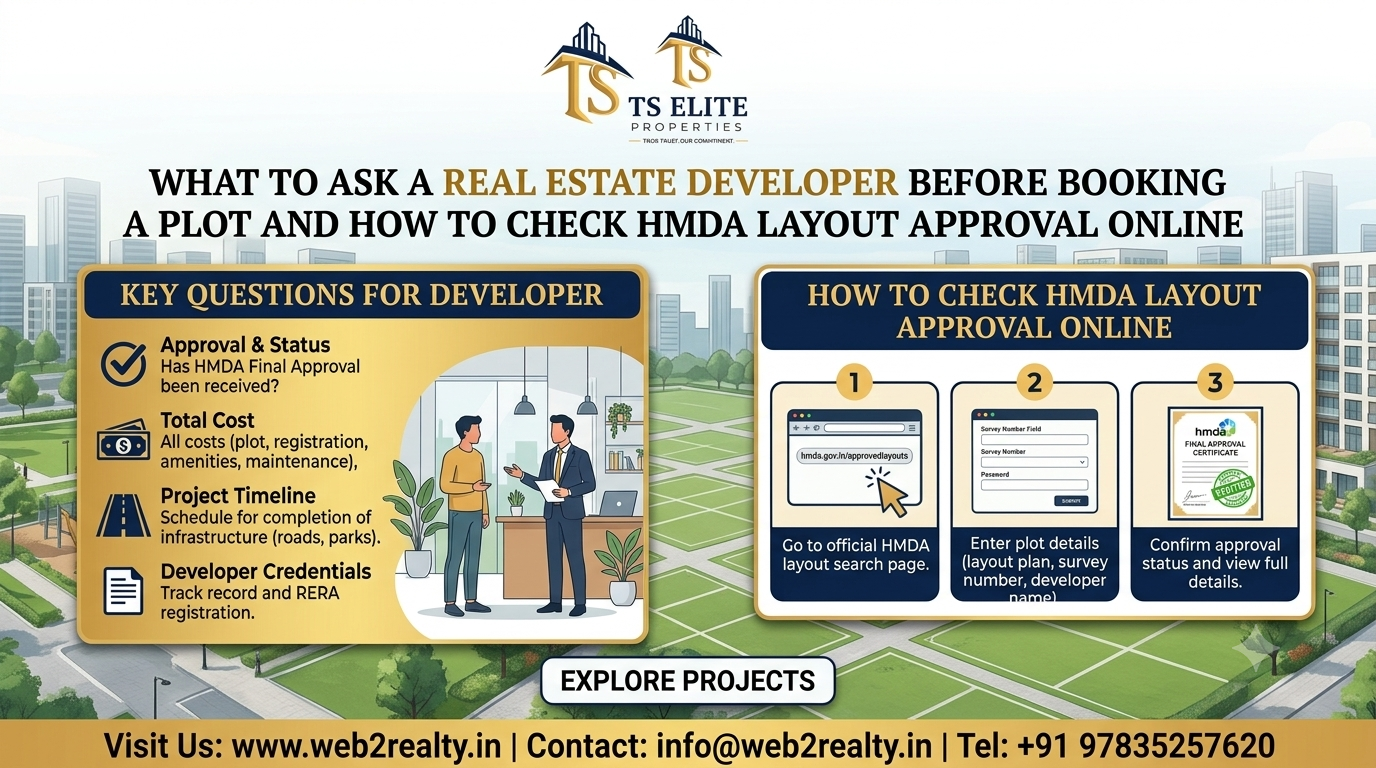
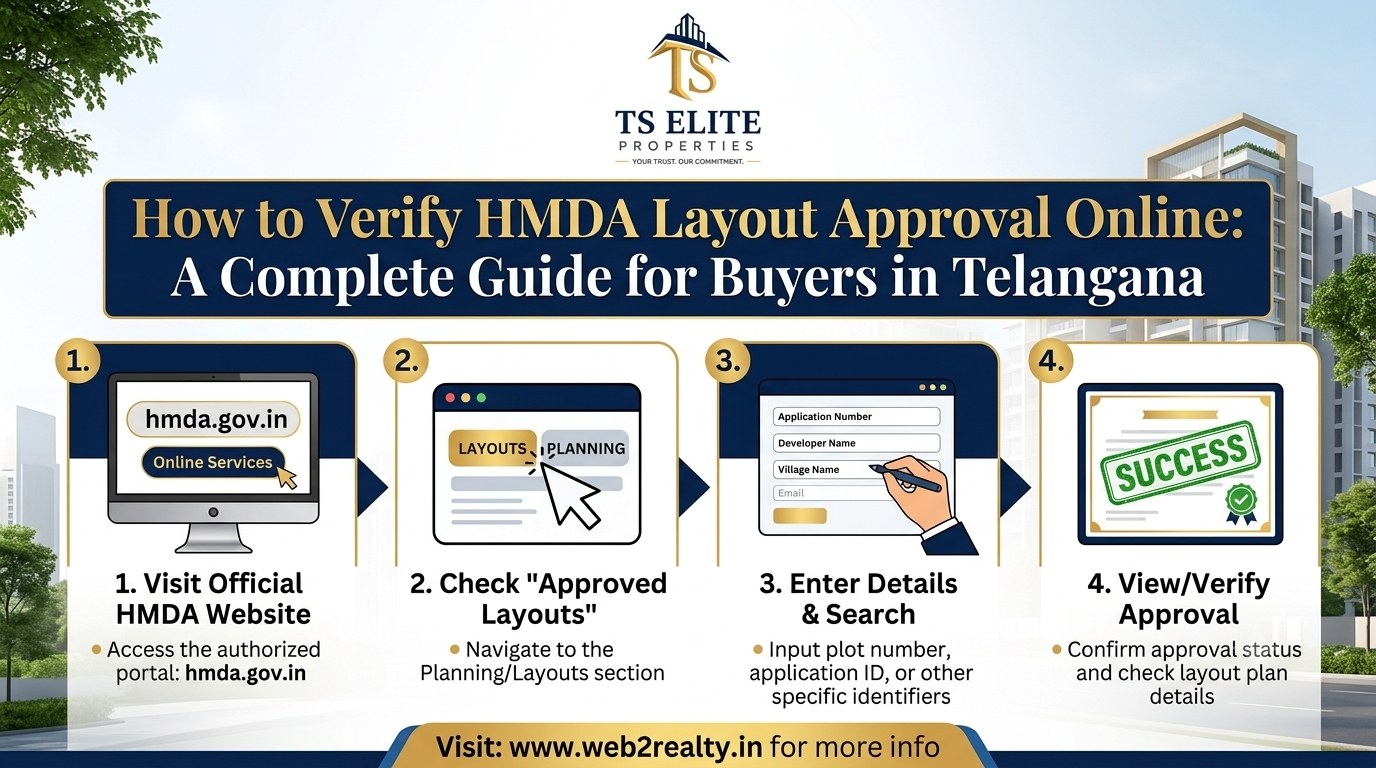
What to Ask a Real Estate Developer Before Booking a Plot and How to Check HMDA Layout Approval Online

HMDA layout approval online before buying land in Telangana

What to Ask a Real Estate Developer Before Booking a Plot and How to Check HMDA Layout Approval Online

Buying a plot is a major financial decision. Whether you are planning to build a home or looking at land as a long-term investment, checking the project carefully before paying a booking amount is important.

Many buyers focus mainly on the plot price, location and payment plans. However, these are only part of the decision. You should also understand the developer’s documentation, layout approval, ownership details, development status, road access and registration process.

If you are considering HMDA plots in Telangana, one of the most important checks is verifying whether the layout approval claimed by the developer can be confirmed through official records.

HMDA provides online systems for development permissions and public searches. Its public search facility allows users to search using details such as file number, applicant name, district, mandal, village, survey number, plot number and permit number. (DPMS)

This guide explains what to ask a real estate developer before booking a plot and how to perform an online HMDA layout approval check.

Why You Should Verify a Plot Before Booking

A property advertisement may highlight attractive features such as:

  • HMDA approved
  • DTCP approved
  • Clear title
  • Bank loan available
  • Excellent connectivity
  • Near upcoming developments
  • Ready for registration
  • Limited plots available

However, buyers should not rely only on advertisements or verbal promises.

Before booking, ask the developer to provide the relevant documents and approval details. Then independently verify important information.

For HMDA plots in Telangana, the approval details should match the actual project, location, survey numbers and layout being offered to you.

A small amount of verification before booking can help you avoid problems later.

What to Ask a Real Estate Developer Before Booking a Plot

1. What Is the HMDA Layout Approval Number?

This should be one of your first questions.

Ask the developer:

“Please provide the HMDA layout approval number and a copy of the approval proceedings.”

Do not be satisfied with a statement such as “This is an HMDA-approved project.”

Ask for the actual reference number and documentation so that you can verify it independently.

The HMDA website provides a public search facility where different project and property details can be searched. (DPMS)

2. What Are the Survey Numbers?

Ask for the exact survey numbers included in the layout.

This is important because a developer may market a project under a particular venture name, while official records identify the property using survey numbers, village and mandal information.

Compare:

  • Survey number
  • Village
  • Mandal
  • District
  • Total land extent
  • Layout plan
  • Plot numbers

These details should be consistent across the documents.

3. Can I See the Approved Layout Plan?

Always ask to see the sanctioned layout plan.

Do not only look at the brochure.

Check whether the plot being offered appears on the approved plan and whether its:

  • Plot number
  • Dimensions
  • Road width
  • Location
  • Facing
  • Open spaces
  • Parks
  • Utility areas

match the information provided by the developer.

An approved layout plan can provide much more useful information than a marketing brochure.

4. Is the Specific Plot Available for Sale?

Ask the developer to confirm that the particular plot you are booking is actually available for sale.

You should know:

  • Plot number
  • Plot area
  • Plot dimensions
  • Facing
  • Road width
  • Corner status
  • Current ownership
  • Whether it is mortgaged or restricted
  • Whether it is earmarked for any other purpose

Do not assume that every plot shown on a layout plan is automatically available for sale.

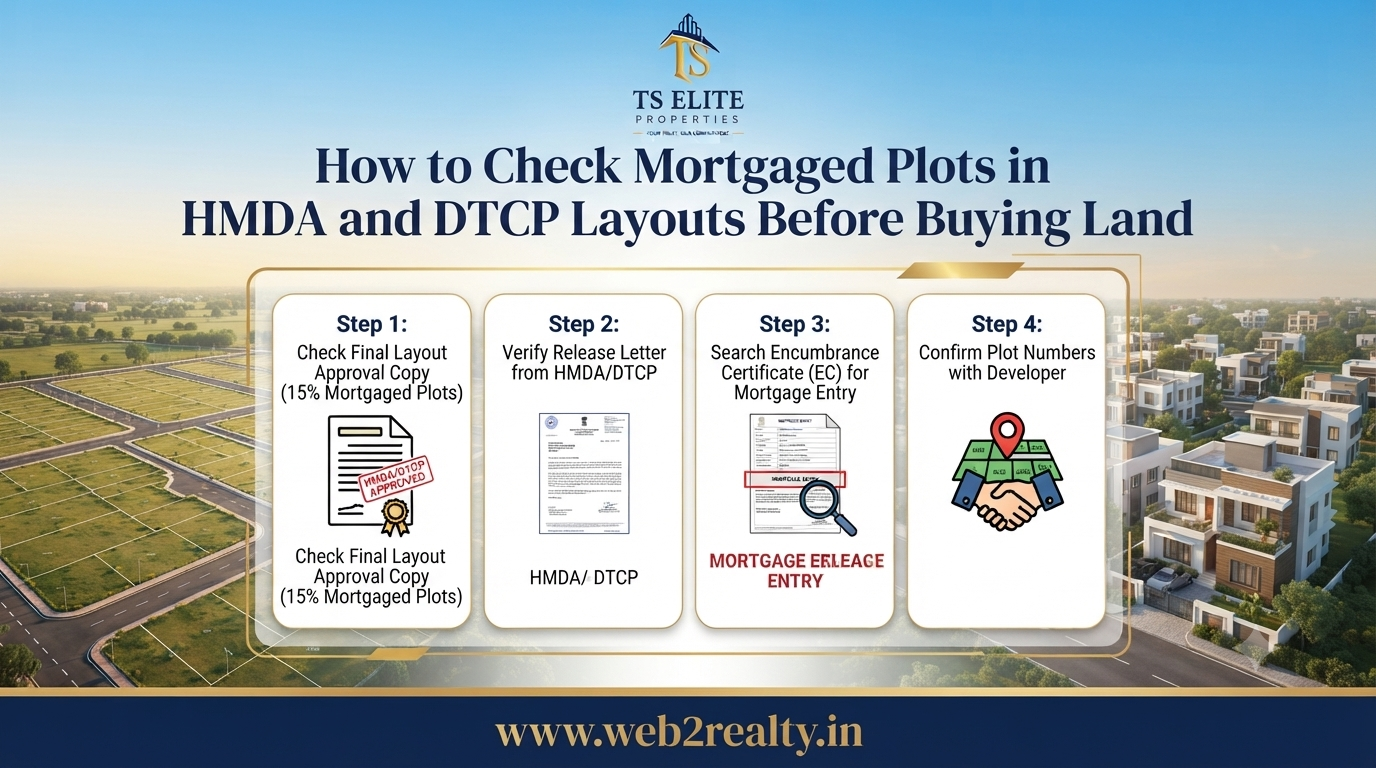
5. Is the Plot Part of a Mortgage?

This is an important question that buyers sometimes overlook.

Ask:

“Is this particular plot mortgaged to HMDA, a bank or any other institution?”

Also ask for documentation showing whether the plot is free from such restrictions.

HMDA’s FAQ explains that its layout approval system can involve mortgaging a portion of the plotted area as security for completing layout development works. (HMDA)

Therefore, buyers should not simply assume that an “approved layout” means every individual plot is immediately free from every restriction.

6. Who Owns the Land?

Ask for the ownership documents and verify the seller’s legal right to sell the property.

Depending on the property and transaction, relevant documents may include:

  • Title deed
  • Sale deed
  • Link documents
  • Partition deed, if applicable
  • Gift deed, where applicable
  • Encumbrance Certificate
  • Revenue records
  • Development agreement, where applicable
  • Power of Attorney, where applicable

For a significant investment, consider having the documents examined by an independent property lawyer.

7. Can I Get the Encumbrance Certificate?

Ask for the latest Encumbrance Certificate (EC) or relevant registration records.

An EC can help identify registered transactions and certain recorded encumbrances associated with the property.

However, an EC should not be treated as the only title check.

A proper legal due-diligence process should consider the complete chain of ownership and other relevant records.

8. What Development Works Are Completed?

Ask the developer to clearly explain the current development status.

For example:

  • Internal roads
  • Drainage
  • Electricity
  • Water facilities
  • Street lighting
  • Avenue plantation
  • Parks
  • Open spaces
  • Other promised infrastructure

Also ask for the expected completion timeline for unfinished works.

Whenever possible, visit the project personally instead of relying only on photographs and videos.

9. What Is the Exact Cost of the Plot?

Ask for a complete cost sheet.

The quoted price per square yard may not always represent the final amount payable.

Ask whether the price includes or excludes:

  • Plot cost
  • Development charges
  • Maintenance charges
  • Registration-related expenses
  • Documentation charges
  • GST, where applicable
  • Other applicable fees

Getting the complete cost in writing makes comparison easier.

10. What Is the Registration Process?

Ask the developer:

“When can the sale deed be registered?”

Also clarify:

  • Where registration will take place
  • Who will execute the sale deed
  • Whether the seller’s title documents are ready
  • Whether the plot is currently eligible for registration
  • What documents you need to provide
  • Who will coordinate the registration process

Do not make a substantial payment without understanding the registration process.

11. Is Bank Finance Available?

If you plan to use a loan, ask which banks or financial institutions have considered the project eligible for financing.

However, remember that bank financing should not replace your own legal verification.

Ask the developer for written information rather than relying only on verbal statements such as “all major banks are providing loans.”

How to Check HMDA Layout Approval Online

One of the most useful steps when researching HMDA plots in Telangana is checking the project through HMDA’s online systems.

HMDA currently states that new building and layout permission applications within the relevant jurisdiction are processed through TG-bPASS, while its website also provides access to DPMS information and public search facilities. (HMDA)

Step 1: Collect Project Details

Before searching online, obtain the following from the developer:

  • HMDA file number
  • Permit number
  • Survey number
  • District
  • Mandal
  • Village
  • Project/layout name
  • Applicant/developer name
  • Plot number

The more information you have, the easier it is to cross-check the project.

Step 2: Open the Official HMDA Website

Start from the official Hyderabad Metropolitan Development Authority (HMDA) website rather than relying on links supplied only through advertisements.

HMDA Official Website

HMDA’s website provides information about planning, development permissions and other online services. (HMDA)

Step 3: Use the Public Search Facility

HMDA’s public search page provides several search fields, including:

  • File/Temporary Number
  • Applicant Name
  • Architect/LE/SE
  • Project Type
  • District
  • Mandal
  • Village
  • Survey Number
  • Plot/Door Number
  • Permit Number
  • Date range

(DPMS)

HMDA DPMS Public Search

If you have the file number or permit number, start with that information.

If you do not have it, try searching using the survey number, village or other available project details.

Step 4: Compare the Online Information With the Developer’s Documents

This is one of the most important parts.

Do not stop after finding a similar-looking project.

Compare the official information with:

Developer’s documents → HMDA records → Approved layout plan → Site

Look for consistency in:

  • Survey numbers
  • Village
  • Mandal
  • Project details
  • Applicant/developer
  • Permit or file number
  • Plot details
  • Layout extent

If the information does not match, ask the developer for clarification before making a payment.

Step 5: Check Whether the Approval Is Relevant to Your Plot

A project having an approval reference does not mean you should automatically assume that every plot has identical status.

Check the approved layout plan and identify the exact plot.

Pay attention to:

  • Plot number
  • Road location
  • Open spaces
  • Parks
  • Utility areas
  • Mortgage/restricted portions
  • Layout boundaries

HMDA’s own FAQ notes that its approval framework can involve mortgaged portions of plotted layouts as security for development works. (HMDA)

What If You Cannot Find the Project Online?

Do not immediately assume that the project is fraudulent.

There can be differences in older records, application systems, project details or search information.

Instead:

  1. Ask the developer for the official approval document.
  2. Verify the file/permit number.
  3. Check survey numbers.
  4. Compare the village and mandal.
  5. Ask for clarification about the approval status.
  6. Seek professional legal or planning advice if necessary.

HMDA maintains information for different types of permissions and older developed layouts, so the exact route for verification can depend on the age and type of the project. (HMDA)

Common Red Flags to Watch For

Be careful if a developer:

Refuses to show approval documents

A genuine buyer should be able to ask for basic project documentation.

Pressures you to book immediately

Statements such as “pay today or the price will increase tonight” should not replace proper verification.

Gives only a brochure

Marketing material is not a substitute for official approval documents.

Avoids giving survey numbers

Survey numbers are important for identifying the underlying land.

Gives inconsistent information

If the brochure, approval document and site details do not match, ask questions before proceeding.

Promises guaranteed returns

Future property prices cannot be guaranteed. Investment decisions should be based on your own research and financial situation.

Says “HMDA approved” without providing details

Ask for the actual approval reference and verify it independently.

Simple Buyer Checklist Before Booking

Before paying a booking amount for HMDA plots in Telangana, check these points:

  • HMDA approval details obtained
  • Survey numbers verified
  • Approved layout plan reviewed
  • Plot number confirmed
  • Plot dimensions checked
  • Road width checked
  • Ownership documents reviewed
  • Encumbrance information checked
  • Mortgage/restriction status clarified
  • Development status inspected
  • Complete cost sheet received
  • Registration process understood
  • Payment terms received in writing
  • Legal verification completed where necessary

Final Thoughts

Buying a plot should not be based only on a good location or attractive price. Proper verification is an important part of the buying process.

If you are researching HMDA plots in Telangana, start by asking the developer for the approval number, survey numbers, sanctioned layout plan and ownership documents. Then independently compare these details with official HMDA records.

HMDA provides online public search facilities that can be used to search development-permission information using details such as file number, survey number, village and permit number. (DPMS)

Most importantly, remember that HMDA approval verification and legal title verification are not the same thing. Check both before making a major financial commitment.

A careful buyer does not simply ask, “Is this plot HMDA approved?”

A careful buyer asks:

“Can I verify the approval, ownership, layout, plot number and registration details before I book?”

That approach can help you make a more informed property decision.

Ready to Explore HMDA Plots in Telangana?

Looking for open plots in Hyderabad and surrounding growth corridors? Before booking your next plot, compare the location, approvals, documentation, connectivity, development status and total cost.

At Web2Realty, we focus on helping buyers understand property details clearly so they can research their options with greater confidence.

Explore available properties, check the project details and schedule a site visit before making your decision.

Your Trust. Our Commitment.

Frequently Asked Questions

1. What should I ask a developer before booking a plot?

Ask for the HMDA approval details, survey numbers, sanctioned layout plan, ownership documents, EC, plot number, development status, complete cost sheet, registration details and mortgage status.

2. How can I check HMDA plots in Telangana online?

You can use the official HMDA public search facility. It provides search fields including file number, district, mandal, village, survey number, plot/door number and permit number. (DPMS)

3. Is HMDA approval enough to buy a plot?

HMDA layout approval is an important planning check, but buyers should also conduct independent title and document verification. Approval and ownership/title verification address different issues.

4. What is an HMDA approval number?

It is a reference associated with the relevant development/layout permission record. Ask the developer for the official reference and supporting approval documents so you can cross-check them.

5. Should I check the survey number before buying?

Yes. The survey number helps connect the marketed project with the underlying land records and approval information.

6. Can an approved layout contain mortgaged plots?

Layout approval arrangements can include mortgaged portions as security for development obligations. Therefore, buyers should specifically ask about the status of the individual plot they intend to purchase. (HMDA)

7. Should I visit the site before booking?

Yes. A site visit can help you compare the actual location, roads, surroundings and development with the approved layout and the developer’s claims.

8. Should I consult a property lawyer?

For a significant land purchase, independent legal review can be useful, particularly for checking title history, ownership, encumbrances and transaction documents.

9. Where can I find official HMDA information?

Start with the official HMDA website and its online planning/public-search services. (HMDA)

10. What is the biggest mistake buyers make?

One common mistake is relying entirely on the developer’s brochure or verbal assurances without independently checking approval, title and plot-specific information.

Related Post

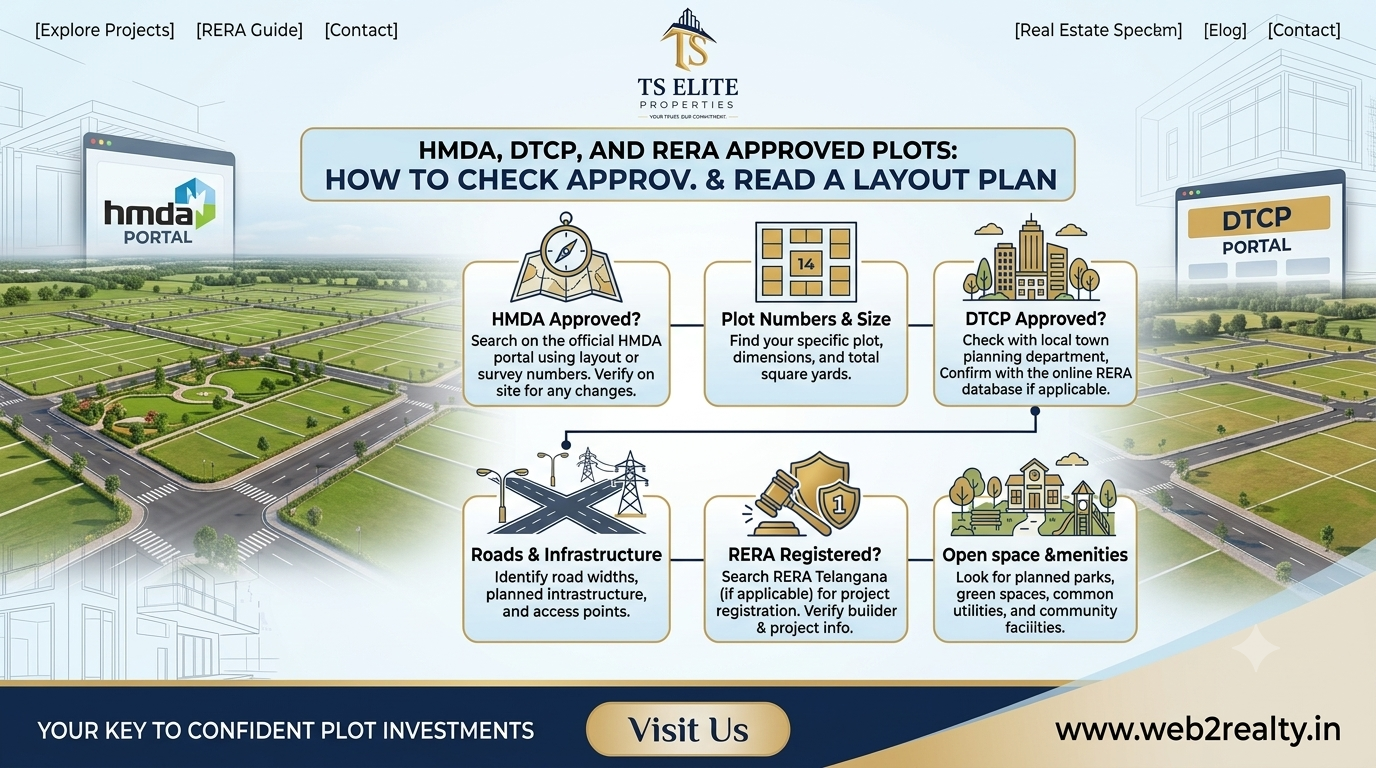
HMDA, DTCP and RERA Approved Plots: How to Check Approvals and Read a Layout Plan

HMDA, DTCP and RERA approvals and documents

HMDA, DTCP and RERA Approved Plots: How to Check Approvals and Read a Layout Plan

Buying a plot is an important financial decision. Location, price and future development are certainly important, but property approvals and documents deserve equal attention.

If you are searching for HMDA, DTCP, RERA approved plots in Hyderabad or Telangana, you may come across several different approval terms in property advertisements. Understanding what these terms mean can help you ask the right questions before purchasing land.

HMDA, DTCP and RERA do not serve exactly the same purpose. Planning authorities deal with development and layout permissions, while RERA focuses on regulating eligible real estate projects and improving transparency for buyers.

Another important document is the sanctioned layout plan. It shows how the land has been divided into plots, roads, open spaces and other designated areas.

This guide explains the basic difference between HMDA, DTCP and RERA and shows you what to look for when examining a layout plan.

Why Property Approvals Matter When Buying a Plot

A property advertisement may describe a project as approved, premium or investment-ready. However, buyers should verify the underlying documents rather than depending only on promotional material.

Proper verification can help you understand:

  • Whether the layout has received the required planning permission
  • Which authority approved the development
  • Whether your particular plot appears in the sanctioned plan
  • Whether the survey numbers match
  • Whether the road shown in the plan exists at the site
  • Whether the project has applicable RERA registration
  • Whether there are mortgage or release conditions
  • Whether the property documents support the seller’s claim

This is why document verification should happen before making a major payment.

What Is HMDA Approval?

HMDA stands for Hyderabad Metropolitan Development Authority.

It is the metropolitan planning authority for its notified area around Hyderabad. Depending on the location and type of development, HMDA deals with development permissions and layout-related approvals.

For a plotted development, the approved layout can provide important information about the proposed arrangement of the site.

It may show:

  • Plot numbers
  • Survey numbers
  • Internal roads
  • Road widths
  • Open spaces
  • Parks
  • Utility areas
  • Layout boundaries
  • Other designated portions of the development

If a project is advertised as an HMDA approved layout, ask the developer or seller to provide the actual approval reference and sanctioned drawing.

Do not consider a marketing brochure as a substitute for the official approval document.

What Is DTCP Approval?

DTCP means the Directorate of Town and Country Planning.

DTCP deals with planning and development matters in areas falling under its applicable jurisdiction.

A DTCP-approved layout is therefore different from an HMDA-approved layout mainly because the competent planning authority depends on the property’s location and applicable planning framework.

If you are considering HMDA, DTCP, RERA approved plots, first identify which planning authority is responsible for that particular property.

Ask for:

  • Approval number
  • Approval date
  • Survey numbers
  • Sanctioned layout drawing
  • Applicant or developer details
  • Conditions attached to the approval

The key is to verify the actual approval instead of relying on a statement such as “DTCP approved” in an advertisement.

What Does RERA Mean for Plot Buyers?

RERA refers to the Real Estate (Regulation and Development) Act, 2016.

RERA was introduced to improve transparency and accountability in the real estate sector. In Telangana, projects covered by the applicable provisions are registered with the Telangana Real Estate Regulatory Authority (TGRERA).

RERA information can help buyers review project-related details and disclosures.

Depending on the project, the information available can include:

  • Promoter details
  • Project information
  • Approved or sanctioned plans
  • Development details
  • Number of plots
  • Project status
  • Completion-related information
  • Other required disclosures

However, one important point should be remembered:

RERA registration is not the same as layout approval.

Similarly, a planning approval should not be treated as a replacement for checking the property’s ownership and title documents.

Each verification serves a different purpose.

HMDA, DTCP and RERA: Understanding the Difference

A simple way to understand these terms is:

HMDA

Deals with planning and development permissions within its applicable metropolitan jurisdiction.

DTCP

Deals with town and country planning and development permissions within its applicable jurisdiction.

RERA

Regulates covered real estate projects and provides a framework for registration, disclosures and buyer protections.

Therefore, when you see the phrase HMDA, DTCP, RERA approved plots, do not assume that the three terms represent one single approval.

They relate to different aspects of a real estate project.

What Is a Sanctioned Layout Plan?

A sanctioned layout plan is an approved drawing showing how a particular parcel of land is planned to be developed.

For a plot buyer, it is one of the most useful documents to examine.

A layout plan can help you understand where your plot is located in relation to:

  • Roads
  • Other plots
  • Parks
  • Open spaces
  • Utility areas
  • Layout boundaries
  • Access points
  • Other designated areas

The plan can also help you compare what was approved with what the developer is offering.

How to Read a Sanctioned Layout Plan

You do not need advanced technical knowledge to perform a basic review.

Start with the following points.

1. Locate the Approval Details

First, identify the approval information printed on the sanctioned plan.

Look for details such as:

  • Authority name
  • Approval number
  • File or proceeding number
  • Date
  • Project or layout name

Keep these details with your property documents so they can be independently verified.

2. Check the Survey Numbers

Survey numbers are extremely important in land transactions.

Compare the survey numbers shown in the layout approval with those mentioned in:

  • Sale documents
  • Link documents
  • Title documents
  • Property records
  • RERA project information, where applicable

If the survey numbers do not match, stop and seek clarification before proceeding.

A small difference in a survey number can represent a completely different parcel of land.

3. Find Your Exact Plot Number

Once you have the layout plan, locate the plot you intend to purchase.

Suppose you are being offered Plot No. 145.

Find Plot No. 145 on the sanctioned drawing and check:

  • Its location
  • Dimensions
  • Area
  • Road frontage
  • Adjacent plots
  • Nearby open spaces
  • Direction

Never assume that the plot shown in a sales brochure is identical to the approved plot without comparing the documents.

4. Verify the Plot Size

The advertised plot area should be compared with the approved plan and sale documents.

For example, if a plot is advertised as 200 square yards, check whether its dimensions and calculated area reasonably correspond to that figure.

Remember:

1 square yard = 9 square feet

Therefore:

200 square yards = 1,800 square feet

Basic calculations can help identify obvious differences between the advertised property and the documents.

5. Examine the Road Width

Roads are an important part of any plotted development.

Look carefully at the road shown in front of your plot.

The plan may identify different road widths, such as:

  • 30 feet
  • 40 feet
  • 60 feet
  • Other approved dimensions

Compare the approved road width with the road visible at the property.

If a brochure promises a wider road but the sanctioned plan shows something different, ask for clarification.

6. Identify Parks and Open Spaces

Look at the portions of the layout marked as:

  • Parks
  • Open spaces
  • Recreational areas
  • Utility areas
  • Social infrastructure areas

This can help you understand how the total land area is being distributed.

If a salesperson tells you that your plot is next to a permanent park, check the sanctioned plan to see what is actually designated in that location.

Do not rely only on verbal assurances.

7. Check for Mortgage or Restricted Plots

Some approved layouts may contain plots or portions of land that are subject to mortgage arrangements or other development conditions.

This is an important point for buyers.

Before purchasing, ask:

“Is this particular plot free from any mortgage or development-related restriction?”

If the answer is no, request the relevant release documentation and have it reviewed before proceeding.

8. Check the Direction of the Plot

Look for the north direction on the layout drawing.

This helps you understand the orientation of the property.

You can then determine whether the plot faces:

  • North
  • South
  • East
  • West
  • A particular road or corner

If plot direction matters to you, verify it using the sanctioned drawing rather than relying on a salesperson’s description.

9. Check Access to the Plot

A plot should have proper access according to the approved layout.

Study the roads connecting your plot to the main entrance.

Ask yourself:

  • Which road leads to the plot?
  • What is the approved road width?
  • Is the road physically developed?
  • Does the site match the approved drawing?
  • Is the access currently usable?

A site visit is particularly useful at this stage.

Compare the Sanctioned Plan With the Actual Property

Documents tell you what has been approved.

A site visit shows you what exists on the ground.

Both are important.

During your site visit, compare:

Approved Layout vs Actual Site

Check the following:

What to Check

What to Compare

Plot number

Plan vs site

Plot size

Documents vs physical measurements

Road

Approved width vs existing road

Open space

Plan vs actual location

Boundaries

Approved drawing vs site

Access

Approved route vs actual access

Surrounding development

Plan vs current situation

If something appears different, ask the developer for an explanation and supporting documents.

Approval Does Not Mean You Can Skip Title Verification

This is one of the most important points for anyone buying land.

An approved layout does not remove the need to verify the property’s legal title.

Before purchasing, consider checking:

  • Current owner’s title
  • Previous link documents
  • Sale deeds
  • Encumbrance Certificate
  • Survey details
  • Land records
  • Applicable land-use or conversion permissions
  • Existing mortgages
  • Litigation or claims, where applicable

It is also advisable to have the documents examined by an independent property lawyer before making a substantial financial commitment.

HMDA, DTCP and RERA Approved Plots: A Practical Buyer Checklist

Before buying a plot, keep this checklist handy.

Planning Approval

☐ Identify the competent planning authority
☐ Obtain the approval number
☐ Verify the approval details
☐ Obtain the sanctioned layout plan
☐ Check the approval status

Plot Details

☐ Confirm plot number
☐ Confirm survey number
☐ Check plot dimensions
☐ Check plot area
☐ Verify road width
☐ Check plot location
☐ Check orientation
☐ Verify mortgage/release status

Legal Documents

☐ Check ownership documents
☐ Review link documents
☐ Obtain and review the Encumbrance Certificate
☐ Check applicable land records
☐ Look for legal claims or disputes
☐ Obtain professional legal advice where necessary

RERA

☐ Check whether RERA registration applies
☐ Verify the project’s registration details
☐ Compare project information with the layout
☐ Review available project disclosures

Common Mistakes Plot Buyers Should Avoid

Mistake 1: Trusting the Advertisement

An advertisement is a marketing tool. Always verify the underlying documents.

Mistake 2: Checking Only the Layout Approval

Layout approval is important, but title and ownership verification are also necessary.

Mistake 3: Ignoring the Survey Number

Your plot should be connected to the correct land parcel. Always compare survey numbers.

Mistake 4: Buying Before Checking the Sanctioned Plan

The brochure may not show the complete approved layout. Ask for the sanctioned drawing.

Mistake 5: Assuming RERA Means Everything Is Verified

RERA registration provides project-related regulatory information, but buyers should still conduct their own legal and property due diligence.

Mistake 6: Skipping the Site Visit

Always compare the approved layout with the actual ground situation.

Why Document Verification Matters for Open Plot Buyers

A good location may attract you to a property, but proper documentation gives you the information needed to make a responsible purchase decision.

When comparing HMDA, DTCP, RERA approved plots, look at the complete picture:

Planning approval + sanctioned layout + plot details + title documents + encumbrance status + applicable RERA information + physical site

No single document should be considered sufficient by itself.

Final Word

Buying an open plot requires more than checking the price per square yard.

Before choosing a property, understand which authority has approved the layout and examine the sanctioned plan carefully.

If you are considering HMDA, DTCP, RERA approved plots, verify the approval details, survey numbers, plot number, dimensions, road width and development conditions. At the same time, review the property’s title and other legal documents.

Most importantly, compare the paperwork with the actual property during a site visit.

A careful verification process can help you understand exactly what you are buying and reduce the possibility of unpleasant surprises later.

Frequently Asked Questions

1. What are HMDA, DTCP and RERA?

HMDA and DTCP are planning authorities involved in development and layout permissions within their respective jurisdictions. RERA is a regulatory framework for covered real estate projects that requires registration and specified disclosures.

2. Are HMDA and DTCP approvals the same?

No. They are associated with different planning authorities and jurisdictions. The applicable authority depends on the property’s location and planning framework.

3. What should I check in an approved layout plan?

Check the approval number, survey numbers, plot number, dimensions, plot area, road widths, open spaces, parks, access roads and any applicable mortgage or development conditions.

4. Does RERA registration replace layout approval?

No. RERA registration and planning approval serve different purposes. Buyers should verify both where applicable.

5. How can I check whether my plot is shown in the approved layout?

Locate the exact plot number on the sanctioned layout and compare its survey number, dimensions, area and location with your property documents.

6. Why are survey numbers important?

Survey numbers identify the underlying land parcel. A mismatch between the survey number in the approval documents and your sale documents should be investigated before purchasing.

7. Should I verify the property title even if the layout is approved?

Yes. Layout approval should not be treated as a substitute for title verification. Ownership, link documents and encumbrances should also be checked.

8. Should I visit the property before buying?

Yes. A site visit allows you to compare the sanctioned layout with the actual location, roads, boundaries and surrounding development.

Looking for HMDA, DTCP and RERA Approved Plots?

If you are planning to buy an open plot in Hyderabad or nearby growth corridors, take time to understand the approval status, layout plan, documentation and location before making your decision.

Explore available properties with Web2Realty and get assistance with property details, documentation and site visits.

Your Trust. Our Commitment.

Related Post

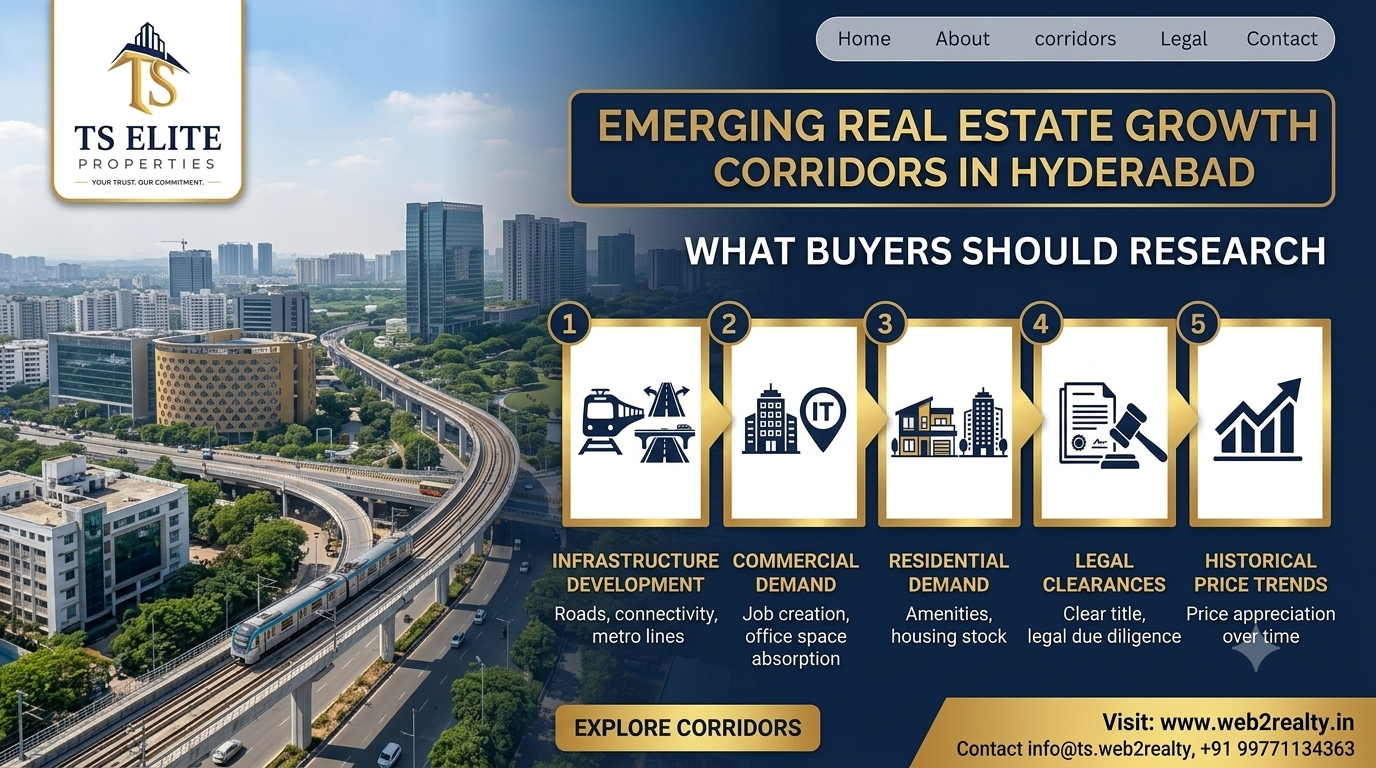
Emerging Real Estate Growth Corridors in Hyderabad: What Buyers Should Research

Land to invest in Hyderabad emerging real estate growth corridors

Emerging Real Estate Growth Corridors in Hyderabad: What Buyers Should Research

Hyderabad has become one of the most closely watched real estate markets in India. The city is expanding beyond its traditional residential and commercial areas, creating new opportunities for homebuyers, investors, and land buyers.

As the city grows, several locations around Hyderabad are attracting attention because of improving infrastructure, better connectivity, employment opportunities, and planned development. For people searching for land to invest in Hyderabad, understanding these emerging growth corridors can help them research locations more carefully before making a purchase.

However, buying land is a long-term financial decision. A location that looks promising today may not necessarily deliver the expected returns tomorrow. Buyers should therefore look beyond advertisements and study approvals, connectivity, infrastructure plans, surrounding development, and the legal status of the property.

This guide explains what buyers should research when looking for land to invest in Hyderabad and how to evaluate emerging growth corridors.

Why Hyderabad’s Real Estate Market Is Expanding

Hyderabad has experienced significant development over the past several years. IT and technology companies, pharmaceutical and life-sciences businesses, educational institutions, residential communities, and infrastructure projects have contributed to the city’s expansion.

As established areas become more developed, new residential and investment corridors are emerging around the city.

This expansion creates different opportunities for buyers. Some people look for apartments close to employment hubs, while others prefer villas or independent houses. Investors interested in land may look for plots in developing areas where infrastructure and surrounding development are expected to improve over time.

For anyone searching for land to invest in Hyderabad, the important question is not simply:

“Which location will increase in price?”

Instead, buyers should ask:

“What evidence shows that this location has the potential for sustainable development?”

That approach encourages proper research instead of relying only on future-return promises.

What Is a Real Estate Growth Corridor?

A real estate growth corridor is an area where development is expanding because of factors such as:

  • New roads and transportation infrastructure
  • Employment and industrial development
  • New residential communities
  • Commercial activity
  • Educational institutions
  • Government infrastructure projects
  • Improved connectivity to established parts of the city
  • Availability of land for future development

Growth corridors can attract developers and buyers because land is often more accessible than in highly developed central locations.

However, development can happen at different speeds. Therefore, buyers should examine actual infrastructure and development indicators rather than assuming that every announced project will immediately increase land values.

Emerging Areas Buyers Can Research Around Hyderabad

Hyderabad’s growth is taking place across multiple directions. Buyers researching land to invest in Hyderabad can study locations based on connectivity, infrastructure, employment opportunities, and development activity.

1. South Hyderabad

South Hyderabad has received considerable attention because of its proximity to major infrastructure and developing employment zones.

Areas around the southern side of Hyderabad can be researched for their connectivity to major roads, existing residential areas, and planned development.

Buyers should study:

  • Road connectivity
  • Existing residential projects
  • Nearby employment centers
  • Proposed infrastructure
  • Availability of approved layouts
  • Distance from major highways

Instead of focusing only on today’s land price, buyers should consider how the surrounding area could develop over the long term.

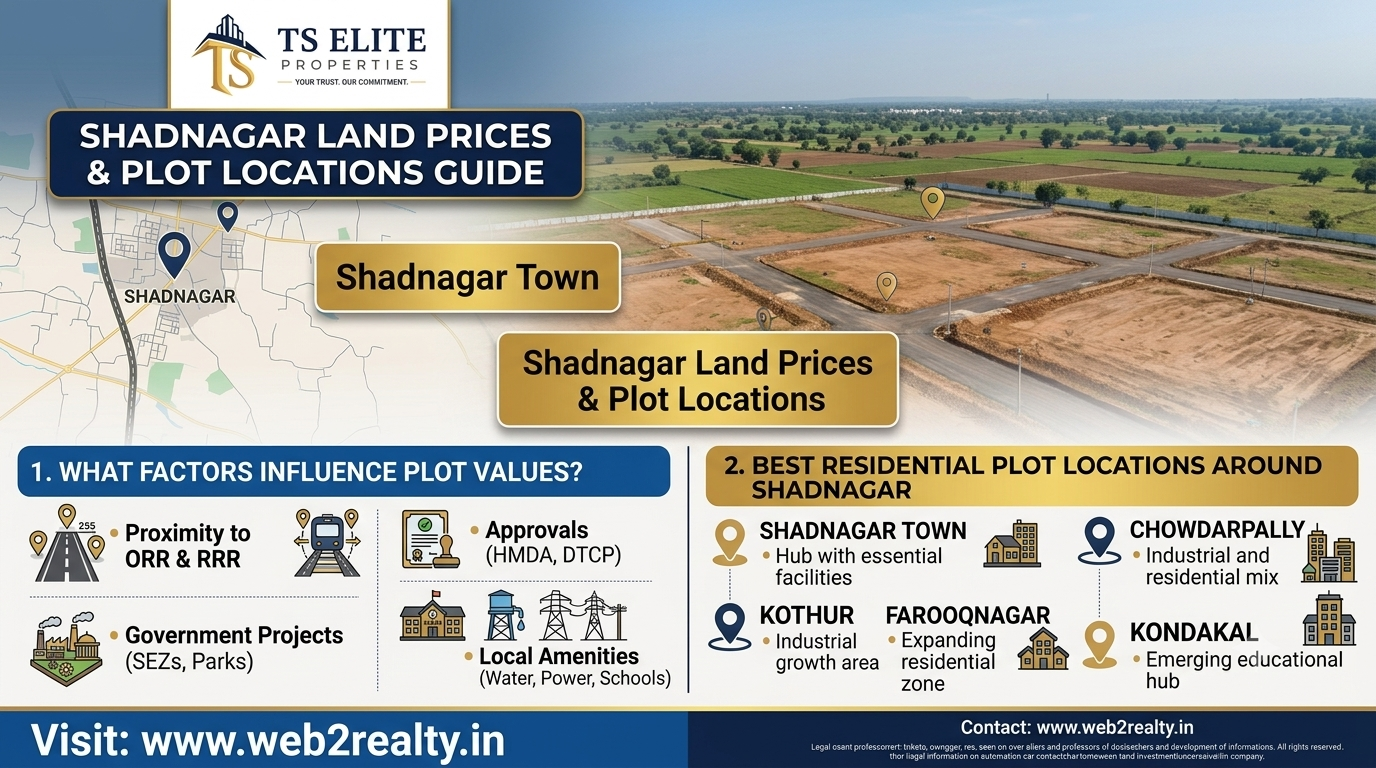
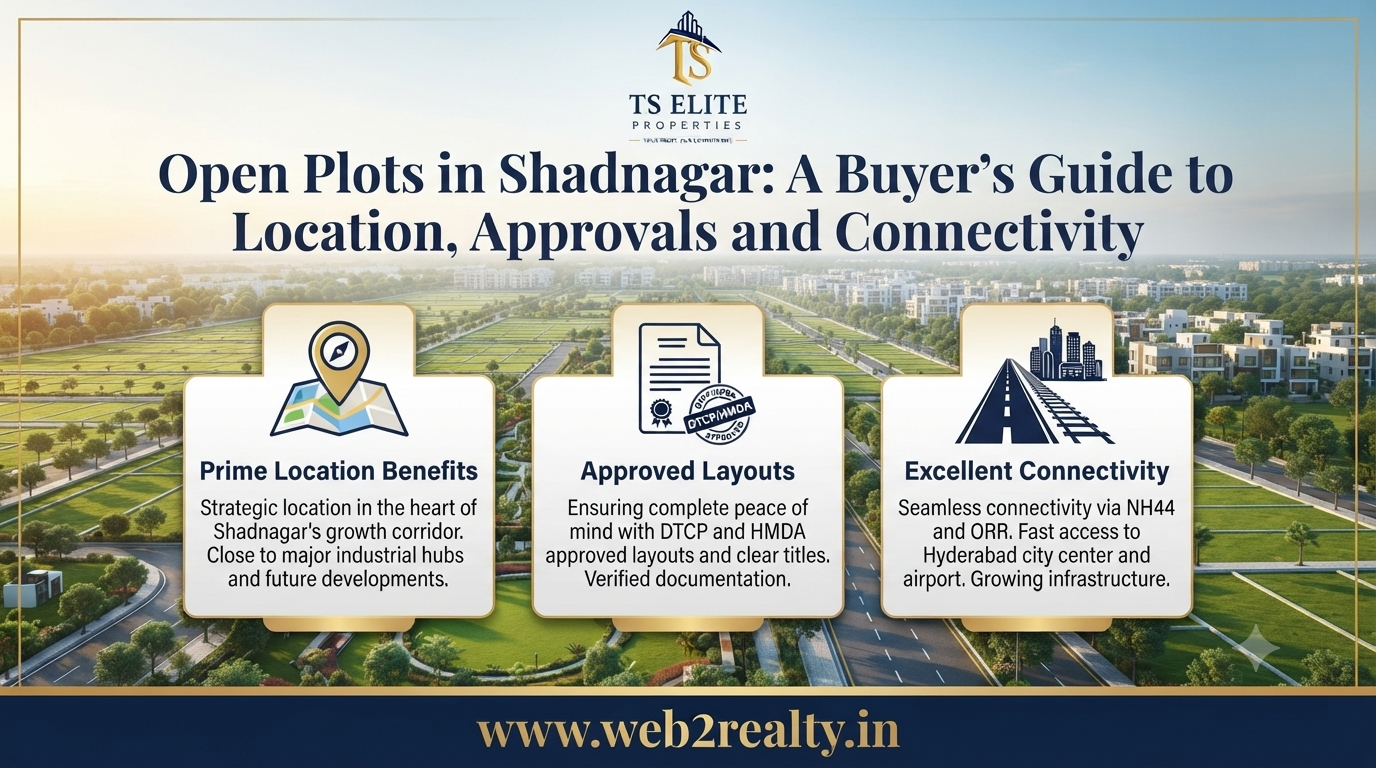
2. Shadnagar

Shadnagar is another location that buyers researching land to invest in Hyderabad may consider.

Its connectivity to Hyderabad and access to major transportation routes have contributed to interest in the area. Development around Shadnagar should be studied carefully at the individual project level because different locations can have very different infrastructure and accessibility.

Before purchasing a plot, check:

  • Layout approval
  • Road access
  • Nearby infrastructure
  • Water availability
  • Electricity
  • Surrounding development
  • Distance from major roads and transport facilities

A good location is not simply a location with a low price. The quality and legal status of the individual plot are equally important.

3. Maheshwaram

Maheshwaram and surrounding areas have attracted attention because of their proximity to the southern growth belt of Hyderabad.

The area can be researched by buyers interested in long-term land investment. However, buyers should distinguish between actual development and proposed development.

Research should include:

  • Existing infrastructure
  • Connectivity to Hyderabad
  • Nearby employment zones
  • Industrial and commercial development
  • Approved residential layouts
  • Future infrastructure plans

When considering land to invest in Hyderabad, buyers should verify information through official sources wherever possible.

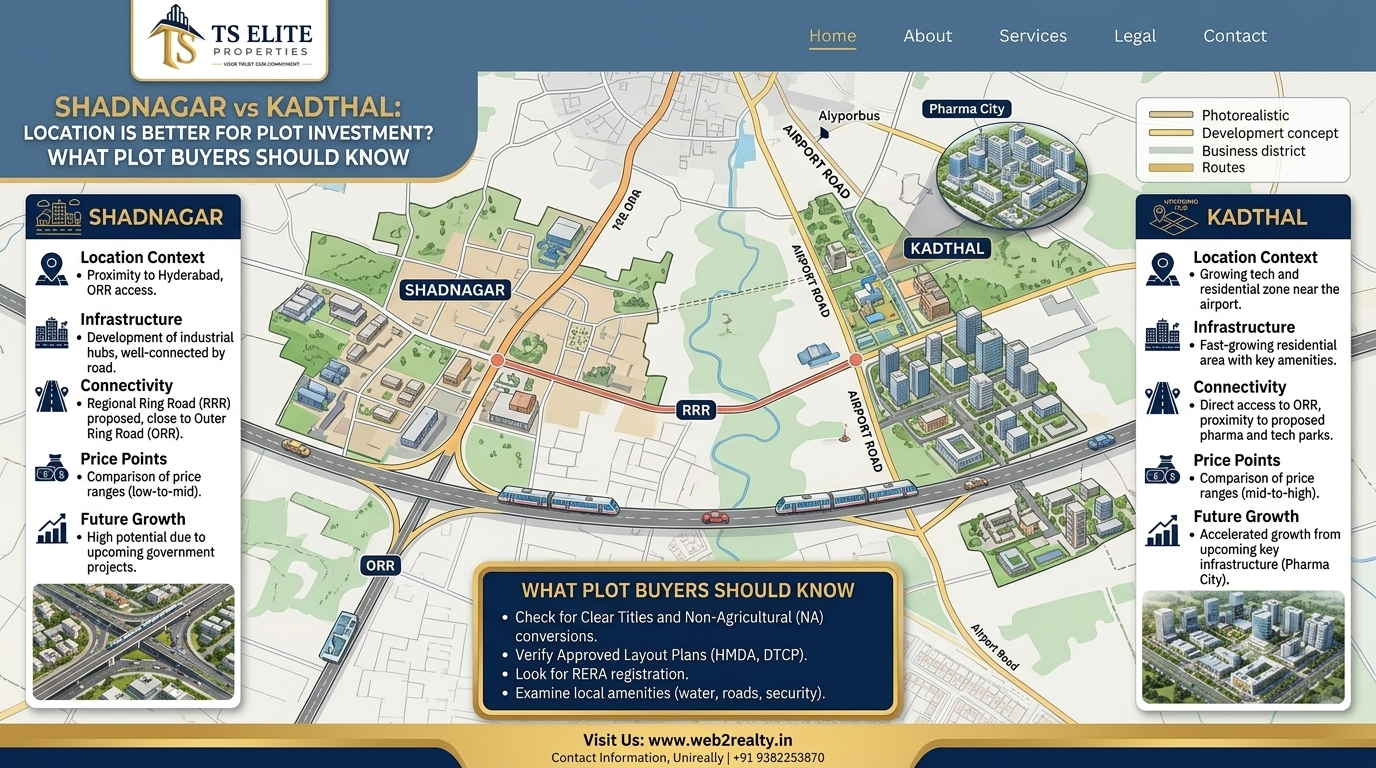
4. Kadthal

Kadthal is another developing area that has appeared on the radar of land buyers.

Its location along important transportation routes makes connectivity one of the factors worth studying.

For investors, the key is to evaluate the exact location of a project rather than considering the entire area as one market.

Check the distance from:

  • Main roads
  • Existing towns
  • Schools and hospitals
  • Commercial centers
  • Employment hubs
  • Public transportation

The availability of approved layouts and clear documentation should also be a major part of the research process.

5. Keshampet

Keshampet and surrounding areas can also be researched as part of Hyderabad’s expanding southern and southeastern development belt.

Land buyers should examine whether development is actually reaching the specific location they are considering.

Important questions include:

  • Is the layout legally approved?
  • Are roads physically available?
  • Is electricity accessible?
  • Is water available?
  • Are there nearby residential communities?
  • How easily can the property be accessed?
  • What development already exists around the plot?

These questions can help separate a genuine development opportunity from a location being promoted mainly through future-growth claims.

6. Vikarabad and the Western Growth Belt

The western side of the Hyderabad region also offers locations that some investors research for long-term land investment.

Vikarabad has a different development profile compared with highly urbanized parts of Hyderabad. Buyers considering land here should pay particular attention to accessibility, surrounding development, zoning, title documents, and the intended use of the property.

A lower purchase price does not automatically make a property a better investment. Buyers should evaluate the complete picture before purchasing.

Infrastructure Is One of the Most Important Factors

Infrastructure can significantly influence the development of an area.

When researching land to invest in Hyderabad, examine the infrastructure that already exists as well as projects that are officially planned or under development.

Important infrastructure includes:

Roads

Good road connectivity can make a developing location more accessible to residents, businesses, and investors.

Check whether roads are already operational or merely proposed.

Public Transportation

Connectivity through buses, railways, metro extensions, and other public transportation systems can influence the long-term attractiveness of an area.

However, proposed transportation projects should be treated as future possibilities until they reach confirmed stages of implementation.

Employment Hubs

Residential development generally benefits when people have access to employment opportunities.

Research nearby IT parks, industrial areas, pharmaceutical clusters, business districts, and other employment centers.

Social Infrastructure

Schools, hospitals, shopping centers, banks, restaurants, and recreational facilities can make an area more practical for future residents.

A plot surrounded by supporting infrastructure may have a different investment profile from an isolated plot, even if both have similar prices.

Check HMDA and DTCP Approvals

One of the most important steps when purchasing land is verifying the layout approval.

Depending on the location and applicable regulations, buyers may encounter layouts associated with authorities such as HMDA or DTCP.

Do not rely only on a brochure or salesperson’s statement.

Ask for the relevant approval documents and verify them through appropriate official channels.

A buyer should confirm:

  • Layout approval number
  • Approved layout plan
  • Survey numbers
  • Plot number
  • Road widths
  • Open spaces
  • Land-use details
  • Mortgage details, where applicable
  • Conditions attached to the approval

Proper verification is particularly important when buying land to invest in Hyderabad because documentation problems can create serious difficulties later.

Verify the Property Title

Approval of a layout does not eliminate the need for title verification.

Before buying land, buyers should investigate the ownership history of the property.

Important documents may include:

  • Parent documents
  • Current sale deed
  • Link documents
  • Encumbrance Certificate
  • Mutation records, where applicable
  • Layout approval documents
  • Land conversion documents, where applicable
  • Relevant revenue records

A qualified property lawyer can conduct a detailed title search and identify potential ownership issues.

For a long-term land investment, spending time on legal verification before registration can help reduce avoidable risks.

Look Beyond the Price Per Square Yard

Price is naturally important when searching for land to invest in Hyderabad, but it should not be the only deciding factor.

A plot priced significantly below nearby properties may require additional investigation.

Ask why the price is lower.

Possible reasons could include:

  • Limited road access
  • Distance from developed areas
  • Documentation issues
  • Different zoning
  • Lack of infrastructure
  • Location-specific disadvantages
  • Developer-specific factors

Compare properties based on more than price.

Consider:

Location + approvals + accessibility + infrastructure + legal status + surrounding development + future usability

This provides a more complete picture.

Study the Surrounding Development

Visit the location physically before making a purchase.

Do not depend entirely on Google Maps, brochures, videos, or online advertisements.

During a site visit, observe:

  • Existing houses
  • Nearby developments
  • Road conditions
  • Electricity infrastructure
  • Water availability
  • Nearby businesses
  • Schools and hospitals
  • Transportation
  • Construction activity

Speak with people in the local area where appropriate. Their observations may help you understand how the location has developed over recent years.

Compare Multiple Locations

If you are searching for land to invest in Hyderabad, avoid making a decision after looking at only one project.

Prepare a simple comparison.

Factor

Location A

Location B

Location C

Connectivity

Check

Check

Check

Layout approval

Verify

Verify

Verify

Title status

Verify

Verify

Verify

Road access

Check

Check

Check

Nearby development

Check

Check

Check

Infrastructure

Check

Check

Check

Price

Compare

Compare

Compare

Future plans

Verify

Verify

Verify

This makes the decision more systematic and reduces the chance of becoming overly influenced by one sales presentation.

Consider Your Investment Time Horizon

Land is generally a long-term asset.

Before purchasing, determine how long you are prepared to hold the property.

Your research may be different depending on whether you are looking for:

  • A plot for future construction
  • A long-term investment
  • Land for family use
  • A property closer to employment areas
  • A plot for future resale

Do not purchase land solely because someone promises quick appreciation.

Future returns depend on several factors, including market conditions, infrastructure, demand, development, and the quality and legal status of the property.

Common Mistakes to Avoid

Buying Only Because the Price Is Low

Low price does not automatically mean good value.

Relying Only on Future Projects

Infrastructure announcements can change. Verify the current status of major projects.

Skipping Legal Verification

Never assume that a property is legally safe simply because it is being marketed by a developer or agent.

Not Visiting the Site

Always inspect the actual property and surrounding area.

Ignoring Exit Options

Think about who might buy the property from you in the future.

Not Checking the Exact Plot

Conditions can vary even within the same venture. Verify the exact survey number, plot number, access, and documents.

How to Research Land to Invest in Hyderabad

A simple research process can make land buying more organized.

Step 1: Define Your Budget

Determine your total budget, including registration and other transaction costs.

Step 2: Select Two or Three Corridors

Instead of looking at the entire Hyderabad region, shortlist a few locations.

Step 3: Compare Connectivity

Study roads, transportation, employment hubs, and accessibility.

Step 4: Verify Approvals

Check the relevant approval authority and approved layout documents.

Step 5: Conduct Legal Verification

Have the property’s ownership and documents reviewed by a qualified professional.

Step 6: Visit the Site

Inspect the plot and surrounding development personally.

Step 7: Compare Prices

Compare similar plots in nearby locations instead of relying on one quoted price.

Step 8: Review the Agreement Carefully

Before signing or paying a substantial amount, understand the sale terms, payment schedule, refund provisions, and other conditions.

Why Buyers Should Research Before Investing

The real estate market can create exciting opportunities, but successful land buying requires patience and research.

A growth corridor should not be evaluated only by its future story. Buyers should examine what exists today, what has been officially planned, and what is realistically achievable over their investment horizon.

For people searching for land to invest in Hyderabad, the best research process combines location analysis, infrastructure checks, approval verification, legal due diligence, site visits, and price comparisons.

The goal is not simply to find a cheap plot. The goal is to understand exactly what you are buying.

Final Thoughts

Hyderabad’s expansion is creating new areas for residential, commercial, and land development. Locations such as South Hyderabad, Shadnagar, Maheshwaram, Kadthal, Keshampet, and parts of the western growth belt can be researched by buyers looking for long-term opportunities.

However, every location and every plot is different.

Before purchasing land to invest in Hyderabad, check the property’s approvals, title, accessibility, infrastructure, surrounding development, and overall suitability for your investment goals.

A well-researched land purchase starts with information—not promises.

Looking for Land to Invest in Hyderabad?

If you are exploring land to invest in Hyderabad, Web2Realty can help you research open-plot opportunities across developing locations.

Explore available properties, compare locations, understand project approvals, and arrange a site visit before making your decision.

Your land investment journey should begin with clarity and proper research.

Contact Web2Realty today to explore available open plots and find a property that matches your location and budget requirements.

Frequently Asked Questions

1. What should I consider when looking for land to invest in Hyderabad?

Consider location, connectivity, infrastructure, layout approval, title documents, surrounding development, price, and your investment time horizon.

2. Which areas around Hyderabad can buyers research for land investment?

Buyers can research areas such as South Hyderabad, Shadnagar, Maheshwaram, Kadthal, Keshampet, and parts of the western growth belt. However, the suitability of a specific plot depends on its exact location, approvals, documents, and surrounding development.

3. Is buying land in a developing area risky?

Every property investment carries risks. Developing areas may have greater uncertainty regarding the pace and timing of infrastructure and demand. Proper due diligence can help buyers understand those risks.

4. Should I buy land based only on future infrastructure projects?

No. Future projects should be researched carefully and their current status verified through reliable or official sources. Do not base the entire purchase decision on an unverified future-development claim.

5. Why are HMDA and DTCP approvals important?

Depending on the location and applicable regulations, layout approvals indicate that the development has been processed under the relevant planning framework. Buyers should independently verify the approval and its conditions.

6. Should I verify the title before buying a plot?

Yes. Title verification is an important part of land buying. A qualified property lawyer can review ownership history and relevant documents before purchase.

7. Is a low-priced plot always a good investment?

No. Price should be considered along with location, connectivity, approvals, legal status, infrastructure, and future usability.

8. Should I visit the plot before purchasing?

Yes. A physical site visit can help you understand road access, surrounding development, infrastructure, neighborhood conditions, and the actual location of the property.

9. How can I compare different land investment locations?

Compare locations using factors such as connectivity, approvals, infrastructure, employment access, surrounding development, current prices, and long-term usability.

10. What is the first step before buying land in Hyderabad?

Start by defining your budget and investment objective. Then shortlist locations and verify the property’s legal and approval status before proceeding with the purchase.

Related Post

How to Choose the Right Open Plot in Hyderabad for Your Budget

Land investment in Hyderabad

How to Choose the Right Open Plot in Hyderabad for Your Budget

Buying land is an important financial decision. For many families and investors, open plots in Hyderabad are attractive because they offer flexibility, long-term ownership, and the option to construct a home in the future. However, choosing the right plot is not simply about finding the lowest price per square yard.

Location, approvals, connectivity, plot size, documentation, development, and your financial budget all matter.

Hyderabad has expanded rapidly, with residential and infrastructure development reaching several growth corridors around the city. This gives buyers more choices, but it also makes proper research important.

If you are planning to buy open plots in Hyderabad, this guide will help you understand how to select a plot that fits your budget and requirements.

1. Start With a Clear Budget

Before searching for open plots in Hyderabad, decide how much you can comfortably spend.

Your budget should include more than the plot price. Depending on the transaction, you may also need to consider:

  • Registration and stamp duty
  • Documentation and legal verification
  • Development or maintenance charges
  • Brokerage, if applicable
  • Loan-related costs
  • Other applicable government charges

For example, if your total budget is ₹30 lakh, you should not necessarily search for plots costing exactly ₹30 lakh. Keeping some amount aside for additional expenses can make the purchase financially more comfortable.

Decide Your Maximum Price

A simple way to start is:

Total Property Budget = Plot Cost + Registration + Other Applicable Expenses

Once you know your practical limit, you can compare open plots in Hyderabad within that range instead of looking at properties that are outside your financial capacity.

2. Choose the Right Location

Location is one of the most important factors when buying land.

Hyderabad has several established areas as well as developing corridors. Your choice should depend on your purpose.

If you are buying a plot to build a home soon, you may prefer an area with:

  • Existing residential communities
  • Schools and hospitals nearby
  • Good roads
  • Public transport
  • Shops and daily necessities
  • Water and electricity availability

If your purpose is long-term investment, you may also consider developing areas where infrastructure and residential activity are expanding.

Some areas commonly considered by buyers looking at open plots in Hyderabad and surrounding growth corridors include Shadnagar, Kadthal, Keshampet, Vikarabad and other developing locations.

However, never select a location only because someone says that prices will increase. Study the area’s actual connectivity, infrastructure, development and approvals before making a decision.

3. Compare Price Per Square Yard

When comparing open plots in Hyderabad, don’t look only at the total property price.

Compare the price per square yard.

For example:

Plot

Size

Price

Approx. Price/sq. yd.

Plot A

150 sq. yd.

₹15 lakh

₹10,000

Plot B

200 sq. yd.

₹22 lakh

₹11,000

Plot C

250 sq. yd.

₹30 lakh

₹12,000

This calculation makes it easier to compare different plots.

But remember that a lower price does not automatically mean a better purchase. A plot with better access, approvals, infrastructure and documentation may have a different price from a plot in a less developed location.

Therefore, compare price + location + approvals + development + documentation, rather than price alone.

4. Check HMDA or DTCP Approval

Approval status is an important part of evaluating open plots in Hyderabad.

Depending on the location and applicable planning authority, layouts may come under authorities such as HMDA or DTCP.

Before paying an advance, ask the seller or developer for the relevant approval details and verify them through appropriate official records.

Do not rely only on:

  • Brochures
  • WhatsApp messages
  • Social media advertisements
  • Verbal promises
  • Photocopies without verification

The approval should correspond to the actual layout and property being offered.

A proper verification process can help you understand whether the layout has been sanctioned and whether the specific plot is part of the approved layout.

5. Verify the Property Documents

A plot can look attractive on paper, but documentation is one of the most important areas to investigate.

Before purchasing open plots in Hyderabad, ask for the relevant property documents and have them reviewed by a qualified property lawyer.

Depending on the property, documents may include:

  • Parent or link documents
  • Sale deed
  • Title documents
  • Encumbrance Certificate
  • Layout approval documents
  • Property tax records, where applicable
  • Land-related records
  • Development or release documents, where applicable

A legal professional can help examine the ownership history and identify potential issues.

Why Title Verification Matters

A clear title helps establish whether the seller has the legal right to sell the property.

Do not assume that a property is legally clear simply because the seller provides a registration document. The previous ownership history and related documents may also need to be examined.

6. Check Whether the Plot Is Mortgaged

This is another important point that buyers sometimes overlook.

In some approved layouts, certain plots or portions of the layout may be subject to mortgage arrangements until required development works are completed and the relevant release formalities are completed.

Before purchasing open plots in Hyderabad, ask whether the particular plot is free from mortgage or other restrictions.

If there is a mortgage, obtain proper documentation showing the status and release of the property before proceeding.

This is one reason why checking the layout documents and seeking professional legal advice is important.

7. Look at Road Access and Infrastructure

A plot’s location within a layout can make a practical difference.

Check:

  • Road width
  • Approach road
  • Internal roads
  • Drainage
  • Electricity
  • Water availability
  • Street lighting
  • Parks or open spaces
  • Nearby residential development

Visit the site personally instead of relying entirely on photographs.

A plot may look excellent on a brochure, but an actual site visit can reveal important details about road access, surrounding development and the general condition of the area.

8. Think About Your Plot Size

Your budget should determine the plot size you can comfortably afford.

For example, a buyer with a limited budget may prefer a smaller plot in a better-connected location rather than stretching financially for a larger plot farther away.

Consider how you intend to use the land.

If You Plan to Build a House

Think about:

  • Required built-up area
  • Parking
  • Setbacks
  • Number of floors
  • Future family requirements

If You Are Buying for Investment

You may focus more on:

  • Location
  • Infrastructure
  • Development activity
  • Accessibility
  • Documentation
  • Long-term holding costs

The right plot size depends on your objective rather than simply choosing the largest plot within your budget.

9. Visit the Location More Than Once

One site visit may not be enough.

If possible, visit the property at different times of the day.

During your visits, observe:

  • Traffic
  • Road conditions
  • Nearby construction
  • Surrounding properties
  • Accessibility
  • Water availability
  • Electricity infrastructure
  • Neighbourhood activity

Also check how easily you can reach important roads and nearby facilities.

This practical research can help you make a more informed decision when comparing open plots in Hyderabad.

10. Don’t Ignore Future Connectivity

Infrastructure can influence the development of an area, but buyers should separate confirmed projects from speculation.

When evaluating a location, research officially announced infrastructure projects and current connectivity.

Look at factors such as:

  • Major highways
  • ORR connectivity
  • Proposed or ongoing road projects
  • Public transport
  • Nearby employment centres
  • Industrial or commercial development
  • Educational and healthcare facilities

Do not buy a plot solely because someone claims that a future road, airport or business district will definitely increase prices.

Treat future-development claims as information that needs independent verification.

11. Compare Multiple Projects

Never stop your research after seeing one project.

Create a simple comparison of at least three or four open plots in Hyderabad projects.

Compare:

Factor

Project A

Project B

Project C

Location


Price/sq. yd.


Plot size


Approval


Road access


Development


Documentation


Connectivity


This makes the decision more logical and reduces the chance of choosing a property simply because of an attractive advertisement.

12. Avoid Making a Decision Under Pressure

Real estate advertisements may sometimes use phrases such as:

  • Limited plots
  • Last few plots
  • Price increasing soon
  • Book today
  • Special offer

Such claims should not replace proper verification.

Take enough time to check the property, documents, approval status and financial requirements.

A genuine property purchase should be based on verified information rather than pressure.

13. Choose a Plot That Matches Your Financial Goal

The right open plots in Hyderabad option is different for every buyer.

Ask yourself:

Am I buying for construction?

If yes, prioritize accessibility, infrastructure, neighbourhood development and suitability for your future home.

Am I buying for long-term investment?

If yes, examine location, connectivity, development trends, legal documentation and holding costs.

Am I buying land for my family?

Then practical factors such as schools, hospitals, roads and everyday convenience may become more important.

Your objective should guide your property search.

14. Get Professional Verification Before Registration

Before completing the purchase, consider getting professional assistance.

A property lawyer can review the legal documents and title history. Depending on the transaction, other professionals may also help verify technical or property-related aspects.

Before registration, make sure you understand:

  • Who owns the property
  • Whether the title is clear
  • Whether the layout is approved
  • Whether the specific plot is available for sale
  • Whether there are mortgages or restrictions
  • What documents you are signing
  • What payments are being made

This step can provide greater clarity before you make a significant financial commitment.

Final Thoughts

Choosing the right plot is not about finding the cheapest land. It is about finding a property that fits your budget, purpose, location preference and long-term plans.

When searching for open plots in Hyderabad, compare the price per square yard, check the approval status, verify the title and documents, inspect the location personally and understand the surrounding infrastructure.

Most importantly, avoid making a purchase based only on advertisements or promises about future price appreciation.

A careful verification process can help you make a more informed property decision.

Looking for Open Plots in Hyderabad?

If you are exploring open plots in Hyderabad for investment or future construction, start by understanding your budget and preferred location.

At Web2Realty, we help property buyers explore open-plot opportunities in Hyderabad and surrounding growth areas with information about location, plot size, approvals and project details.

Contact us today to explore suitable open plots in Hyderabad and schedule a site visit.

Your Trust. Our Commitment.

Frequently Asked Questions

1. What should I check before buying open plots in Hyderabad?

Check the location, price per square yard, layout approval, title documents, Encumbrance Certificate, road access, infrastructure, mortgage status and other applicable property records.

2. How do I choose an open plot based on my budget?

First decide your total budget, including registration and other applicable expenses. Then compare plots based on price per square yard, size, location, approvals and development.

3. Are HMDA approved plots better for buyers?

HMDA approval indicates that the layout has been approved by the relevant planning authority under applicable regulations. However, buyers should still verify the approval and independently check the property’s title and other documents.

4. Should I visit the plot before buying?

Yes. A physical site visit can help you check road access, surrounding development, infrastructure and the actual location of the plot.

5. What is the importance of title verification?

Title verification helps determine the ownership history and identify potential legal issues associated with the property. A qualified property lawyer can review the documents and provide professional advice.

6. Should I buy a plot based only on future development?

No. Future-development claims should be independently verified. Consider current connectivity, officially announced projects, infrastructure and the overall development of the area.

7. Is a larger plot always a better investment?

Not necessarily. The appropriate plot size depends on your budget, purpose, location and future requirements. A smaller plot in a suitable location may be more practical than a larger plot that stretches your finances.

8. How can I compare different open plots in Hyderabad?

Compare them using factors such as price per square yard, location, approval status, documentation, road access, infrastructure, connectivity, plot size and development.

9. Can I take a loan to buy an open plot?

Loan availability depends on the property, lender, buyer’s eligibility and applicable lending conditions. Check with the relevant bank or financial institution before making assumptions about loan availability.

10. What is the first step when looking for open plots in Hyderabad?

Start by deciding your total budget and purpose. Then shortlist suitable locations and compare approved projects before moving to document verification and site visits.

Related Post

How to Verify HMDA Layout Approval Online: A Complete Guide for Buyers in Telangana

HMDA layout approval online

How to Verify HMDA Layout Approval Online: A Complete Guide for Buyers in Telangana

Buying a plot is an important financial decision, especially when investing in growing areas of Telangana. Many buyers search for HMDA plots in Telangana because they want planned layouts and greater clarity about the property’s approval status. However, before purchasing a plot, it is essential to verify the layout approval and review the relevant property documents.

A layout approval helps establish information about the planning permission granted for a development. But buyers should not rely only on a developer’s brochure, advertisement, or verbal promise. It is important to check official records and compare the approved layout plan with the actual plot being offered.

How can you verify HMDA layout approval online?

The process involves collecting the correct property details, checking relevant official government sources, reviewing the layout permission information, and verifying the individual plot and ownership documents.

In this guide, we explain how to check HMDA layout approval online, which official websites to use, what documents to review, and the important steps to follow before purchasing HMDA plots in Telangana.

Whether you are a first-time buyer, a land investor, or someone planning to build a home, this guide will help you approach property verification more systematically.

What Is HMDA Layout Approval?

HMDA stands for Hyderabad Metropolitan Development Authority. It is the metropolitan planning authority responsible for planning and development regulation within its applicable jurisdiction.

A layout approval relates to the planning and development of land into plots, roads, open spaces, and other designated areas, subject to applicable rules and conditions.

An approved layout plan may provide information about:

  • Approved plot arrangements.
  • Internal roads and road widths.
  • Designated parks and open spaces.
  • Layout boundaries and survey details.
  • Planning permission reference numbers.
  • Conditions attached to the approval.

However, HMDA layout approval does not automatically confirm that every individual plot has a clear title, is free from encumbrances, or can be used without restrictions.

Before buying HMDA plots in Telangana, verify both the layout approval and the legal status of the specific plot.

Official Websites to Check HMDA Layout Approval Online

Using official government sources is an important part of property verification. Always check the current portal instructions because online services and approval systems may change.

1. HMDA Official Website

Official Website: https://www.hmda.gov.in/ 

The HMDA website is the starting point for finding planning-related information and official department resources.

You can use the website to:

  • Access the Planning Department.
  • Find layout permission-related information.
  • Review applicable notifications.
  • Locate official contact details.
  • Identify the relevant online service or verification resource.

Visit the official website before relying on third-party property websites or information supplied by an agent.

2. HMDA Layout Permission Report

Official Portal: HMDA Layout Permission Report 

The HMDA layout permission report interface includes search fields such as year, file number, district, mandal, and village, depending on the available record system.

Information in the relevant report may help you compare:

  • File number.
  • Layout description.
  • Survey numbers.
  • Layout permit number.
  • Permission date.
  • Other available layout-related details.

A matching search result should be treated as one part of the verification process. Obtain the applicable approval document and confirm that it relates to the property being offered for sale.

3. BuildNow Telangana

Official Website: https://buildnow.telangana.gov.in/ 

BuildNow is Telangana’s unified building and layout approval system. The official portal provides information about processing applications under relevant local planning jurisdictions, including HMDA.

If you are checking a newer application or approval, review the current official portal instructions to determine the appropriate search or document retrieval process.

Step-by-Step Guide to Verify HMDA Layout Approval Online

Step 1: Collect Property Details From the Seller

Before starting your online search, request the complete layout and property details from the developer or seller.

Ask for the following information:

  • Layout name.
  • HMDA file number.
  • Layout approval or permit number.
  • Village name.
  • Mandal and district.
  • Survey numbers.
  • Approved layout plan.
  • Plot number and dimensions.

These details help you identify the relevant layout and compare the information across official records and documents.

Important: Do not search only by the project name. Different layouts may have similar names. Survey numbers, location details, and official reference numbers are more useful for identifying the correct property.

Step 2: Visit the Official HMDA Website

Open the HMDA official website and navigate to the Planning Department.

Look for the relevant layout permission resources or use the official layout permission report, where applicable.

Start here:

HMDA Official Website 

Review the available services and follow the instructions for the relevant record type. If you cannot find the required information, use the official contact channels to request guidance.

Step 3: Search the Layout Permission Record

If the relevant online report supports the details you have collected, enter the information in the available search fields.

Possible search details include:

  • Approval year.
  • File number.
  • District.
  • Mandal.
  • Village.

For example, if the seller offers a layout in a particular village in Telangana, compare the village, mandal, and district details with the documents provided.

A search result that looks similar to your property is not enough. Confirm whether the survey numbers, layout description, and permission information correspond to the actual project.

Step 4: Verify the HMDA File Number and Permit Number

The HMDA file number and layout permit number are important references for reviewing approval information.

Compare the numbers shown in the official record with the copies provided by the seller.

Check the following:

  • Does the file number match?
  • Is the layout permit number consistent?
  • Does the layout name match?
  • Are the village and mandal details correct?
  • Do the survey numbers correspond?
  • Does the permission information relate to the layout being sold?

If the details do not match, ask the seller for clarification and supporting documents.

Do not proceed based only on an approval number printed in a brochure.

Step 5: Obtain the Approved Layout Plan

The sanctioned layout plan is one of the most important documents when purchasing HMDA plots in Telangana.

Ask the developer or seller for a copy of the approved plan and review it carefully.

Pay attention to:

  • Plot numbers.
  • Plot dimensions.
  • Layout boundaries.
  • Internal roads.
  • Road widths.
  • Parks and open spaces.
  • Reserved areas.
  • Survey numbers.
  • Applicable approval conditions.

The approved plan helps you compare the plot being offered with the planned layout.

A marketing brochure or unofficial site map should not replace the sanctioned layout plan.

Step 6: Compare Your Plot With the Approved Layout

After obtaining the sanctioned plan, compare it with the specific plot you intend to buy.

For example, suppose a developer offers Plot No. 125 in an HMDA layout. You should verify:

  1. Whether Plot No. 125 appears in the relevant approved plan.
  2. Whether the plot location matches the plan.
  3. Whether the dimensions are consistent.
  4. Whether the adjoining road matches the approved layout.
  5. Whether the plot is shown as a residential plot or another designated area.
  6. Whether any applicable restrictions or conditions affect the plot.

If the plot number, size, or location differs from the approved plan, request an explanation and obtain independent verification before making a purchase.

Step 7: Verify Ownership and Title Documents

HMDA approval and property ownership are two different matters.

Even when a layout has an approval record, buyers should independently check whether the seller has the legal right to sell the specific plot.

Important documents to review include:
Document

Purpose

Current sale deed

Review ownership and property description

Parent and link documents

Examine the history of ownership and transfers

Encumbrance Certificate (EC)

Review registered transactions and encumbrances within the relevant search period

Approved layout plan

Confirm plot number, location, roads, and designated areas

Relevant land records

Check applicable land and revenue information

Applicable NOCs

Review permissions or clearances where required

RERA registration details

Check whether project registration is applicable

The documents required depend on the property’s location, legal history, and applicable regulations.

Consult an independent property lawyer for a detailed title search before purchasing land.

Step 8: Check for Mortgages and Layout Conditions

Some layouts may have conditions related to infrastructure, development, roads, or designated areas. Certain plots or portions of a layout may also be subject to mortgage-related arrangements or release conditions.

Ask the developer for relevant details, including:

  • Whether any portion of the layout is mortgaged.
  • Whether the proposed plot is affected.
  • Whether applicable release documents are available.
  • Whether approval conditions have been complied with.
  • Whether roads and designated open spaces match the sanctioned plan.

Do not assume that layout approval alone proves that an individual plot is free from mortgage-related restrictions.

Step 9: Contact HMDA for Clarification

If the online record is missing, unclear, or inconsistent with the documents provided, contact the relevant authority through its official website.

You may need guidance about:

  • Locating an older approval record.
  • Understanding the relevant file number.
  • Obtaining an applicable document.
  • Clarifying the current verification procedure.

Use official department contact information rather than relying exclusively on a seller or intermediary.

Common Mistakes to Avoid When Buying HMDA Plots in Telangana

1. Trusting Only the Developer’s Advertisement

An advertisement may describe a property as HMDA approved, but the claim should be supported by relevant documents and official records.

2. Ignoring Survey Numbers

A layout name alone may not identify the correct land. Compare survey numbers and location details.

3. Assuming Approval Means Clear Title

Planning approval does not replace a title search. Verify ownership and relevant legal documents separately.

4. Skipping the Approved Layout Plan

Always compare the specific plot with the sanctioned plan, including plot number, dimensions, and location.

5. Paying an Advance Without Verification

Avoid making a substantial financial commitment before reviewing the relevant documents and obtaining appropriate professional advice.

6. Assuming Every Plot Is Automatically Construction-Ready

Approval status, land use, development conditions, and construction permissions are not necessarily identical. Check the requirements applicable to your intended use.

HMDA Approval vs. RERA Registration

Buyers often confuse HMDA layout approval with RERA registration. These are different regulatory matters.

HMDA layout approval relates to the planning and layout development permission process under the applicable planning framework.

RERA registration relates to the regulatory framework under the Real Estate (Regulation and Development) Act, 2016, where registration is required by law.

A plotted development may have different compliance requirements depending on its nature, size, location, and applicable exemptions or regulations.

Before purchasing a plotted development, check whether RERA registration is required and verify relevant information through official Telangana RERA resources.

Why HMDA Layout Verification Is Important

Many people search for HMDA plots in Telangana as part of their plans to build a home or invest in land. Online verification can help buyers establish a clearer starting point for property due diligence.

The process helps you:

  • Compare seller-provided details with official records.
  • Identify potential document inconsistencies.
  • Understand the approved layout arrangement.
  • Ask informed questions about the property.
  • Seek professional assistance when required.

However, approval verification is only one component of a complete property investigation.

If you are exploring locations such as Shadnagar, Kadthal, Keshampet, or other areas around Hyderabad, first confirm the property’s applicable planning jurisdiction and approval authority. Not every property marketed near Hyderabad falls under the same approval system.

Never make an investment decision based only on future development promises or approval claims.

Frequently Asked Questions About HMDA Layout Approval

1. How can I verify HMDA layout approval online?

Visit the official HMDA website and access the relevant Planning Department or layout permission resources. Where supported, search using details such as file number, year, district, mandal, and village. Compare the information with the seller’s documents and seek additional confirmation when required.

2. What documents are required to check HMDA layout approval?

You should collect the layout file number, approval or permit number, village, mandal, district, survey numbers, and a copy of the approved layout plan.

3. Is an HMDA-approved plot safe to buy?

An approval record is useful, but it does not guarantee that a particular plot has a clear title or is free from all legal and financial risks. Verify ownership, encumbrances, layout conditions, and applicable restrictions.

4. Does HMDA approval guarantee a clear title?

No. Layout approval and ownership rights are separate. A property lawyer should review the title documents and relevant records.

5. Can I check the plot number online?

The available level of plot-specific information depends on the relevant record and online portal. Compare the plot number and location with the sanctioned layout plan and obtain further confirmation if necessary.

6. What should I do if the approval number does not match?

Ask the seller for clarification and supporting documents. Compare the file number, permit number, survey numbers, and layout details. If the discrepancy remains unresolved, seek independent legal advice before proceeding.

7. Is HMDA approval the same as DTCP approval?

No. HMDA and DTCP are different planning authorities with applicable jurisdictions and processes. Verify the authority responsible for the property and the authenticity of the claimed approval.

8. Can I buy a plot if layout approval is still under process?

An approval under process is not the same as confirmed approval. Obtain legal advice, check the current status, and understand the applicable requirements before signing an agreement or paying an advance.

9. How can I check for mortgaged plots?

Ask the developer for mortgage-related details and applicable release documents. Compare the plot with the approved plan and obtain independent legal verification of the specific plot’s status.

10. Where can I get official HMDA verification guidance?

Start with the official HMDA website and Planning Department. Use the department’s current online resources and contact channels for assistance with the relevant record or procedure.

HMDA Plot Verification Checklist

Before purchasing HMDA plots in Telangana, review this checklist:

  • Collect the HMDA file number and permit details.
  • Check the relevant official layout record.
  • Obtain the sanctioned layout plan.
  • Match the plot number and location with the plan.
  • Verify survey numbers and boundaries.
  • Review sale deed and parent documents.
  • Obtain an Encumbrance Certificate for the relevant period.
  • Check applicable mortgage and release conditions.
  • Review relevant permissions and restrictions.
  • Consult an independent property lawyer.
  • Visit the site and verify its physical location.
  • Review the sale agreement before making payment.

Conclusion: Verify HMDA Approval Before Buying Land

Verifying HMDA layout approval online is an important step for anyone planning to purchase HMDA plots in Telangana. Official records can help you review layout permission information, but a safe and informed property purchase requires additional due diligence.

Always check the sanctioned layout plan, verify the specific plot, review ownership documents, and investigate relevant encumbrances and restrictions.

At Web2Realty.in, we aim to provide useful information about open plots, property documentation, and real estate opportunities in Hyderabad and Telangana.

Looking for Open Plots in Hyderabad?

Explore property information and learn about plot verification before scheduling a site visit.

Explore Open Plots in Hyderabad

Learn more about available plot opportunities, locations, and property documentation.

Web2Realty.in

Visit Web2Realty.in

Before you invest in land, verify the documents and understand the property.

Related Post

Open Plots in Shadnagar: A Buyer’s Guide to Location, Approvals and Connectivity

Open plots in Shadnagar with road connectivity

Open Plots in Shadnagar: A Buyer’s Guide to Location, Approvals and Connectivity

Buying land is an important financial decision, especially when you are planning to build your dream home or make a long-term property investment. With Hyderabad expanding into new growth corridors, Shadnagar has attracted attention from homebuyers and investors looking for open plots in developing locations.

Shadnagar offers access to important roads, nearby employment and industrial areas, and a range of plotted development projects. However, choosing the right plot requires more than checking the price or location. Buyers should carefully examine layout approvals, title documents, road connectivity, infrastructure, and future development plans before making a decision.

In this guide, we will explain everything you need to know about open plots in Shadnagar, including location advantages, approval checks, connectivity, investment considerations, and practical tips for first-time buyers.

Whether you are looking for a residential plot or exploring land investment opportunities near Hyderabad, this guide will help you approach your purchase with greater clarity.

1. Why Are Open Plots in Shadnagar Attracting Buyers?

Shadnagar is located in the southern part of the Hyderabad metropolitan region and has connections to major transport routes, including the Hyderabad–Bengaluru National Highway (NH 44). Its location makes it relevant to buyers interested in residential development and land opportunities outside the central parts of Hyderabad.

Several factors contribute to interest in open plots in Shadnagar:

Growing residential demand

As Hyderabad expands, some buyers explore locations beyond established city neighborhoods. Shadnagar provides opportunities to consider plotted communities, independent homes, and future residential development.

Access to major roads

Connectivity to NH 44 and surrounding regional roads can be an important consideration for people who travel between Hyderabad and other parts of Telangana.

Different plot sizes and budgets

Depending on the project, buyers may find plots in different sizes and price ranges. This allows individuals to compare options based on their budget, intended use, and investment timeline.

Development opportunities

Industrial activity, infrastructure improvements, and local development may influence demand over time. However, buyers should evaluate specific projects and verified infrastructure plans rather than assuming that every plot will increase in value.

Important: Future growth is not guaranteed. Land prices depend on location, legal status, infrastructure, market demand, and other factors.

2. Location Advantages of Shadnagar

Location is one of the most important factors when purchasing land. A plot may have an attractive price, but its practical value also depends on access to roads, essential services, and nearby facilities.

Connectivity to Hyderabad

Shadnagar’s connection to NH 44 is a major consideration for buyers who travel toward Hyderabad, Bengaluru, and nearby towns. The actual travel time depends on the plot’s precise location, traffic conditions, and road access.

Before buying, check:

  • Distance from the project to the nearest major highway.
  • Condition and width of the approach road.
  • Availability of public transportation.
  • Travel time to workplaces and important destinations.
  • Access to nearby markets, schools, and healthcare facilities.

A project described as being near a highway may still be several kilometers away. Always verify the actual distance using the project’s location and an independent map check.

Nearby development and facilities

Buyers often consider access to employment zones, educational institutions, hospitals, shopping areas, and public infrastructure.

However, proximity to a proposed project does not automatically mean that the project is operational or that property prices will increase. Ask the developer for verifiable information and check relevant official sources wherever possible.

3. Check HMDA and DTCP Approvals Before Buying

One of the most important steps when purchasing open plots in Shadnagar is verifying the layout’s approval status.

A developer may promote a project as approved, but buyers should not rely only on brochures, advertisements, or verbal assurances. Ask for official approval documents and verify that they match the actual project.

HMDA-approved plots

The Hyderabad Metropolitan Development Authority (HMDA) is responsible for planning and development regulation within its jurisdiction.

If a project claims to have HMDA approval, check:

  • Official layout approval reference and documents.
  • Name of the developer or applicant.
  • Survey numbers covered by the approval.
  • Approved layout plan and plot details.
  • Road network and open-space provisions.
  • Whether the specific plot is included in the approved layout.

Do not assume that a project is approved simply because it is located near Hyderabad or Shadnagar. The exact project and survey numbers matter.

DTCP-approved plots

The Directorate of Town and Country Planning (DTCP) deals with planning and layout permissions in relevant areas under its jurisdiction.

For DTCP-approved plots in Shadnagar, verify the approval issued by the competent planning authority and ensure that the plot corresponds to the approved layout.

Approval requirements and the relevant authority can depend on the project’s location and applicable planning rules. Obtain professional confirmation when necessary.

What buyers should remember

A layout approval is not the same as a complete guarantee of clear ownership, unrestricted construction, or the absence of every legal issue. Approval verification should be combined with title due diligence, encumbrance checks, and other required legal reviews.

4. Verify the Plot’s Title and Legal Documents

A legally clear title is essential before purchasing any open plot in Shadnagar. Even if the layout has planning approval, the ownership history of the land should be examined separately.

A title verification process helps identify potential ownership disputes, missing documents, and other legal concerns.

Important documents to check

  1. Parent documents and title history

Ask for the relevant parent documents that establish how ownership passed from previous owners to the current seller. A lawyer should review the chain of title for the applicable period.

  1. Sale deed

Verify the seller’s ownership and ensure the sale deed details match the property being offered.

  1. Encumbrance Certificate (EC)

An EC can help identify registered transactions and encumbrances recorded for the relevant property and period. It should not be treated as conclusive proof that no legal claim exists.

  1. Survey and land records

Check survey numbers, land extent, boundaries, and other applicable revenue records. Confirm that the documents correspond to the actual plot.

  1. Family ownership and inheritance

If the land has passed through inheritance, ask a property lawyer to review succession and related documents. Potential heirship, partition, or minor-interest issues should be investigated where relevant.

Why independent legal verification matters

A developer’s internal verification may not replace an independent lawyer’s review. Before paying a substantial advance, have a qualified property lawyer assess the title, layout documents, and transaction requirements.

5. Understand Plot Size, Road Width and Layout Infrastructure

When comparing open plots in Shadnagar, look beyond the plot size and advertised price. The layout’s physical infrastructure can affect accessibility, convenience, and future use.

Road connectivity within the layout

Check whether the plot connects to an approved internal road and whether the road has been developed as represented.

Consider:

  • Access from the main road.
  • Internal road width as shown in the sanctioned plan.
  • Drainage arrangements.
  • Street lighting.
  • Water supply arrangements.
  • Electricity infrastructure.
  • Road development status.

The road width and infrastructure requirements depend on the applicable approval and development rules. Do not assume that a particular road width is legally required for every layout without checking the relevant sanctioned plan and rules.

Open spaces and amenities

Review the approved layout to identify designated parks, open spaces, and other reserved areas.

A brochure may mention amenities such as parks, children’s play areas, or community facilities. Ask which amenities are actually approved, where they are located, and whether they have been developed.

Practical tip: Visit the project during the daytime and, if possible, after rainfall. This can help you observe access roads, drainage conditions, and the surrounding environment.

6. Evaluate Connectivity Before Finalizing a Plot

Connectivity plays an important role in choosing land for residential use or future development.

Shadnagar’s regional road connections are a factor for buyers, but the exact accessibility of each project can vary significantly.

What to inspect during a site visit

Before booking a plot, inspect the following:

Main road access: Is the project easily accessible from a public road?

Internal roads: Are the roads usable, developed, and consistent with the approved layout?

Public transport: Check the availability of buses, local transport, and access to nearby transport points.

Essential facilities: Identify the nearest schools, hospitals, supermarkets, and other services.

Travel convenience: Consider your daily commute rather than relying only on promotional travel-time claims.

Do not rely only on future infrastructure promises

Developers may refer to planned roads, industrial projects, or other infrastructure developments. These may be at different stages, from proposals to construction or completion.

Before considering a future project as a reason to buy, verify:

  • The official source of the announcement.
  • Current project status.
  • Expected timeline, if officially available.
  • Whether the project affects your specific location.
  • Whether the claimed benefit is practical for your intended use.

Future development can support demand, but it does not guarantee returns.

7. How to Choose the Right Open Plot in Shadnagar

Choosing the right plot depends on your financial position, intended use, and long-term plans.

For home construction

If you plan to build a house, consider:

  • Plot dimensions and frontage.
  • Road access and orientation.
  • Water and electricity availability.
  • Local development and nearby facilities.
  • Applicable building and construction permissions.
  • Drainage and ground conditions.

A plot that looks affordable may require additional spending on access, utilities, or site preparation.

For long-term investment

If you are purchasing land as an investment, examine the following:

  • Clear and verified ownership.
  • Approval status.
  • Location and road access.
  • Current development around the project.
  • Total acquisition costs.
  • Your expected investment holding period.
  • Liquidity and possible resale demand.

Avoid making a decision based only on statements such as “prices will double” or “guaranteed returns.” Property markets can change, and land may take time to sell.

Compare total cost, not just the quoted price

The advertised price per square yard may not represent the total cost of purchasing the plot.

Ask for a written breakdown of:

  • Base plot price.
  • Registration and stamp-related expenses.
  • Applicable taxes or statutory charges.
  • Development or infrastructure charges.
  • Maintenance fees, if any.
  • Other documented transaction costs.

Confirm the applicable charges with the seller and relevant professionals before proceeding.

8. Common Mistakes to Avoid When Buying Open Plots in Shadnagar

First-time buyers may focus on discounts and location while overlooking important legal and practical details. Avoiding these mistakes can help you make a more informed purchase.

Mistake 1: Buying without verifying approvals

Never rely solely on an advertisement that says “HMDA approved” or “DTCP approved.” Ask for the official documentation and verify the project details.

Mistake 2: Skipping title verification

A plot’s ownership history should be reviewed by a qualified property lawyer. Do not assume that the seller’s documents are sufficient without independent examination.

Mistake 3: Paying a large advance too early

Understand the refund terms, booking conditions, and documentation requirements before making a payment. Obtain written receipts and agreements.

Mistake 4: Ignoring the actual site location

Visit the plot and compare its boundaries, approach road, and surroundings with the approved layout and sale documents.

Mistake 5: Believing guaranteed returns

No property investment can guarantee a specific appreciation rate or resale profit. Evaluate the risks and your own financial requirements.

9. Step-by-Step Checklist for Buying a Plot in Shadnagar

Use the following checklist before finalizing your purchase.

Plot Buying Checklist

Practical guide

Define your budget and intended use

Compare project location and approach roads

Verify HMDA or DTCP approval, where applicable

Review title documents with an independent lawyer

Check EC and relevant ownership records

Compare the sanctioned layout with the actual site

Confirm plot dimensions, boundaries and survey details

Get a written cost and payment breakdown

Review sale agreement and registration requirements

Make the purchase only after completing due diligence

0 of 10 completed

Reset

This checklist is a general planning tool, not a substitute for legal or regulatory verification.

10. Why Choose Web2Realty for Open Plots in Shadnagar?

At Web2Realty.in, our focus is to help buyers explore property opportunities with greater clarity and confidence.

We understand that purchasing a plot involves more than selecting a location. Buyers want to understand the project, compare options, review documents, and plan the next steps.

Our approach focuses on providing property information and helping interested buyers connect with the relevant project team.

What buyers can explore

  • Open plots in Shadnagar and surrounding growth corridors.
  • Property location and project information.
  • Available plot sizes and pricing, subject to project terms.
  • Approval-related information provided for the project.
  • Guidance on arranging a site visit.
  • Support in understanding the next steps in the buying process.

Important: Approval status, prices, availability, and project features should be independently verified before making a purchase. Web2Realty should not be presented as a substitute for the competent authority or an independent legal professional.

11. Book a Site Visit to Explore Open Plots in Shadnagar

Are you searching for open plots in Shadnagar for your dream home or long-term property plans?

The next step is to explore suitable projects, understand the location, and review the relevant documents before making a decision.

At Web2Realty.in, we can help interested buyers explore available property options and connect with the project team for further details.

Why arrange a site visit?

  • Understand the exact project location.
  • Inspect the approach and internal roads.
  • Review the surrounding development.
  • Compare plot sizes and available options.
  • Ask questions about documentation and project facilities.
  • Make a decision based on your requirements.

Take the first step toward exploring your land investment options in Shadnagar.

Explore Open Plots in Shadnagar

Find a suitable plot, understand the location, and connect with our property team for more information.

Visit Web2Realty.in

Contact the team through the website to enquire about available projects and site visits.

Frequently Asked Questions (FAQs)

1. Why should I consider open plots in Shadnagar?

Shadnagar offers regional connectivity, developing residential areas, and opportunities to explore plotted developments. Buyers should assess each project’s location, approval status, infrastructure, and legal documentation before purchasing.

2. Are HMDA-approved plots available in Shadnagar?

The applicable planning authority depends on the project’s location and jurisdiction. Some projects may claim HMDA approval, while others may fall under DTCP or another competent authority. Verify the specific approval documents for the project you are considering.

3. How can I verify the approval of a plot?

Request the official layout approval documents from the developer and check the approval reference, survey numbers, layout plan, and relevant project details with the competent authority. An independent professional can assist with verification.

4. Is Shadnagar suitable for land investment?

Shadnagar may be considered by buyers interested in residential development and longer-term land ownership. Suitability depends on your budget, investment horizon, legal due diligence, location, and risk tolerance. Land investment does not guarantee appreciation.

5. What documents should I check before buying a plot?

Important documents may include the title chain, sale deed, EC, applicable land records, layout approval, and survey details. A qualified property lawyer should review the documents relevant to the transaction.

6. How much does an open plot in Shadnagar cost?

Plot prices vary depending on the project, location, approval status, plot size, road access, and market conditions. Obtain the current price directly from the project team and confirm all additional charges before making a decision.

7. Should I visit the plot before booking?

Yes. A site visit helps you inspect the actual location, access roads, surroundings, and project development. Compare what you see with the approved layout and the information provided by the seller.

8. Can I get a bank loan for open plots in Shadnagar?

Loan availability depends on the lender, the project, the buyer’s eligibility, and the property’s legal and approval documentation. Ask the relevant bank for its current land-loan requirements. Do not assume that every advertised plot is eligible for financing.

9. What is the difference between HMDA and DTCP approval?

HMDA and DTCP are planning authorities with different jurisdictions and applicable planning responsibilities. The relevant authority depends on the project’s location and regulations. Buyers should verify the specific approval rather than relying on the label alone.

10. How can I arrange a site visit for open plots in Shadnagar?

You can visit Web2Realty.in  to explore property information and contact the team about available projects and site visit arrangements.

Conclusion

Buying open plots in Shadnagar can be an important step toward building a home or planning a long-term property investment. However, a successful purchase requires careful evaluation of location, connectivity, approvals, legal documents, infrastructure, and total costs.

Do not make a decision based only on attractive prices or future growth promises. Verify the documents, visit the site, and consult qualified professionals before completing the transaction.

If you are exploring open plots in Shadnagar, use this guide as a starting point to compare projects and make an informed property decision.

Explore your options with Web2Realty.in and take the next step toward finding a plot that fits your requirements.

Related Post

How to Check Mortgaged Plots in HMDA and DTCP Layouts Before Buying Land

HMDA layout verification checklist

How to Check Mortgaged Plots in HMDA and DTCP Layouts Before Buying Land

Buying a plot in Hyderabad or the surrounding areas of Telangana can be an exciting step toward building a home or planning a long-term investment. With new roads, expanding residential areas, and growing demand for land, many buyers are exploring HMDA and DTCP-approved layouts.

But before booking a plot, there is one important question you should ask:

Is the plot I am purchasing free from mortgage restrictions, and have all the necessary documents been verified?

Many buyers focus on the location, price, road connectivity, and future development. These factors matter, but property documentation deserves equal attention. A layout may be approved while particular plots or portions of the layout remain subject to mortgage arrangements or other restrictions.

This is why HMDA layout verification should be an essential step before purchasing land.

In this guide, you will learn how to examine layout approvals, identify potential mortgage issues, check important documents, and prepare for a safer property purchase in Telangana.

What Does a Mortgaged Plot Mean?

A mortgaged plot is land provided as security for a financial obligation or development-related requirement. The mortgage may involve a financial institution, an authority, or another party, depending on the circumstances.

In certain approved layouts, a portion of the land may be mortgaged as security for completing development works. The existence of a mortgage arrangement does not automatically establish that every plot in the layout has the same status.

For a buyer, the key issue is whether the particular plot being offered is affected by a mortgage, restriction, or pending release.

For example, a developer may show a large plotted project in a brochure and describe it as approved. However, the plot number you have selected might need additional verification before you proceed.

Never assume that the approval of an entire project automatically confirms the sale status of every individual plot.

The applicable approval conditions and current records should be checked with the relevant authority.

Why HMDA Layout Verification Matters Before Buying Land

HMDA layout verification involves examining the approval records and related property details to determine whether a proposed plot corresponds with the sanctioned layout and applicable requirements.

This process can help buyers investigate several important questions:

  • Is the layout approved by the competent planning authority?
  • What is the current approval status?
  • Does the plot appear in the approved plan?
  • Does the survey number match the property documents?
  • Is the plot affected by a mortgage or development restriction?
  • Are mortgage release documents available, where required?
  • Do the seller’s documents support their right to sell?
  • Does the actual site match the approved layout?

These checks do not guarantee that a property has no legal risks, but they can help identify issues that require further investigation.

A property lawyer should review the title and relevant legal documents before a major purchase.

HMDA and DTCP Layouts: What Should Buyers Verify?

HMDA and DTCP are planning authorities or systems relevant to different areas and approval processes in Telangana. The competent authority depends on the location, jurisdiction, and nature of the development.

When examining a project, first identify which authority issued the approval and whether the documentation is genuine and applicable to the property.

For an HMDA-related project, examine the relevant HMDA records. For a DTCP or other local planning authority project, verify the approval through the applicable authority.

Do not rely exclusively on the wording used in advertisements.

A useful rule for buyers is:

Verify the approval authority, the sanctioned plan, and your exact plot not just the project’s name.

8 Practical Steps for HMDA Layout Verification

1. Request the Original Layout Approval Details

Begin by asking the seller or developer for the project’s approval documents.

A brochure, WhatsApp message, or marketing poster can help you identify a project, but it should not be the final basis for your decision.

Ask for the following information:

  • Layout approval number
  • Approval date
  • Name of the approving authority
  • Village, mandal, and district details
  • Relevant survey numbers
  • Approved layout plan
  • Total project extent
  • Plot number being offered
  • Applicable approval conditions

The documents should be clear enough for you and your lawyer to examine.

If the seller refuses to share relevant approval details, ask why the information is unavailable before making a financial commitment.

2. Find Out the Current Approval Status

A layout’s approval status needs to be understood correctly.

Depending on the approval process, documents may refer to draft, provisional, final, or other stages. The legal significance of each stage depends on the applicable rules and the particular approval.

Do not assume that a preliminary or draft permission provides the same rights and assurances as a final approval.

Ask the seller to explain:

  • Whether the approval is final
  • Whether any conditions remain pending
  • Whether development obligations have been completed
  • Whether additional permissions are required
  • Whether the documents provided are current

For projects within HMDA jurisdiction, verify the status using the relevant official records or by consulting the competent authority.

An approval number alone is not a substitute for understanding the approval’s conditions and present status.

3. Match Your Plot With the Sanctioned Layout Plan

One of the most useful steps in HMDA layout verification is comparing the plot you intend to buy with the approved plan.

Ask the seller to identify the exact plot on the sanctioned drawing.

Review the following:

Item

What to check

Plot number

Matches the sale offer and documents

Survey number

Corresponds with the relevant land records

Dimensions

Length, width, and approximate area

Boundaries

Adjacent plots, roads, and other boundaries

Road access

Approved access and road location

Open spaces

Whether the plot conflicts with designated areas

Layout position

Whether it matches the sanctioned drawing

A plot shown in a sales brochure may look different from the official sanctioned plan. If you find any discrepancy, ask for clarification and supporting documentation.

Do not proceed based on a verbal explanation alone when the property records do not match.

4. Identify Whether the Plot Is Part of a Mortgaged Area

This is a central part of checking mortgaged plots.

Ask the developer a direct question:

“Is the plot being offered included in any mortgaged portion of the approved layout?”

The answer should be supported by appropriate documentation.

Some layout approval processes require mortgage arrangements as security for development obligations. The exact conditions, affected land, and release process depend on the approval and applicable rules.

Ask for information about:

  • The area covered by the mortgage
  • The relevant mortgage document
  • The plots or survey numbers affected
  • Whether the plot has been released
  • The authority or institution responsible for the release
  • Any pending conditions

Avoid assuming that a plot is available for unrestricted sale simply because the project is marketed as approved.

5. Obtain Proof of Mortgage Release, If Applicable

If your plot was previously part of a mortgage arrangement, request documentation showing its current status.

Depending on the circumstances, the relevant documents may include:

  • Mortgage deed or related instrument
  • Mortgage release order or proceedings
  • Release certificate or supporting authority record
  • Updated layout records
  • Bank release documentation, if a bank mortgage is involved
  • Other documents required by the competent authority

The exact paperwork depends on the type of mortgage and the authority or institution involved.

A seller’s statement that the mortgage “will be released soon” is not equivalent to documentary proof that the release has already occurred.

If the release is pending, consult an independent property lawyer about the risks, conditions, and appropriate contractual safeguards before committing funds.

6. Review the Encumbrance Certificate and Title History

An Encumbrance Certificate, commonly called an EC, is an important document in property due diligence.

It can help you examine registered transactions reflected in the relevant records for the period searched. Depending on the records and search scope, it may provide information about transactions such as registered sales or mortgages.

However, an EC should not be treated as a complete guarantee of clear title.

A broader title review may be necessary to investigate:

  • Previous ownership transfers
  • Parent or link documents
  • Registered mortgages
  • Relevant court or legal issues
  • Inheritance and partition claims
  • Property descriptions and boundaries
  • Other potential interests or restrictions

The scope of the search matters. An independent property lawyer can help determine which records and time periods should be examined.

For a major land purchase, do not rely only on a seller-provided EC or a verbal claim that the property has a clear title.

7. Confirm the Seller’s Right to Sell the Plot

The person offering the plot should have the legal authority to transfer it.

Review the documents relevant to the seller’s ownership and the proposed transaction. These may include the current sale deed, previous link documents, inheritance or partition records, and other supporting papers, depending on the property’s history.

Check whether the following details match:

  • Seller’s name
  • Survey number
  • Plot number
  • Land extent
  • Property boundaries
  • Relevant ownership records

If the seller is acting through a power of attorney, development agreement, or another arrangement, ask a lawyer to review the authority and scope of the transaction.

A mismatch between the seller’s identity and the property documents deserves careful investigation before you pay an advance.

8. Visit the Site and Compare the Actual Property

Document verification and physical inspection should work together.

Visit the property and compare the location with the approved plan and the documents provided.

Look at:

  • Access roads
  • Road width
  • Plot boundaries
  • Nearby development
  • Open spaces and parks
  • Drainage arrangements
  • Electricity and water infrastructure
  • The location of the plot in relation to surrounding properties

Use the sanctioned plan to understand whether the physical site appears consistent with the approved layout.

If the actual road, boundary, or plot position differs from the documents, request an explanation and investigate the issue before continuing.

A site visit is useful, but it does not replace legal and official record verification.

HMDA Layout Verification: Documents Buyers Should Prepare

The following list can help you organize the documents for your property review.

Layout and Approval Documents

  • Official layout approval
  • Sanctioned layout plan
  • Relevant approval conditions
  • Survey number details
  • Current approval status

Plot and Ownership Documents

  • Current sale deed
  • Parent or link documents
  • Relevant revenue records
  • Seller’s identity and authority documents
  • Development agreement or power of attorney, where applicable

Mortgage and Encumbrance Records

  • Mortgage documents, where applicable
  • Mortgage release records, where applicable
  • Encumbrance Certificate
  • Other relevant registered transaction records

The list is a starting point, not a complete legal checklist for every transaction. Your lawyer may require additional documents depending on the property’s history and the proposed sale.

Common Mistakes to Avoid When Buying a Plot

Mistake 1: Believing Every Marketing Claim

Words such as “approved,” “clear title,” and “ready for registration” should be supported by relevant documentation.

Mistake 2: Checking the Project but Not the Plot

The approval of a layout does not eliminate the need to verify the individual plot’s identity, location, and status.

Mistake 3: Ignoring Pending Mortgage Release

If a plot is subject to a mortgage arrangement, ask for the relevant release documentation and understand any remaining conditions.

Mistake 4: Treating an EC as Complete Title Verification

An EC is one part of due diligence. It should be considered alongside the title chain and other relevant records.

Mistake 5: Paying Before Reviewing the Documents

Avoid rushing into a major advance payment without understanding the documents, terms, and risks.

Mistake 6: Skipping Independent Legal Advice

A property lawyer can review the transaction from a legal perspective and identify issues that a buyer may not notice.

A Simple Checklist for Buyers

Use this checklist before booking a plot.

Approval

  • Approval authority identified
  • Approval number and date checked
  • Current approval status confirmed
  • Sanctioned layout plan obtained

Plot Details

  • Plot number verified
  • Survey number checked
  • Dimensions compared
  • Boundaries examined
  • Site location inspected

Mortgage

  • Mortgage status investigated
  • Affected area or plot identified, if applicable
  • Release documentation checked, where applicable
  • Pending conditions reviewed

Legal Review

  • Sale deed examined
  • Link documents reviewed
  • EC obtained and examined
  • Seller’s authority verified
  • Independent lawyer consulted

How to Make a More Informed Plot Purchase

Buying land involves more than selecting an attractive location or negotiating a price. The documents, approval status, legal title, and actual site conditions should be examined together.

A practical approach is to follow these steps:

First, collect the documents.

Ask the seller for the approval records, sanctioned plan, ownership documents, and relevant mortgage information.

Next, compare the details.

Check whether the plot number, survey number, boundaries, and other information match across the documents.

Then, seek professional advice.

If you identify a mortgage, a title discrepancy, or an unclear approval status, consult an independent property lawyer before proceeding.

Finally, make a decision based on verified information.

Do not let urgency, limited-time offers, or verbal assurances replace the checks necessary for a significant property purchase.

Conclusion: Verify Before You Invest

Purchasing an open plot in Hyderabad or Telangana requires careful planning and document review. Whether you are considering an HMDA-approved project or a DTCP-approved layout, it is important to understand the approval status and examine the specific plot you intend to purchase.

HMDA layout verification can help you organize the approval and plot checks, but it should be part of a wider property due-diligence process.

Before signing an agreement or paying a substantial amount, investigate the layout plan, ownership documents, EC, mortgage status, and any applicable release records. Where legal questions arise, seek independent professional advice.

A clear process can help you identify questions early and make your property purchase with greater understanding.

Looking for Open Plots in Hyderabad?

At Web2Realty, we help property seekers explore open-plot opportunities in Hyderabad and developing areas of Telangana.

If you are searching for HMDA-approved plots, DTCP-approved plots, or suitable land investment opportunities, connect with our team to discuss your preferred location, plot size, and budget.

We encourage buyers to request and review relevant property documents before making a purchase decision.

Your next property investment deserves careful verification.

Visit www.web2realty.in to explore property opportunities and get in touch with our team.

Frequently Asked Questions (FAQs)

1. What is HMDA layout verification?

HMDA layout verification is the process of examining relevant approval records, the sanctioned layout plan, plot details, and other applicable documents to check whether a property corresponds with the approved development.

2. How do I find out whether a plot is mortgaged?

Ask the developer or seller for the applicable mortgage information and supporting documents. Identify whether the specific plot is affected and request evidence of release if the mortgage has been discharged.

3. Does HMDA approval guarantee that a plot is free from mortgage?

No. Approval and mortgage status are separate matters that may require individual verification. The applicable layout conditions and the status of the particular plot should be examined.

4. What should I do if the seller says the mortgage will be released later?

Ask for written documentation, understand the pending conditions, and consult an independent property lawyer before making a substantial payment or committing to the transaction.

5. Is checking the EC enough before buying land?

No. An EC is an important part of the verification process, but it does not replace a comprehensive title review and examination of other relevant documents.

6. Why should I compare the plot with the sanctioned layout plan?

The comparison helps you check whether the plot number, survey details, dimensions, and location are consistent with the approved development. It may also highlight discrepancies requiring further investigation.

7. Is DTCP layout verification necessary for DTCP-approved plots?

Yes. Buyers should check the applicable DTCP or competent planning authority approval, sanctioned layout plan, and the specific plot’s documentation.

8. Can I verify the property without a lawyer?

You can collect documents and perform preliminary checks yourself. However, an independent property lawyer can help examine legal title, transaction history, and potential risks before a significant purchase.

9. What is the first thing to check before booking a plot?

Start by obtaining the relevant approval documents and identifying the exact plot. Then investigate the ownership, mortgage status, and other legal details before committing funds.

10. How can Web2Realty help me explore open plots?

You can visit www.web2realty.in to explore the company’s property offerings and contact the team about your location, plot size, and budget requirements. Request the relevant project documents and carry out independent due diligence before purchasing.

Related Post

HMDA vs DTCP Approved Plots: Understanding the Differences in Telangana

HMDA vs DTCP approved plots in Telangana comparison guide

HMDA vs DTCP Approved Plots: Understanding the Differences in Telangana

Buying an open plot in Telangana can be a smart step toward building your dream home or planning a long-term investment. However, choosing the right plot requires more than checking its location and price. You should also understand the approval authority, layout permissions, land documents, and development regulations.

Two common terms that property buyers come across are HMDA approved plots and DTCP approved plots. But what is the difference between them? Is one approval suitable for every buyer? How can you check whether a plotted venture has genuine approval?

In this guide, we will explain HMDA vs DTCP approved plots in simple language. You will learn how HMDA and DTCP differ, what buyers should verify before purchasing land, and how to make a more informed property decision in Telangana.

Why HMDA and DTCP Approval Matters

Telangana has experienced significant growth in residential development, infrastructure, and demand for open plots. Areas around Hyderabad and other developing towns attract buyers looking for affordable land and future construction opportunities.

As plotted layouts expand, buyers need to understand whether a project has received approval from the appropriate planning authority.

HMDA stands for Hyderabad Metropolitan Development Authority. It is responsible for planning and development within its notified metropolitan region, subject to its statutory jurisdiction.

DTCP stands for Directorate of Town and Country Planning. It is associated with town planning and layout permissions in areas governed by the relevant planning framework outside HMDA’s jurisdiction, including applicable municipalities and other local planning areas.

Both types of approval can be important. However, the authority responsible for a particular plot depends on the location, applicable planning jurisdiction, and approval requirements.

Let’s explore the differences between HMDA vs DTCP approved plots and the checks that every buyer should complete.

What Are HMDA Approved Plots?

HMDA approved plots are plots in a layout that has received the relevant approval from the Hyderabad Metropolitan Development Authority, where HMDA is the competent planning authority.

HMDA operates within its legally notified metropolitan planning area. Its planning responsibilities include land-use planning and development regulation under applicable laws and regulations.

Key Features of HMDA Approved Plots

  • Planning authority: Hyderabad Metropolitan Development Authority, where applicable.
  • Location: Within the relevant HMDA planning jurisdiction.
  • Layout permission: Subject to applicable HMDA planning and layout approval requirements.
  • Development standards: The approved layout must comply with applicable conditions and planning norms.
  • Buyer responsibility: Verify the actual approval, plot details, ownership, and legal documents.

HMDA approval can be relevant for buyers looking at plotted developments around Hyderabad. However, HMDA approval alone does not guarantee that a plot is free from every legal or financial risk.

Buyers should still check title, land use, layout conditions, and any restrictions on the specific plot.

What Are DTCP Approved Plots?

DTCP approved plots are plots in a layout approved by the competent planning authority under the applicable Directorate of Town and Country Planning framework.

DTCP-related planning permissions apply to relevant areas outside HMDA’s jurisdiction, subject to the authority and local planning rules governing the property.

These layouts may be found in towns, municipalities, and developing areas across Telangana.

Key Features of DTCP Approved Plots

  • Planning authority: The relevant competent planning authority under the DTCP framework.
  • Location: Areas governed by the applicable DTCP or local planning jurisdiction.
  • Layout permission: Granted according to the relevant planning regulations and approval conditions.
  • Development standards: Subject to the approved layout and applicable planning requirements.
  • Buyer responsibility: Confirm the approval authority, approval number, title documents, and site-specific restrictions.

DTCP approved plots may be considered by buyers who want to purchase land outside the HMDA planning region. The suitability of a plot depends on the location, legal status, infrastructure, budget, and the buyer’s purpose.

HMDA vs DTCP Approved Plots: Key Differences

Understanding the difference between HMDA vs DTCP approved plots helps buyers identify the relevant planning authority and ask the right questions before making a purchase.

The most important difference is generally the planning jurisdiction and the authority responsible for approving the layout.

HMDA vs DTCP Approved Plots: Comparison Table


Feature

HMDA Approved Plots

DTCP Approved Plots

Full form

Hyderabad Metropolitan Development Authority

Directorate of Town and Country Planning

Planning jurisdiction

Relevant HMDA metropolitan region

Applicable DTCP and local planning areas

Main purpose

Planned development within HMDA’s jurisdiction

Town and country planning in relevant areas

Layout permission

As per applicable HMDA rules

As per applicable DTCP and planning rules

Location

Notified HMDA planning area

Relevant areas outside HMDA or under the applicable planning authority

Verification

Check official approval and layout records

Check official approval and layout records

Buyer focus

Location, approval, title, and development conditions

Location, approval, title, and development conditions

Important: HMDA and DTCP approval should not be treated as a simple quality ranking. The correct approval authority depends on the property’s location and applicable regulations. Verify the relevant authority for the exact survey number and layout.

1. Difference in Planning Jurisdiction

The first difference in HMDA vs DTCP approved plots is the area where each planning framework applies.

HMDA is responsible for planning and development within its notified metropolitan region. The HMDA website provides information about its jurisdiction and planning responsibilities.

DTCP-related permissions apply to relevant areas under the town and country planning framework outside HMDA and other urban development authority jurisdictions, subject to the applicable local planning structure.

For example, a plot near Hyderabad may fall under HMDA jurisdiction, while a plot in another part of Telangana may fall under a different planning authority.

What buyers should do:

Before purchasing land, confirm the following:

  • Is the property inside HMDA jurisdiction?
  • Which planning authority is responsible for this location?
  • Does the approval document correspond to the property’s actual survey number?
  • Is the layout approval valid and applicable to the proposed purchase?

Do not rely only on a sales representative’s verbal explanation. Check the official records and seek professional verification.

2. Difference in Layout Approval

A layout approval indicates that the relevant competent authority has considered the layout proposal under the applicable planning process and conditions.

However, buyers should distinguish between:

  • Approved layout plans
  • Tentative or draft approvals
  • Final layout approval, where applicable
  • Compliance with development conditions
  • Release of mortgaged portions of the layout

The approval status matters because a layout may have conditions that must be fulfilled before all plots can be sold or development work is completed.

The Telangana government’s layout regularization FAQs explain that layouts sold without obtaining required final approval can be treated as unapproved or unauthorized layouts.

Why This Matters

Suppose a developer shows you an approval document and says the entire venture is ready for registration. You should still verify whether:

  1. The document is genuine.
  2. The approval covers the advertised layout.
  3. Any development conditions remain pending.
  4. The plot is affected by a mortgage, road reservation, or other restriction.
  5. The sale and registration are permitted under the applicable rules.

An approval document should be reviewed carefully rather than accepted solely on the basis of its title.

3. Difference in Location and Connectivity

Location is a major consideration when comparing HMDA vs DTCP approved plots.

HMDA-approved layouts may be located in different parts of the metropolitan region, including developing areas around Hyderabad. DTCP-approved layouts may be located in towns and other regions governed by the relevant planning framework.

The approval authority itself does not establish how close a plot is to a major road, railway station, employment hub, or future infrastructure project.

Factors to Compare Before Buying

When evaluating a plot, examine:

  • Distance from major roads and highways
  • Public transport availability
  • Nearby schools and hospitals
  • Access to water, electricity, and drainage
  • Existing residential development
  • Applicable master plan and land-use designation
  • Current and planned road connectivity, based on verified information

For example, a buyer comparing plots in Shadnagar and another location should assess the specific location and its development conditions, rather than assuming that HMDA or DTCP status alone determines the property’s future potential.

Remember: Approval and location are separate considerations. Both need to be assessed.

4. Difference in Development Regulations

Both HMDA and DTCP-related layouts are subject to applicable planning regulations and approval conditions. The exact requirements may vary according to the location, layout type, applicable rules, and the approval process.

Development considerations may include:

  • Layout roads and their approved widths
  • Open spaces and parks
  • Utility areas
  • Social infrastructure reservations
  • Land-use restrictions
  • Drainage and other infrastructure requirements
  • Mortgage conditions and release procedures

Current government systems and regulations should be consulted for the specific layout. The Telangana BuildNow portal provides layout approval information, including questions concerning road widths, open spaces, and mortgaged portions.

Check the Approved Layout Plan

Do not rely only on a brochure or marketing map.

Compare the approved plan with the actual site to determine whether:

  • The plot number matches.
  • The road is shown in the approved plan.
  • The plot size is consistent.
  • Open spaces have been preserved.
  • The plot is not marked for a different purpose.
  • Any mortgage or development restrictions are disclosed.

If the site and the approved plan do not match, seek clarification before proceeding.

5. HMDA vs DTCP Approved Plots: Which Is Better for Investment?

Many buyers ask whether HMDA approved plots are better than DTCP approved plots.

A useful way to approach this question is to assess the individual property rather than assuming that the approval name determines the investment outcome.

The following factors can influence a plot’s suitability:

Location and Demand

Check whether the property is close to established residential areas, employment centers, transport routes, and essential services.

Legal Documentation

A plot should be supported by appropriate ownership and transaction documents. A planning approval does not replace a complete title investigation.

Development Status

Review whether roads, drainage, electricity, and other promised infrastructure have been developed and whether the approval conditions have been met.

Budget

Compare the total cost, including the plot price, registration expenses, applicable taxes or charges, and possible development costs.

Intended Use

Your needs may differ if you are:

  • Planning to build a home.
  • Buying land for long-term holding.
  • Considering resale.
  • Looking for a plot near an existing residential area.

A plot’s suitability depends on these factors, along with the applicable legal and planning requirements.

6. How to Verify HMDA Approved Plots in Telangana

If you are planning to purchase an HMDA approved plot, follow a structured verification process.

Step 1: Request the Layout Approval Number

Ask the developer or seller for the official layout approval number and approval documents.

Do not accept an informal claim such as “HMDA approved” without supporting records.

Step 2: Check the Official Authority

Use the relevant official HMDA or government portal to verify the available approval information.

The HMDA website provides planning and development permission information, including procedures and related documentation.

Step 3: Match the Layout Plan

Compare the approved plan with the actual venture and the plot being offered.

Check the layout boundaries, plot number, roads, open spaces, and other relevant details.

Step 4: Verify Title Documents

Consult an independent property lawyer to examine the title chain, ownership, registered documents, and potential legal issues.

Step 5: Confirm Site Conditions

Visit the property and assess access roads, development work, neighboring properties, and the actual condition of the plot.

7. How to Verify DTCP Approved Plots in Telangana

The DTCP verification process also requires careful attention to the relevant approval authority and property documents.

Step 1: Identify the Competent Authority

Confirm which planning authority has jurisdiction over the property. Do not assume that every plot outside Hyderabad is automatically governed by the same authority.

Step 2: Request Official Approval Documents

Obtain the layout approval number, sanctioned plan, and relevant conditions from the developer or seller.

Step 3: Verify the Layout

Use the applicable official government portal or department records to check the approval information.

Step 4: Check Land and Ownership Documents

Ask a property lawyer to review the ownership history, title documents, encumbrance information, and other relevant records.

Step 5: Compare the Site With the Plan

Visit the location and check whether the advertised plot and infrastructure match the approved layout.

Important: An approval label is not a substitute for verifying the legal status of the specific plot.

8. Documents to Check Before Buying a Plot

Whether you choose HMDA vs DTCP approved plots, documentation should be a central part of your purchase process.

Here is a practical checklist.

Plot Buyer Verification Checklist

Layout approval document and approval number

Approved layout plan and plot number

Parent documents and title chain

Encumbrance Certificate (EC)

Current seller ownership and registered sale documents

Land-use and master plan verification

Mortgage and development condition verification

Road access and physical site inspection

Independent legal opinion

Applicable registration and building permission requirements

0 of 10 checks reviewed

Reset

This checklist is a starting point, not a replacement for legal due diligence. Additional documents may be required depending on the property and applicable regulations.

9. Common Mistakes to Avoid When Buying Open Plots

Even when a venture is advertised as approved, buyers should be cautious about the following mistakes.

Mistake 1: Choosing Only Based on Approval Name

Some buyers assume that HMDA approval or DTCP approval automatically makes a plot suitable for every purpose.

Better approach: Consider planning approval, title, location, development status, and intended use together.

Mistake 2: Not Checking the Exact Plot Number

A layout approval does not mean that every plot in the brochure has identical legal and development conditions.

Better approach: Match the specific plot number with the sanctioned layout and documents.

Mistake 3: Ignoring Mortgaged Portions

Layouts may include portions mortgaged to the relevant authority to secure compliance with development conditions. The applicable release requirements must be verified.

Better approach: Ask for the mortgage details and confirmation of release where relevant. The Telangana BuildNow FAQ describes a requirement for a portion of plotted area to be mortgaged and the process for release upon compliance with conditions.

Mistake 4: Skipping Legal Verification

A planning approval does not replace a title search.

Better approach: Consult an independent lawyer before paying a substantial advance or completing the purchase.

Mistake 5: Relying Only on Future Development Promises

Advertisements may highlight future roads, employment zones, or infrastructure.

Better approach: Distinguish between completed infrastructure, officially documented proposals, and unverified marketing claims.

10. Why Choose Web2Realty for Your Plot Search?

Finding the right property involves more than comparing prices. Buyers need clear information about location, layout details, and the documents they should review before proceeding.

At Web2Realty, our focus is on helping buyers explore open plots and understand important property considerations in and around Hyderabad.

We aim to support buyers with:

  • Information about open plot opportunities.
  • Guidance on questions to ask about layout approval.
  • Location-focused property exploration.
  • Assistance with understanding the plot buying process.
  • A clear path from inquiry to site visit and further evaluation.

Whether you are exploring HMDA-approved plots or DTCP-approved plots, make your decision after reviewing the relevant documents and confirming the property’s suitability.

Explore property opportunities and connect with our team to discuss your requirements.

Looking for Open Plots in Hyderabad?

Explore plotted property opportunities in developing locations and get guidance on the questions to ask before buying.

Visit Web2RealtyContact Us

Frequently Asked Questions (FAQs)

1. What is the difference between HMDA vs DTCP approved plots?

HMDA and DTCP relate to planning authorities and frameworks applicable to different areas of Telangana. HMDA operates within its notified metropolitan region, while DTCP-related permissions apply to relevant planning areas outside HMDA and other applicable urban development authorities.

The correct authority depends on the property’s location and the applicable rules.

2. Are HMDA approved plots and DTCP approved plots the same?

No. They may involve different planning authorities and jurisdictions. However, both should be evaluated based on the actual approval, legal documentation, development conditions, and property location.

3. Are DTCP approved plots suitable for home construction?

A DTCP-approved plot may be suitable for home construction, depending on the approval conditions, land use, and applicable building permission requirements. Buyers should verify the specific plot and confirm the requirements with the relevant authority.

4. Does HMDA approval guarantee a clear title?

No. HMDA approval does not guarantee that the property has no ownership disputes, encumbrances, or other legal issues. An independent title investigation is important before purchasing land.

5. How can I verify an HMDA approved plot?

Request the official layout approval documents and verify the relevant details through the official HMDA or government systems. Match the approval with the layout plan, plot number, and property documents.

6. How can I verify a DTCP approved plot?

Identify the competent planning authority for the property and request the official approval documents. Verify the layout and review the title and other legal documents with professional assistance.

7. Which approval should I choose for investment in Telangana?

Instead of relying only on the approval name, compare the individual property’s location, title, approval status, infrastructure, budget, and intended use. A qualified property lawyer can help review the legal documentation.

8. Can I buy a plot in an unapproved layout?

Purchasing an unapproved layout involves additional risks and potential restrictions. Telangana’s official LRS FAQs explain that unauthorized layouts may face limitations on building permissions and services, and that regularization is subject to applicable rules and eligibility.

Do not assume that a future regularization opportunity is guaranteed. Verify the current legal position before making a purchase.

9. What documents should I check before buying an open plot?

Important documents may include the layout approval, sanctioned plan, title chain, sale deeds, Encumbrance Certificate, and relevant land-use and development records. The exact requirements depend on the property and transaction.

10. Is location important when comparing HMDA vs DTCP approved plots?

Yes. Location affects accessibility, surrounding development, applicable planning jurisdiction, and your intended use of the property. Evaluate the individual location rather than using the approval category as the only deciding factor.

Conclusion: Make an Informed Plot Buying Decision

Understanding HMDA vs DTCP approved plots is an important step for anyone planning to buy land in Telangana. HMDA and DTCP relate to planning frameworks that apply in different areas, and the correct approval authority depends on the property’s location.

Before purchasing an open plot, focus on the following:

  • Verify the relevant planning authority.
  • Check the official layout approval and sanctioned plan.
  • Review ownership and title documents.
  • Confirm development conditions and any mortgage restrictions.
  • Inspect the property and its surroundings.
  • Seek independent legal advice before completing the transaction.

A well-informed buyer evaluates the full property, not just the approval label.

Looking for open plots in Hyderabad? Visit Web2Realty.in  to explore property information and connect with our team.

Related Post

HMDA Approved Plots in Hyderabad: Complete Guide for First-Time Buyers

HMDA approved plots in Hyderabad

HMDA Approved Plots in Hyderabad: Complete Guide for First-Time Buyers

Buying a plot of land is a major financial decision, especially for a first-time buyer. Hyderabad has become an important real estate market, and many buyers are looking for open plots for building a future home or making a long-term investment. However, choosing the right plot requires more than checking the location and price.

One of the important factors buyers consider is whether the layout has approval from the Hyderabad Metropolitan Development Authority (HMDA).

If you are searching for HMDA approved plots in Hyderabad, it is important to understand what HMDA approval means, what documents you should verify, how to check the layout approval, and what questions you should ask before paying an advance.

This guide explains the important points in simple language so first-time buyers can make a more informed property decision.

What Are HMDA Approved Plots in Hyderabad?

HMDA approved plots are plots located within a layout that has received approval from the Hyderabad Metropolitan Development Authority according to the applicable planning and development requirements.

HMDA approval relates primarily to the layout and its planned development. It does not, by itself, mean that every legal aspect of an individual plot is automatically clear.

For this reason, buyers should verify both the layout approval and the property documents before purchasing land.

When searching for HMDA approved plots in Hyderabad, look beyond advertisements. Ask the seller or developer for the relevant approval documents and verify the information through appropriate official records.

Why Are HMDA Approved Plots Popular Among Buyers?

Hyderabad has expanded significantly beyond its traditional urban areas. Development around major roads, employment hubs, infrastructure projects and growing residential areas has increased interest in plotted developments.

For many buyers, an approved layout provides greater clarity about the planned roads, open spaces and other layout features.

Some common reasons buyers consider HMDA approved plots in Hyderabad include:

  • Planned layout development
  • Defined road network
  • Designated open spaces
  • Better documentation visibility
  • Potential suitability for future construction, subject to applicable rules
  • Greater confidence compared with purchasing land without proper layout approval

However, approval should never be treated as a substitute for complete legal due diligence.

HMDA Approval vs. Individual Plot Verification

This is one of the most important points for first-time buyers.

A layout can have planning approval, but you still need to verify the particular plot you intend to purchase.

Before buying HMDA approved plots in Hyderabad, check:

  1. Layout approval details
  2. Plot number and dimensions
  3. Survey number
  4. Sale deed and previous title documents
  5. Encumbrance Certificate (EC)
  6. Link documents
  7. Seller’s ownership
  8. Tax and other applicable records
  9. Mortgage or release status, if applicable
  10. Physical location and boundaries

The documents should be consistent with one another.

For example, the plot number shown in the sale documents should match the approved layout plan and the plot you inspect on the ground.

How to Verify HMDA Approved Plots in Hyderabad

Verification should be done before making a substantial payment.

1. Ask for the Layout Approval Documents

Request a copy of the approved layout plan and relevant approval proceedings from the developer or seller.

Check whether the project details, survey numbers and layout information match the property being offered to you.

Do not rely only on statements such as “HMDA approved” in a brochure or advertisement.

2. Check the Approved Layout Plan

The approved layout plan can help you understand the overall development.

Look at:

  • Plot numbers
  • Road widths
  • Open spaces
  • Parks
  • Utility areas
  • Social infrastructure areas
  • The location of your proposed plot

Make sure your plot exists in the approved plan and has not been created by altering the original layout.

3. Verify the Seller’s Title

Ownership is a critical part of land verification.

Ask for the current sale deed and previous link documents. Ideally, review the ownership history for an appropriate period and have a qualified property lawyer conduct a title search.

The objective is to identify possible ownership disputes, missing links, inheritance claims or other issues.

4. Obtain and Check the Encumbrance Certificate

An Encumbrance Certificate can help identify registered transactions and certain registered encumbrances relating to the property.

Check whether there are registered mortgages, transfers or other entries that could affect the transaction.

An EC should be considered as one part of due diligence rather than the only proof of clear title.

5. Check for Mortgaged Plots

Some approved layouts may have portions of land subject to mortgage arrangements or other conditions until development obligations are completed and released.

If the particular plot is shown as mortgaged, ask for the relevant mortgage and release documentation.

Do not assume that a plot is available for unrestricted sale simply because the overall layout has approval.

6. Visit the Property

Never purchase a plot based only on online photographs or a brochure.

Visit the site and check:

  • Actual plot location
  • Road access
  • Plot dimensions
  • Boundary markings
  • Nearby development
  • Physical infrastructure
  • Surrounding properties
  • Access from the main road

Compare what you see at the site with the approved plan and sale documents.

Important Documents to Check Before Buying a Plot

First-time buyers should create a document checklist before proceeding.

Some important documents may include:

Document

Why It Matters

HMDA layout approval

Helps verify planning approval of the layout

Approved layout plan

Shows plots, roads and designated areas

Sale deed

Establishes the current transaction

Link documents

Help trace ownership history

Encumbrance Certificate

Shows registered transactions/encumbrances

Property tax records

Helps check applicable tax records

Mortgage/release documents

Important where mortgage exists

Identity and ownership documents

Helps verify the seller

Survey records

Helps verify land and survey details

The exact documents required can vary depending on the property and transaction. A qualified property lawyer can help identify documents relevant to your particular case.

How Much Do HMDA Approved Plots in Hyderabad Cost?

The price of a plot can vary significantly depending on location, road connectivity, development, project features, plot size and market conditions.

Plots closer to established residential areas, employment hubs and major infrastructure may have different pricing from plots in developing areas.

Do not choose a plot simply because it has the lowest price.

Compare the price with:

  • Location
  • Plot size
  • Road width
  • Development status
  • Approval status
  • Documentation
  • Connectivity
  • Nearby infrastructure
  • Future construction suitability

A lower price does not necessarily represent better value if the documentation or development status requires additional verification.

What Should First-Time Buyers Avoid?

Buying land can become complicated when buyers rush into a transaction.

Avoid these common mistakes:

Ignoring Documents

Do not make a decision based only on a marketing brochure. Verify the relevant property and approval documents.

Paying a Large Advance Too Quickly

Before paying a significant advance, understand the title, approval status, payment terms, cancellation conditions and other contractual details.

Not Checking the Exact Plot

The plot shown during a site visit should correspond with the plot number and dimensions in the documents.

Depending Only on the Seller

The seller or developer can provide documents, but independent verification is important.

Skipping Legal Verification

A property lawyer can identify issues that a buyer may not notice during a basic document review.

Confusing HMDA Approval With Clear Title

HMDA approval and clear title are different matters. Buyers should verify both.

Are HMDA Approved Plots Good for Investment?

Land can be considered for different purposes, including future home construction or long-term investment. However, no property investment comes with a guaranteed return.

The potential of a plot can depend on factors such as:

  • Location
  • Infrastructure development
  • Accessibility
  • Demand
  • Surrounding development
  • Future land-use changes
  • Local market conditions

If you are considering HMDA approved plots in Hyderabad as an investment, research the location carefully rather than relying only on future-growth claims.

How to Choose the Right HMDA Approved Plot

A simple approach is to divide your decision into four stages:

Stage 1: Location

Study connectivity, nearby residential development, employment zones, schools, hospitals, transport and major roads.

Stage 2: Approval

Verify the HMDA approval and approved layout plan.

Stage 3: Legal Due Diligence

Check title, link documents, EC, survey details and other relevant records with professional assistance.

Stage 4: Site Inspection

Visit the property and compare the physical site with the approved plan and documents.

This process can help first-time buyers avoid making decisions based only on advertisements or verbal promises.

Why Location Matters When Buying Plots in Hyderabad

Location is one of the most important factors in any land purchase.

Different parts of Hyderabad and the surrounding growth corridors have different development patterns. Buyers should study existing infrastructure as well as planned projects and verify the latest information before making an investment decision.

Areas with improving connectivity and expanding residential development can attract interest, but future infrastructure should not be treated as a guaranteed increase in property value.

The best approach is to combine location research with document verification and a realistic assessment of your budget and purpose.

Final Checklist for First-Time Buyers

Before purchasing HMDA approved plots in Hyderabad, ask yourself these questions:

  • Is the layout approval genuine and verifiable?
  • Is my specific plot shown in the approved layout?
  • Does the seller have valid ownership?
  • Have I checked the link documents?
  • Have I obtained and reviewed the EC?
  • Is the plot free from applicable mortgage issues?
  • Do the survey numbers match?
  • Have I physically inspected the plot?
  • Are the roads and open spaces consistent with the approved plan?
  • Have I obtained independent legal advice?
  • Are the sale agreement and payment terms clear?

If the answer to these questions is satisfactory after proper verification, you can move forward with greater clarity.

Conclusion

Buying your first plot in Hyderabad can be an important step toward building a home or planning a long-term asset. HMDA approved plots in Hyderabad can offer buyers the benefit of a planned and approved layout, but approval alone should not be the only factor in your decision.

Always verify the layout approval, ownership documents, EC, link documents, survey details, mortgage status and physical location of the plot.

Take your time, inspect the property personally and seek professional legal advice before completing the transaction.

Looking for HMDA Approved Plots in Hyderabad?

If you are searching for HMDA approved plots in Hyderabad for your family, future home or long-term investment, explore available plotted developments based on your preferred location and budget.

At Web2Realty, we focus on helping buyers explore open-plot opportunities in and around Hyderabad with clear information about location, project features and available options.

Contact Web2Realty today to:

  • Explore available HMDA-approved plot options
  • Compare locations and plot sizes
  • Get project information
  • Schedule a site visit
  • Understand available payment options
  • Take the next step toward your land purchase

Your Trust. Our Commitment.

Start your property search with proper information and verification.

Frequently Asked Questions

1. What are HMDA approved plots in Hyderabad?

HMDA approved plots are plots located within layouts approved by the Hyderabad Metropolitan Development Authority under applicable planning requirements. Buyers should still conduct independent legal and property verification.

2. Is HMDA approval enough to buy a plot?

No. HMDA approval relates to the layout’s planning approval. Buyers should separately verify ownership, title, EC, link documents, survey details, mortgage status and other relevant property records.

3. How can I verify an HMDA approved layout?

Ask for the official approval details and approved layout plan and verify the relevant information through appropriate official records or professional assistance.

4. Should I check the title before buying an HMDA-approved plot?

Yes. Title verification is an important part of land due diligence. A qualified property lawyer can review the ownership history and relevant documents.

5. What is an Encumbrance Certificate?

An Encumbrance Certificate, commonly called an EC, records certain registered transactions and encumbrances relating to a property for the period covered by the certificate. It is one of the documents buyers should review during due diligence.

6. Can an HMDA-approved plot be mortgaged?

A plot may be subject to a mortgage or other financial encumbrance depending on the circumstances. Buyers should verify the specific plot’s status and obtain applicable release documentation before proceeding.

7. Should I visit an HMDA-approved plot before buying?

Yes. A physical site visit helps you check the actual location, dimensions, access, boundaries, roads and surrounding development and compare them with the documents.

8. Are HMDA approved plots suitable for first-time buyers?

They can be considered by first-time buyers, but the decision should be based on approval verification, title, location, budget, documentation, development status and the buyer’s intended use.

9. What documents should I check before buying a plot?

Depending on the property, buyers may need to review the layout approval, approved plan, sale deed, link documents, EC, survey records, tax records and mortgage/release documents, along with other applicable records.

10. How can I find HMDA approved plots in Hyderabad?

You can research available projects by location, budget and plot size and then verify the approval and property documents before making a purchase decision. A site visit and independent legal verification are strongly recommended.

Related Post