Category: Real Estate

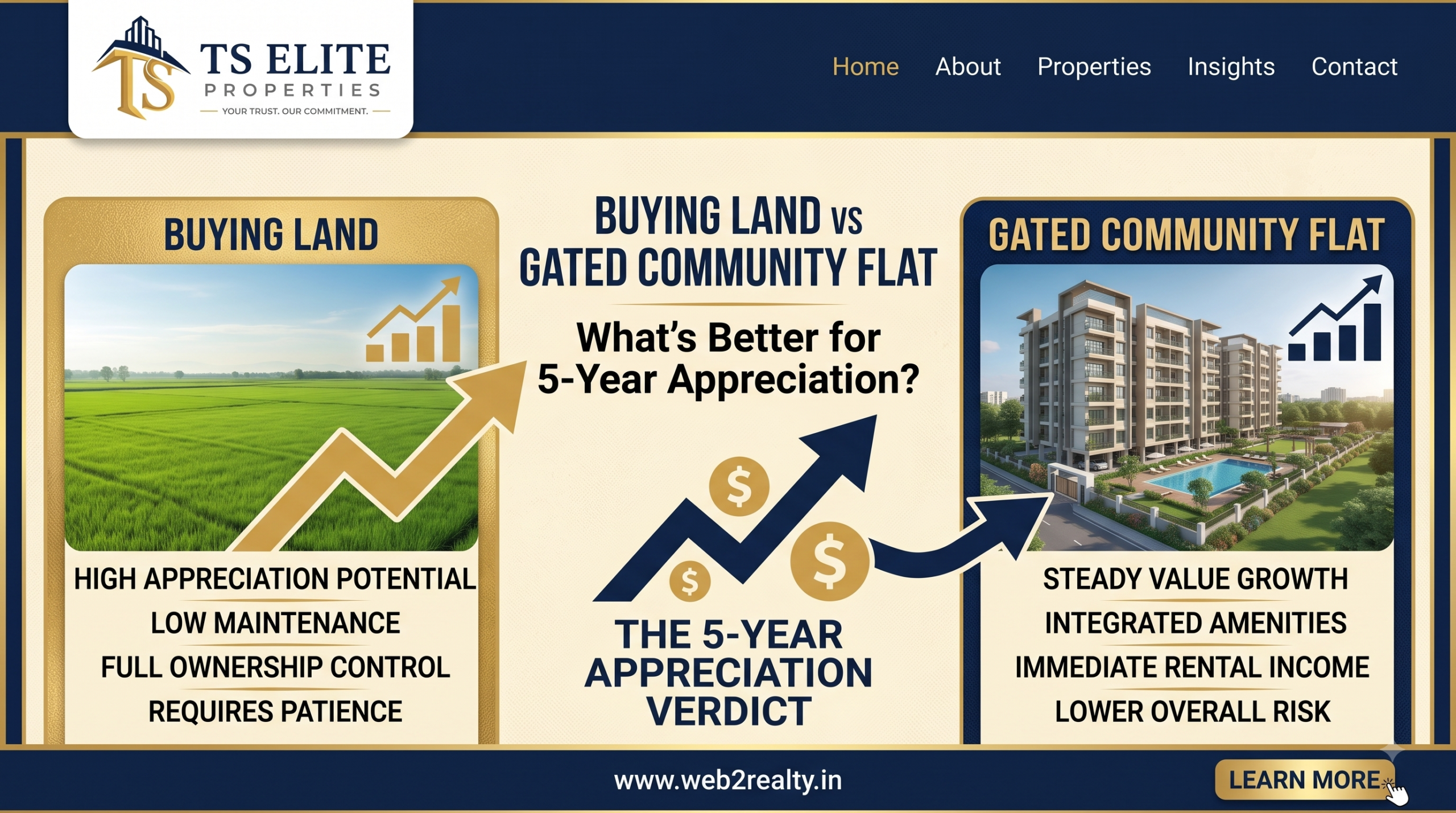
Buying Land vs Gated Community Flat: What’s Better for 5-Year Appreciation?
Best property investment opportunities

Buying Land vs Gated Community Flat: What’s Better for 5-Year Appreciation?

Real estate has always been considered a popular long-term investment option in India. But when you have a limited budget and want to invest for the next five years, an important question comes up: Should you buy land or invest in a gated community flat?

Both options have their own advantages. A flat can provide modern amenities, security, convenience, and the possibility of rental income. Land, on the other hand, offers flexibility, lower maintenance, and the potential for appreciation as an area develops.

If you are searching for the best property investment, you should not choose only based on what is popular in the market. Your decision should depend on your budget, investment goal, location, expected appreciation, maintenance costs, and how long you plan to hold the property.

In this article, let us compare buying land vs a gated community flat and understand which option could be better for 5-year appreciation.

What Does 5-Year Property Appreciation Mean?

Property appreciation means an increase in the value of a property over time.

For example, suppose you purchase a property for ₹40 lakh today. If its value increases to ₹55 lakh after five years, the property has appreciated by ₹15 lakh.

However, appreciation is never guaranteed. Real estate values depend on several factors, including:

  • Location
  • Infrastructure development
  • Road connectivity
  • Employment opportunities
  • Demand and supply
  • Nearby commercial development
  • Government projects
  • Neighborhood development
  • Property quality
  • Legal approvals

Therefore, when looking for the best property investment, it is important to study the future potential of the location instead of focusing only on today’s price.

Buying Land: Why Is It Considered a Good Investment?

Land is a limited natural resource. Unlike buildings, land does not depreciate physically with age.

If you purchase land in a developing location with good connectivity and infrastructure potential, its value may increase as the surrounding area develops.

1. Land Has Lower Maintenance

One of the biggest advantages of land investment is relatively low maintenance.

A flat requires regular maintenance of the building, common areas, lifts, security systems, parking areas, amenities, and other facilities. Land generally does not require the same level of recurring maintenance.

This can make land attractive for investors who want to hold a property for several years.

2. Land Offers Flexibility

With land, you have more flexibility regarding future use, subject to applicable laws and permissions.

Depending on the land type and approvals, you may eventually build a house or other permitted development.

This flexibility can be an advantage for long-term investors.

3. Development Can Increase Land Value

When roads, highways, educational institutions, hospitals, shopping areas, offices, and residential communities develop around a location, demand for nearby land can increase.

This is one reason investors often consider land when looking for the best property investment for long-term appreciation.

4. No Building Depreciation

A flat includes both land and a constructed building. The building itself ages over time and may require repairs and renovations.

With land, there is no building structure that physically gets older.

However, this does not mean every plot will automatically appreciate. Location, title, approvals, accessibility, and demand remain critical.

Gated Community Flats: Why Are They Attractive?

Gated community flats have become popular among families and working professionals because they combine housing, security, amenities, and convenience.

If your objective is both investment and personal use, a flat can offer benefits that vacant land cannot provide immediately.

1. Ready-to-Use Property

A completed flat can be occupied immediately after possession and required formalities.

You do not need to wait for years to construct a home.

This makes flats particularly useful for buyers who want a property for personal living.

2. Rental Income Potential

One major advantage of flats is the possibility of rental income.

A flat in a location with strong rental demand can potentially generate regular rental income while you hold the property.

For example, properties near IT hubs, business districts, educational institutions, hospitals, and transportation corridors may attract tenants.

Therefore, investors should consider both capital appreciation and rental potential when deciding on the best property investment.

3. Amenities and Security

Modern gated communities often provide amenities such as:

  • Security systems
  • Clubhouses
  • Swimming pools
  • Gyms
  • Children’s play areas
  • Walking tracks
  • Landscaped gardens
  • Community spaces
  • Parking facilities

These facilities can make flats attractive to families and tenants.

4. Easier Financing for Some Buyers

Home loans are commonly available for eligible residential flats, subject to lender policies and the buyer’s financial profile.

A loan can make it easier for some buyers to purchase a flat without paying the entire purchase price upfront.

However, buyers should consider interest costs and their long-term repayment capacity before taking a loan.

Land vs Gated Community Flat: Which Appreciates More?

There is no universal answer.

The best property investment depends heavily on the location and the specific property.

A well-located plot in a rapidly developing area could outperform a flat in a location with limited growth.

Similarly, a flat in a high-demand location near employment centers could perform better than land located far from infrastructure.

Therefore, rather than asking whether land or flats are always better, ask:

Which specific property has stronger long-term demand and better fundamentals?

5-Year Comparison: Land vs Flat

Let’s compare the two options from an investment perspective.

Factor

Land

Gated Community Flat

Maintenance

Usually low

Regular maintenance required

Rental income

Usually not immediate

Possible

Construction

Future construction possible

Already constructed/under construction

Amenities

Usually limited

Multiple amenities

Flexibility

Higher, subject to permissions

Limited to apartment use

Building depreciation

Not applicable

Building ages over time

Security

Depends on location

Usually managed by community

Loan availability

Depends on property and lender

Commonly available for eligible properties

Personal use

Requires construction if vacant

Can be ready to occupy

Appreciation

Strongly location-dependent

Strongly location and project-dependent

Which Is Better for 5-Year Appreciation?

If your primary objective is capital appreciation, land can be an attractive option when purchased in a location with strong future development potential.

Suppose an area is currently developing but has planned infrastructure, improving connectivity, and increasing residential demand. Land in such an area may benefit as the location matures.

However, you should never invest solely because someone promises that a plot will double in five years.

Real estate returns depend on actual market conditions.

A gated community flat can also appreciate, especially when it is located near employment hubs and established infrastructure.

The difference is that a flat can potentially provide rental income during the holding period, while land generally does not generate regular rental income unless it is used for a permitted purpose.

Location Is More Important Than Property Type

Whether you choose land or a flat, location is one of the biggest factors affecting appreciation.

Before investing, study:

Connectivity

Check access to major roads, highways, public transportation, and important destinations.

Employment

Areas close to major employment centers can have sustained housing demand.

Infrastructure

Look for existing and credible upcoming infrastructure projects.

Social Infrastructure

Schools, hospitals, shopping centers, restaurants, and recreational facilities can improve an area’s attractiveness.

Future Development

Study how the surrounding area is changing.

An investment made before significant development can sometimes offer better appreciation potential than buying after prices have already increased significantly.

What Should You Check Before Buying Land?

If you decide that land is the best property investment for your goals, do proper due diligence before making a payment.

Check:

  • Ownership and title
  • Previous sale deeds
  • Encumbrance details
  • Survey number
  • Land classification
  • Layout approval, where applicable
  • Road access
  • Property boundaries
  • Applicable government restrictions
  • Registration eligibility
  • Local development plans
  • Physical location of the property

Never rely entirely on brochures or verbal promises.

It is advisable to have the property’s documents reviewed by a qualified property lawyer before purchase.

What Should You Check Before Buying a Gated Community Flat?

For a flat, your due diligence should include:

  • Project approvals
  • Developer track record
  • RERA registration, where applicable
  • Sale agreement
  • Carpet area
  • Possession timeline
  • Maintenance charges
  • Parking arrangements
  • Amenities
  • Construction quality
  • Loan and payment terms
  • Location and connectivity
  • Resale demand
  • Rental demand

Do not select a flat only because it has a beautiful clubhouse or attractive interiors.

The surrounding location and the financial health and reputation of the project matter significantly for long-term investment.

Land or Flat: Which Is Better for You?

Choose land if:

  • Your primary goal is long-term appreciation.
  • You do not need immediate rental income.
  • You can wait several years for the location to develop.
  • You want lower property maintenance.
  • You prefer flexibility for future development, subject to permissions.
  • You have identified a legally clear property in a promising location.

Choose a gated community flat if:

  • You want a home for personal use.
  • You want the possibility of rental income.
  • You prefer ready-made amenities.
  • You value security and community facilities.
  • You want a property that can potentially serve both lifestyle and investment purposes.

How to Find the Best Property Investment?

Finding the best property investment requires more than comparing prices.

Start by identifying your objective.

Are you investing for appreciation?

Do you want rental income?

Are you planning to build a home?

Do you need a property for immediate use?

Once your goal is clear, compare suitable properties based on location, legal status, infrastructure, demand, affordability, and future potential.

Do not rush because of limited-time offers or pressure from salespeople.

A good property investment should fit your financial plan and long-term objectives.

Final Verdict: Land or Gated Community Flat?

So, what’s better for 5-year appreciation land or a gated community flat?

There is no guaranteed winner.

For investors primarily focused on long-term capital appreciation, a well-located plot can be an attractive choice because land is limited and does not physically depreciate like a building.

For buyers who want a combination of personal use, rental income, amenities, and potential appreciation, a gated community flat can be a practical option.

Ultimately, the best property investment is the property that matches your budget, purpose, risk tolerance, and investment timeline.

The key is not simply choosing between land and a flat. The real key is choosing the right property in the right location at the right price.

Frequently Asked Questions (FAQs)

1. Is land better than a flat for 5-year appreciation?

Land can offer strong appreciation potential in developing locations, but appreciation is not guaranteed. A flat in a high-demand location can also appreciate significantly. Location, price, infrastructure, and demand are important factors.

2. Is buying a flat a good property investment?

A flat can be a good property investment for buyers looking for a combination of potential appreciation, rental income, personal use, and modern amenities. The project and location should be carefully evaluated.

3. Why do investors consider land one of the best property investments?

Land is limited in supply and generally requires less maintenance than a constructed property. If purchased in a developing location with strong fundamentals, it can have good long-term appreciation potential.

4. Can a flat generate rental income?

Yes. A flat located near employment hubs, educational institutions, hospitals, commercial centers, and good transportation can have rental demand. Actual rental returns depend on the location and property.

5. What factors affect land appreciation?

Location, infrastructure, connectivity, development, employment opportunities, demand, accessibility, legal clarity, and surrounding projects can influence land appreciation.

6. What should I check before buying land?

Verify title, ownership, survey details, encumbrances, land classification, applicable approvals, access roads, boundaries, restrictions, and registration eligibility. A professional legal review is recommended.

7. What should I check before buying a gated community flat?

Check project approvals, RERA registration where applicable, developer reputation, construction quality, carpet area, possession schedule, maintenance charges, amenities, connectivity, resale potential, and rental demand.

8. Which is better for rental income: land or flat?

A flat is generally more suitable if your investment goal includes regular rental income. Vacant land typically does not provide regular rental income unless used for a permitted income-generating purpose.

9. Is location more important than property type?

In many cases, yes. A property in a strong location with good connectivity, infrastructure, demand, and future development can perform better than a similar property in a weaker location.

10. How can I choose the best property investment?

Define your goal first, then compare the location, property type, price, legal status, infrastructure, demand, potential appreciation, rental prospects, and your ability to hold the investment for the required period.

Looking for the Best Property Investment?

Whether you are interested in open plots, residential properties, or gated community projects, take the time to compare your options before investing.

Looking for the best property investment opportunities? Contact our real estate team today to explore available properties, compare locations, understand your options, and find a property that suits your budget and long-term goals.

Your next investment could be the foundation of your future. Start exploring the right property today!


Related Post

Can Non-Agriculturists Buy Agriculture Land in Telangana?

Buying agricultural land in Telangana

Can Non-Agriculturists Buy Agriculture Land in Telangana?

Buying land is one of the most popular ways to build long-term wealth. In Telangana, agricultural land is especially attracting buyers who are looking for larger parcels, peaceful surroundings, and future investment opportunities. But one common question comes up before making a purchase: Can non-agriculturists buy agricultural land in Telangana?

The simple answer is that being a non-agriculturist does not automatically mean you cannot purchase agricultural land. However, agricultural land transactions in Telangana are subject to several legal restrictions, land classifications, title conditions, and government regulations. Therefore, buyers should not assume that every agricultural parcel can be freely purchased or used for any purpose.

If you are searching for the best lands in Telangana, understanding these rules can help you make a safer and more informed investment decision.

What Is Agricultural Land?

Agricultural land is land primarily classified and recorded for farming and related agricultural activities. It may be used for growing crops, horticulture, orchards, or other permitted agricultural purposes.

The classification of land is important because buying agricultural land is not the same as buying a residential plot. If your intention is to construct a house, resort, commercial building, or other non-agricultural development, you may need the required permissions and land-use conversion.

Telangana has a formal land-record and registration system through which ownership, transactions, mutations, and other land-related information are maintained. Government information describes Dharani as an integrated system for agricultural land records and registration services.

Can a Non-Agriculturist Buy Agricultural Land in Telangana?

In general, a person does not become automatically disqualified from purchasing agricultural land simply because they are not an agriculturist. However, this does not mean every agricultural property is freely transferable.

The buyer must first check whether the particular land is legally transferable.

Several restrictions may apply depending on the property’s history and classification. For example, Telangana government sale-deed documentation requires verification that the property is not prohibited under Section 22A of the Registration Act and is not in violation of laws relating to assigned lands, land ceilings, or Scheduled Area land transfers.

This is why anyone searching for the best lands in Telangana should focus on legal verification rather than simply choosing land based on price or location.

Important Laws and Restrictions to Check

Before purchasing agricultural land, buyers should understand some of the important legal areas that can affect the transaction.

1. Telangana Land Reforms Laws

Agricultural land holdings can be subject to land-ceiling regulations. A buyer should verify that the proposed purchase does not violate applicable provisions of the Telangana Land Reforms (Ceiling on Agricultural Holdings) Act.

Government documentation used in land transactions specifically requires declarations concerning compliance with land-ceiling provisions.

2. Assigned Land Restrictions

Assigned lands can have restrictions on their transfer. Telangana’s Assigned Lands (Prohibition of Transfers) Act, 1977 is particularly important when checking agricultural property.

A buyer should confirm that the land being offered for sale is not assigned land or otherwise restricted from transfer. Government sale documentation specifically requires verification of this point.

3. Scheduled Area Land

Special restrictions can apply to land located in Scheduled Areas. The Telangana Scheduled Area Land Transfer Regulation, 1970 is one of the laws identified in official transaction documentation that must be considered before a transfer.

Therefore, buyers looking for the best lands in Telangana should not make a decision based only on the location and market price.

4. Prohibited Properties

Some properties may appear attractive but may fall under prohibited categories.

The government registration system provides services related to prohibited properties, while official Telangana information has also highlighted issues involving prohibited-list properties and land-record discrepancies.

Before paying an advance, verify whether the survey number is clear for registration.

Can Agricultural Land Be Used for a House or Commercial Purpose?

This is another important question for non-agriculturist buyers.

Buying agricultural land does not automatically give you permission to use it for residential or commercial development.

Telangana has a land-conversion framework for converting agricultural land to non-agricultural use. The Hyderabad District administration explains that the Non-Agricultural Lands Assessment Act regulates the conversion of agricultural land for non-agricultural purposes.

So, if your plan is to purchase agricultural land and later build a farmhouse, commercial property, resort, or other structure, you should first understand the applicable land-use and building permissions.

Never assume that agricultural land can automatically be converted simply because you own it.

What Should You Check Before Buying Agricultural Land?

If you are searching for the best lands in Telangana, legal verification should be your first priority.

Here is a simple checklist to follow.

1. Verify the Seller’s Ownership

Check whether the seller is the genuine owner of the property.

Ask for the original title documents and previous link documents. The ownership history should be clear and consistent.

2. Check the Survey Number

The survey number is one of the most important details when buying land.

Verify the survey number, extent, boundaries, village, mandal, and district against the official land records.

3. Check Land Records

Government land-record services provide facilities such as mutation, land conversion, encumbrance search, certified copies, land valuation information, and other registration-related services.

Use the available official records to cross-check the property details before proceeding.

4. Obtain an Encumbrance Check

An encumbrance search can help identify registered transactions or charges affecting the property.

Do not rely only on documents provided by the seller. Conduct an independent verification wherever possible.

5. Check for Court Cases

Make sure the property is not involved in litigation, injunctions, or ownership disputes.

Official Telangana transaction documentation includes a declaration that there is no court order or injunction restricting the transfer.

6. Check Whether the Land Is Assigned or Restricted

Confirm that the property is not assigned land, government land, forest land, endowment land, Wakf land, or another restricted category.

This step is especially important when evaluating the best lands in Telangana.

7. Check the Land Use

Ask yourself what you actually want to do with the property.

If you want agricultural use, verify that the land is suitable for farming.

If you want residential or commercial development, find out whether conversion and development permissions are legally possible.

Why Are People Interested in Agricultural Land in Telangana?

Telangana offers a wide range of land options, from agricultural parcels and farm properties to approved residential plots and developing investment locations.

Many buyers are attracted to agricultural land because it may offer:

  • Larger land parcels
  • Lower entry prices in selected areas
  • Peaceful surroundings
  • Agricultural use
  • Long-term investment potential
  • Opportunities close to developing regions

However, investment potential depends heavily on location, accessibility, infrastructure, legal status, demand, and future development.

That is why the best lands in Telangana should not be judged only by the lowest price per acre.

A property with proper documentation, good road access, clear ownership, and strong location fundamentals may be more valuable than a cheaper property with legal or access issues.

What Makes the Best Lands in Telangana?

If you are planning to invest in land, consider these factors before choosing a property.

Good Road Connectivity

Land located near major roads, highways, or important transportation corridors may have better accessibility.

Future Development

Look for areas where infrastructure, residential communities, educational institutions, commercial activity, or other development is expanding.

Clear Documentation

This should be one of your highest priorities. A low-priced property is not a good investment if its title is unclear.

Water Availability

For agricultural land, water availability can have a major impact on the land’s usefulness.

Nearby Facilities

Check the distance from towns, markets, schools, hospitals, banks, and other essential facilities.

Legal Approvals and Land Classification

Always understand whether the land is agricultural, residential, commercial, or part of an approved layout.

If land has been divided into plots, buyers should also check the applicable layout approval. Telangana’s official LRS information explains that unauthorized layouts can include land subdivided without approval from the competent authority.

Agricultural Land vs Open Plots: Which Is Better?

There is no single answer because it depends on your investment objective.

If you want land for farming or agricultural purposes, agricultural land may be suitable.

If your primary objective is to build a house in the future, an appropriately approved residential plot may be more convenient.

For buyers who want to invest without immediately taking up farming, approved open plots can sometimes provide a simpler investment structure, provided the layout and title are properly verified.

Therefore, when looking for the best lands in Telangana, first identify your purpose and then select the appropriate type of property.

Common Mistakes to Avoid

Many land buyers make mistakes because they focus only on price.

Avoid these common problems:

Do not buy based only on a brochure. Verify the actual land records.

Do not pay a large advance before verification. First check ownership, restrictions, and registration eligibility.

Do not assume agricultural land can automatically be used for construction. Land conversion and development permissions may be required.

Do not ignore access roads. Confirm that the property has legally usable access.

Do not rely only on verbal promises. Get important commitments documented.

Do not skip professional legal verification. A qualified property lawyer can help identify issues that may not be obvious to a first-time buyer.

FAQs

1. Can non-agriculturists buy agricultural land in Telangana?

In many cases, being a non-agriculturist does not automatically prevent a person from purchasing agricultural land. However, the specific property must be legally transferable and comply with applicable Telangana laws and restrictions.

2. What should I check before buying agricultural land in Telangana?

Check the ownership, title documents, survey number, land records, encumbrances, court cases, land classification, access road, and whether the property falls under any restricted or prohibited category.

3. Can agricultural land be converted into residential land in Telangana?

Agricultural land may require the applicable land-use conversion process before it can legally be used for non-agricultural purposes. Buyers should verify the current requirements with the relevant authorities.

4. Is agricultural land a good investment in Telangana?

Agricultural land can be a long-term investment option, but its potential depends on location, connectivity, water availability, development, legal status, and market demand.

5. How can I find the best lands in Telangana?

When searching for the best lands in Telangana, compare location, road connectivity, title clarity, land classification, surrounding development, water availability, and future growth potential rather than focusing only on price.

6. Can I construct a house on agricultural land?

Not necessarily. Agricultural land cannot automatically be used for residential construction simply because you own it. Applicable conversion and building permissions should be checked before construction.

7. What are assigned lands in Telangana?

Assigned lands are lands granted by the government under specific conditions. Their transfer can be restricted under applicable laws, so buyers should verify the land’s status before purchasing.

8. Why is title verification important when buying land?

Title verification helps establish whether the seller has the legal right to sell the property and whether there are potential disputes, claims, encumbrances, or restrictions affecting the land.

9. What makes the best lands in Telangana for investment?

Good accessibility, clear title, suitable land classification, nearby infrastructure, development potential, availability of basic facilities, and reasonable pricing are important factors when evaluating the best lands in Telangana.

10. Should I consult a lawyer before buying agricultural land?

Yes. Agricultural-land transactions can involve different legal restrictions and documentation requirements. A qualified property lawyer can help verify the title and identify potential legal issues before purchase.


Final Thoughts

So, can non-agriculturists buy agriculture land in Telangana? In many situations, being a non-agriculturist by itself does not automatically prevent a person from purchasing agricultural land. However, the specific property must be legally transferable and free from applicable restrictions.

Land laws and records can be complicated. Restrictions relating to assigned lands, prohibited properties, land ceilings, Scheduled Areas, title disputes, and land-use conversion can significantly affect a purchase.

If you are searching for the best lands in Telangana, take your time, verify the records, inspect the property, understand its classification, and obtain professional legal advice before completing the transaction.

The right land investment is not simply about finding a cheap property. It is about finding legally clear land in the right location with good long-term potential.

Looking for the Best Lands in Telangana?

Searching for the best lands in Telangana for investment, agriculture, or future development? Explore suitable land opportunities based on your budget, preferred location, and investment goals.

Contact our real estate team today to learn about available land options, check property details, and find a property that matches your requirements.

Your ideal land investment could be closer than you think start your search today!

Related Post

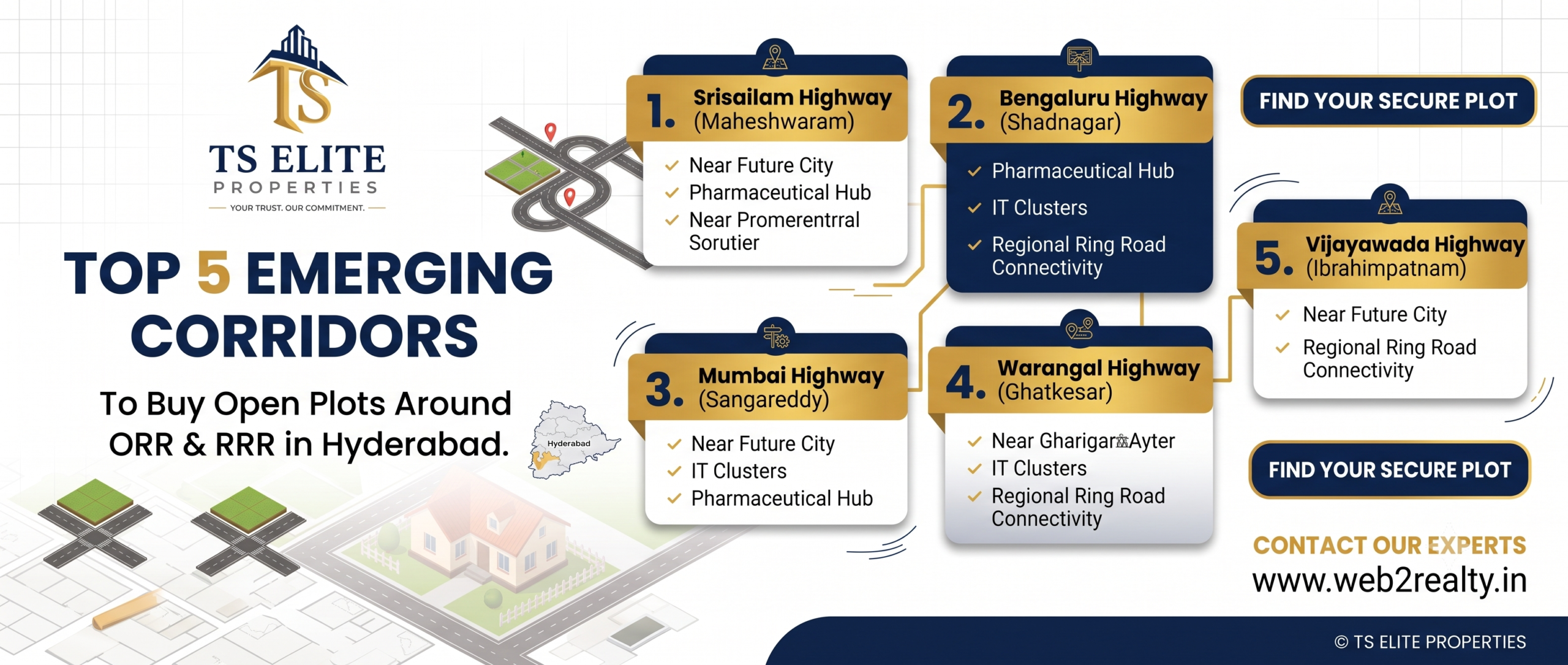
Top 5 Emerging Corridors to Buy Open Plots Around ORR & RRR in Hyderabad.

buy land in Hyderabad

Top 5 Emerging Corridors to Buy Open Plots Around ORR & RRR in Hyderabad.

Buying land has always been one of the safest and most profitable ways to build long-term wealth in India. In Hyderabad, the real estate market is expanding rapidly, fueled by mega-infrastructure projects, massive IT hubs, industrial clusters, and world-class connectivity.


If you are looking for the best location to buy land in Hyderabad, the real growth story is no longer in the saturated city center it is unfolding along two massive arterial highways: the 158 km Outer Ring Road (ORR) and the upcoming Regional Ring Road (RRR).


These outer corridors offer accessible entry prices, clear land approvals, and exceptional appreciation potential. To help you make a smart investment, here is a detailed breakdown of the top 5 emerging corridors around the ORR and RRR belt.


Why Invest Near ORR and RRR Corridors?

Before picking a specific area, it helps to understand why the ORR and RRR belts dominate real estate investment discussions:


  • Seamless Connectivity: The ORR connects peripheral sub-markets directly to the Financial District, HITEC City, and Rajiv Gandhi International Airport in 25–40 minutes.


  • The RRR Factor: The 340+ km Regional Ring Road acts as a secondary multiplier, connecting satellite towns and creating major logistics, industrial, and residential hubs.


  • High ROI & Appreciation: Land values along expanding infrastructure rings experience compounding growth compared to central urban properties that face price saturation.


  • Flexible Entry Pricing: Whether you have a budget of ₹15,000 per sq. yard or ₹45,000 per sq. yard, these corridors accommodate both retail investors and high-net-worth buyers.


1. The South Corridor: Tukkuguda, Maheshwaram & Srisailam Highway

The southern growth zone is arguably the most dynamic real estate corridor in Hyderabad today. Driven by its close proximity to the airport, the proposed Future City mega-project, and hardware tech parks, South Hyderabad attracts high buyer demand.


Key Micro-Locations

  • Tukkuguda (ORR Exit 14): Directly adjacent to the airport, offering instant access to Gachibowli. Ideal for premium HMDA open plots and luxury villa projects.


  • Maheshwaram: Famous for expanding electronic hardware parks, industrial corridors, and clean suburban layouts.


  • Kadthal & Mucherla: Budget-friendly growth zones situated along the Srisailam Highway, benefiting from Future City developments.


Investment Highlights

  • Average Price Range: ₹18,000 – ₹42,000 per sq. yard (depending on layout approvals and proximity to main roads).


  • Best Suited For: Medium to long-term investors looking for rapid capital appreciation.


  • Growth Drivers: Rajiv Gandhi International Airport, E-City, Hardware Park, and Srisailam Highway infrastructure expansions.


2. The South-West Corridor: Shadnagar & Bangalore Highway (NH-44)

Shadnagar has evolved from a quiet satellite town into a bustling real estate hub. Situated along the heavily traveled Hyderabad-Bengaluru Highway (NH-44), it sits right at the intersection of future ORR extensions and the RRR belt.


Key Micro-Locations

  • Shadnagar Main Town: Well-developed commercial area with direct train connectivity and established local amenities.


  • Farooqnagar & Kothur: Industrial and logistics hubs with expanding residential layouts.


Investment Highlights

  • Average Price Range: ₹15,000 – ₹35,000 per sq. yard (HMDA & DTCP approved).


  • Best Suited For: First-time plot buyers, long-term wealth builders, and budget investors.


  • Growth Drivers: NRSC (ISRO), Amazon Fulfillment Center, Symbiosis International University, and RRR junction access.


3. The West Suburban Belt: Mokila, Shankarpally & Kollur

For buyers looking to build a luxury home or secure a plot near the IT corridor, the Western belt remains the most prestigious investment choice. As central western hubs like Tellapur face space constraints, buyers are moving toward Mokila and Shankarpally.


Key Micro-Locations

  • Kollur & Tellapur: Located right off the ORR, offering immediate access to the Financial District. High-density growth zone.


  • Mokila: Known as the “villa capital” of western Hyderabad, offering peaceful, green surroundings away from pollution.


  • Shankarpally: Nestled along green belts, offering a mix of gated community open plots, farm plots, and long-term land investments.


Investment Highlights

  • Average Price Range: ₹35,000 – ₹65,000+ per sq. yard.


  • Best Suited For: IT professionals, HNI investors, and buyers planning to build a house within 1 to 3 years.


  • Growth Drivers: Financial District proximity, IIT Hyderabad, 100-ft connecting roads, and premium gated communities.


4. The North-West Belt: Patancheru, Sangareddy & Mumbai Highway (NH-65)

Connecting Hyderabad to Mumbai, this northwest industrial corridor offers high liquidity, excellent public transport, and continuous commercial expansion.


Key Micro-Locations

  • Patancheru: A major industrial-to-residential transformation zone located right at the ORR junction.


  • Sangareddy: A district headquarters along the NH-65 highway, directly benefiting from planned RRR interchanges.


  • Kandi: Home to educational hubs like IIT Hyderabad, driving strong plot demand.


Investment Highlights

  • Average Price Range: ₹20,000 – ₹40,000 per sq. yard.


  • Best Suited For: Rental yield investors and medium-term land buyers.


  • Growth Drivers: Mumbai Highway expansion, IIT Hyderabad, industrial estates, and upcoming RRR bypasses.


5. The East Corridor: Ghatkesar, Bibinagar & Warangal Highway (NH-163)

East Hyderabad provides some of the most affordable entry points for HMDA and DTCP approved plots while offering high growth backed by government infrastructure.


Key Micro-Locations

  • Ghatkesar & Pocharam: Driven by major IT and corporate campuses like Infosys and Raheja Mindspace.


  • Bibinagar: Famous for AIIMS Hospital, seeing massive growth in healthcare, education, and residential developments.


  • Pedda Amberpet & Choutuppal: Positioned along the Vijayawada and Warangal corridors with rapid RRR progress.


Investment Highlights

  • Average Price Range: ₹15,000 – ₹38,000 per sq. yard.


  • Best Suited For: Budget-conscious buyers looking for steady, long-term capital growth.


  • Growth Drivers: AIIMS Bibinagar, Infosys Campus, Warangal Highway expansion, and proposed Metro extensions.


Quick Summary: Comparing the Top Investment Corridors

Corridor

Key Locations

Average Growth Drivers

Best Suited For

South Corridor

Tukkuguda, Maheshwaram, Kadthal

Airport, Future City, Hardware Park

High capital appreciation, long-term plots

South-West

Shadnagar, Kothur, Farooqnagar

Bangalore Highway (NH-44), RRR Junction

Budget investors, 5–10 year holding

West Corridor

Mokila, Shankarpally, Kollur

Financial District, IT Hubs, Luxury Villas

Immediate home construction, HNIs

North-West

Patancheru, Sangareddy, Kandi

Mumbai Highway (NH-65), IIT Hyderabad

Medium-term holding, industrial demand

East Corridor

Ghatkesar, Bibinagar, Pocharam

AIIMS, Infosys, Warangal Highway

Low entry-cost, stable appreciation

How to Verify Land Before Buying

Finding the best location to buy land in Hyderabad is only half the battle. Ensuring your investment is legally secure is critical.


  1. Verify Layout Approval: Ensure the plot has a valid HMDA LP Number or DTCP Approval. Avoid unapproved Gram Panchayat layouts.
  2. Check RERA Registration: Verify the real estate project on the official Telangana RERA portal.
  3. Inspect Road Widths: Confirm internal roads are at least 30 to 40 feet wide as per master plan norms.
  4. Obtain an Encumbrance Certificate (EC): Ensure the property has clear titles for the last 30 years without legal encumbrances.


Frequently Asked Questions (FAQs)

1. Which is the best location to buy land in Hyderabad for high ROI?

For high capital growth over 3 to 5 years, the South Corridor (Tukkuguda, Maheshwaram) and South-West Corridor (Shadnagar) offer high potential due to airport proximity, industrial parks, and upcoming RRR infrastructure.


2. What is the average price of HMDA open plots near RRR in Hyderabad?

Plot prices near the Regional Ring Road (RRR) belt typically range between ₹15,000 and ₹35,000 per sq. yard, depending on exact location, road width, and developer amenities.


3. Is it safe to buy DTCP plots near the RRR corridor?

Yes, DTCP-approved plots are legally safe and vetted by state planning authorities. Just ensure the layout has final approval, clear title deeds, and a valid LP number.


4. Can I get a bank loan for open plots around the ORR and RRR?

Yes. Leading public and private banks offer plot loans for HMDA and DTCP-approved layouts around ORR and RRR, covering up to 70%–80% of the plot value subject to clear legal titles.


Ready to Secure Your High-Growth Plot in Hyderabad?

Navigating real estate options across outer Hyderabad can feel overwhelming, but you do not have to do it alone.


At www.web2realty.in, we help investors and homebuyers find verified, 100% legal, HMDA and DTCP approved open plots and farmland investments across top growth corridors like Shadnagar, Maheshwaram, Tukkuguda, and Shankarpally.


Call / WhatsApp Us Today: Speak directly with our land advisory experts to discuss your budget and goals.


 Book a Free Site Visit: Experience the growth corridors firsthand with organized weekend site tours.


Explore Top Listings: Visit www.web2realty.in to view handpicked, high-ROI open plots today!

Related Post

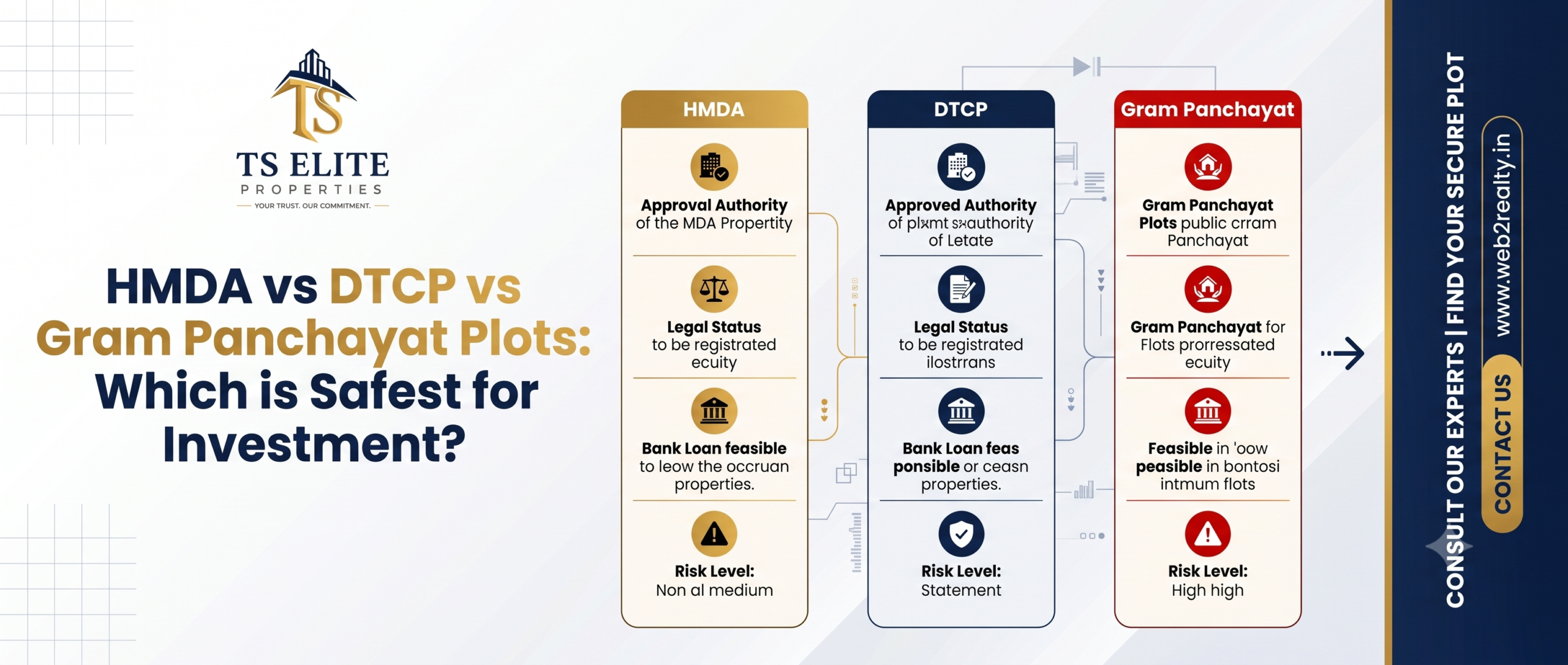
HMDA vs DTCP vs Gram Panchayat Plots: Which is Safest for Investment?

HMDA vs DTCP vs Gram Panchayat Plots

HMDA vs DTCP vs Gram Panchayat Plots: Which is Safest for Investment?

Buying a plot of land is one of the most popular ways to build wealth in India. If you are looking to invest in real estate around Hyderabad or expanding towns across Telangana, you have likely come across three common labels: HMDA, DTCP, and Gram Panchayat.


At first glance, a plot of land looks the same regardless of its approval tag. However, the legal backing behind that plot determines whether your investment will appreciate smoothly or turn into a costly legal nightmare.


If you are evaluating HMDA plots in Telangana alongside cheaper DTCP or Gram Panchayat options, this detailed guide breaks down how these approvals work, which option is the safest, and how to protect your hard-earned money.


Understanding the Approvals: HMDA, DTCP, and Gram Panchayat

Before comparing safety, it helps to understand what each governing body actually does.


1. What is an HMDA Approved Plot?

The Hyderabad Metropolitan Development Authority (HMDA) governs urban planning across Hyderabad and its surrounding suburban districts, covering an area of over 7,200 square kilometers.


When a developer creates a layout within the metropolitan area, they must submit plans to the HMDA. The authority checks:


  • Title deeds and land ownership records.
  •  
  • Provision for wide blacktop roads (minimum 30-foot to 40-foot internal roads).
  •  
  • Reservation of 10% of total land area for public parks and open green spaces.
  •  
  • Infrastructure plans for underground drainage, water supply pipelines, and electricity setups.
  •  

HMDA plots in Telangana represent the highest standard of urban planning, making them the top choice for investors seeking risk-free assets.


2. What is a DTCP Approved Plot?

The Directorate of Town and Country Planning (DTCP) oversees land developments in Telangana that fall outside the HMDA metropolitan jurisdiction. This includes tier-2 towns, peri-urban zones, and expanding rural districts like Warangal, Karimnagar, Nizamabad, and peripheral areas along major highways.


DTCP layout rules follow strict planning guidelines similar to HMDA, including mandatory road widths, open space allocation, and drainage requirements. The primary difference lies in geography: DTCP covers rural-to-urban transitioning zones, whereas HMDA covers the core metropolitan region.


3. What is a Gram Panchayat Plot?

Gram Panchayats are local self-governments at the village level. Historically, village Sarpanches issued layout permissions for land falling under their village boundaries.


However, Gram Panchayats do not have the legal authority to approve commercial or residential plot layouts without explicit sanction from regional planning authorities like HMDA or DTCP. Most Gram Panchayat layouts sold by private developers are unapproved, illegal layouts created without adhering to road width standards or reserving public spaces.


Detailed Comparison: HMDA vs DTCP vs Gram Panchayat

Feature

HMDA Approved Plots

DTCP Approved Plots

Gram Panchayat Plots

Jurisdiction

Hyderabad Metropolitan Area

Telangana Districts & Municipalities

Local Village Boundaries

Legal Risk

Extremely Low

Very Low

Extremely High

Bank Loan Eligibility

Almost 100% (Nationalized & Private Banks)

High (Major Banks & NBFCs)

Extremely Low (Unapproved)

Road Width Rules

Minimum 30 to 40 ft internal roads

Minimum 30 to 33 ft internal roads

Unstandardized (Often 15-20 ft)

Park & Open Space

Mandatory 10% reserved area

Mandatory 10% reserved area

Rarely provided

Price Point

Premium / Higher

Medium / Moderate

Low / Discounted

Resale & Liquidity

High demand, quick resale

Steady demand, good long-term ROI

Difficult to sell, legal hurdles

Which Plot Approval is the Safest?

The Clear Winner: HMDA & DTCP Approved Plots

If legal security, hassle-free construction, and easy bank financing are your priorities, HMDA and DTCP approved plots are the safest options in Telangana.


Here is why buying an approved plot gives you complete peace of mind:


  1. Clear Land Title: Both HMDA and DTCP conduct multi-departmental background checks to verify that the land does not belong to the government, lake buffer zones (FTL/Nala), or disputed court cases before issuing a Layout Permit (LP Number).
  2. Guaranteed Infrastructure: Approved layouts require developers to install basic amenities like electricity lines, overhead water tanks, underground sewage lines, and paved roads before final layout approval is granted.
  3. Instant Bank Loans: Top public and private banks readily approve home and plot loans for HMDA and DTCP projects because the legal risks are already vetted.
  4. Hassle-Free Building Approvals: When you decide to build a house, obtaining building permissions through state portals (like TS-bPASS) is quick and straightforward for approved plots.

The Danger of Investing in Gram Panchayat Plots

It can be tempting to buy Gram Panchayat plots because they are often listed at 30% to 50% lower prices than nearby HMDA plots in Telangana. However, buying an unapproved Gram Panchayat plot carries serious risks:


  • No Building Permissions: The Telangana government strictly prohibits granting building construction permits on unapproved plots.
  •  
  • Registration Restrictions: State rules restrict the registration of individual plots in unapproved layouts unless they have been regularized under official schemes like the Layout Regularisation Scheme (LRS).
  •  
  • Lack of Civic Utilities: Local municipalities and electricity boards may deny official water, electricity, and drainage connections to illegal layouts.
  •  
  • Risk of Demolition: If a layout encroaches on government land, water bodies, or public roads, authorities can clear the structures without compensation.
  •  

Key Rule: A layout permission stamped solely by a village Sarpanch or Gram Panchayat secretary without an official HMDA or DTCP LP number is legally invalid for residential layout development.


5-Step Verification Checklist Before Buying Land

Before paying an advance or signing a sales agreement, follow this verification process:


  1. Ask for the LP Number: Every genuine layout has a unique Layout Permit (LP) Number issued by HMDA or DTCP.
  2. Verify Online: Cross-check the LP number on the official HMDA portal or DTCP portal to confirm the layout map matches what the seller is offering.
  3. Check the Final Layout Copy: Ensure the layout has received Final Layout Approval, not just tentative layout permission.
  4. Verify Road Widths & Park Space: Measure internal roads on site to confirm they match the approved master plan (minimum 30 feet).
  5. Apply for an Encumbrance Certificate (EC): Obtain an EC for the last 13 to 31 years from the registration portal to verify clear ownership history.

Summary: Making the Right Choice

  • Buy HMDA approved plots if you want to invest around the Hyderabad Metropolitan region, near the Outer Ring Road (ORR), or along major highway corridors where rapid urban growth is expected.
  •  
  • Buy DTCP approved plots if you are targeting developing towns across Telangana or long-term agricultural fringe developments outside HMDA limits.
  • Avoid Gram Panchayat plots unless the plot has a valid, government-verified LRS (Layout Regularisation Scheme) approval certificate.

Investing in approved land requires a slightly higher initial budget, but it protects your capital, guarantees steady price appreciation, and keeps your property investment completely safe.


Frequently Asked Questions (FAQs)

1. Is a Gram Panchayat plot safe if it has an LRS approval?

If a Gram Panchayat plot was successfully regularized under the government’s Layout Regularisation Scheme (LRS) and holds an official LRS proceedings certificate, its legal status improves significantly. However, you should still verify whether banks offer loans on the plot and confirm that internal road access is sufficient.


2. How can I verify HMDA plots in Telangana online?

You can verify approved layouts by visiting the official HMDA portal. Go to the “Approved Layouts” section and search using the developer’s name, survey number, village location, or official LP (Layout Permit) number.


3. What is the difference in road width between HMDA and Gram Panchayat layouts?

HMDA mandates that all internal roads must be at least 30 to 40 feet wide, with main connecting roads often requiring 60 to 100 feet. Unapproved Gram Panchayat layouts often feature narrow 15 to 20-foot roads, making vehicle movement and utility installation difficult.


4. Do banks give home loans for DTCP approved plots?

Yes. Nationalized banks (like SBI) and leading private banks provide plot and construction loans for DTCP approved layouts, provided the title deeds and layout documents are clear.

Looking for 100% Legal & HMDA/DTCP Approved Plots?

Don’t let unapproved land turn into a legal headache. At www.web2realty.in, we curate verified, clear-title open plots and farmland investments across Telangana’s top growth corridors.

 [Schedule a Free Legal & Site Consultation with Web2Realty Experts]

Ready to Invest in Risk-Free Land Around Hyderabad?

Browse our handpicked selection of HMDA and DTCP approved layouts near ORR, Shadnagar, and Maheshwaram with guaranteed bank loan support.

 [Call www.web2realty.in Today or Request an Online Callback]

Related Post

How to Select a Plot for Building Your Future Home & Plan Your Budget.

HMDA-approved open plot layout

How to Select a Plot for Building Your Future Home & Plan Your Budget.

Buying an open plot and constructing a customized home is one of the most fulfilling investments you can make. Unlike buying an apartment where layout, room dimensions, and common facilities are fixed by a builder, owning land gives you complete control. You choose the architectural style, room layouts, garden spaces, and interior finishes that reflect your personal vision.

In expanding metropolitan markets like Hyderabad, open plots also serve as powerful financial growth engines. Plotted land does not depreciate over time; instead, it gains substantial value as surrounding roads, employment centers, and commercial hubs mature.

However, buying land requires careful planning. Selecting the wrong plot can lead to legal complications, construction delays, or budget overruns. Success depends on two crucial steps: knowing how to evaluate the physical land and planning your complete budget before making a deposit.

This guide provides a step-by-step walkthrough of plot selection, breaks down the hidden costs of land purchases, and highlights the best open plots in Hyderabad across top growth corridors.

 How to Select a Plot for Building Your Future Home

Selecting a plot involves balancing legal security, structural practicality, and everyday convenience. Before signing an agreement or paying an advance, evaluate these critical factors:

1. Legal Due Diligence & Regulatory Approvals

Legal verification is the single most important step when buying land. In Telangana, unapproved or illegal layouts can prevent you from securing building permits, water connections, or bank loans.

  • Layout Approvals: Ensure the plot is officially approved by urban planning authorities such as the HMDA (Hyderabad Metropolitan Development Authority) or the DTCP (Directorate of Town and Country Planning). Approved layouts guarantee dedicated space for public roads, parks, and utility reserves.
  • TRERA Registration: For modern plotted layouts, check whether the project is registered under the Telangana Real Estate Regulatory Authority (TRERA).
  • Clear Title Deed: Work with an independent legal professional to review ownership records for the past 30 years. Confirm that the seller holds a clear, marketable title without pending family disputes or co-owner litigation.
  • Encumbrance Certificate (EC): Obtain an EC from the sub-registrar’s office covering 13 to 30 years to confirm the plot is free from mortgages, court attachments, or bank liens.

2. Soil Quality, Elevation, and Topography

The physical condition of the ground directly impacts your construction costs and the long-term safety of your home:

  • Soil Bearing Capacity: Conduct a basic soil test before finalizing the purchase. Hard, gravelly, or rocky soil provides a strong base, reducing foundation costs. Soft clay or black cotton soil expands when wet and shrinks when dry, requiring deeper and more expensive foundation engineering.
  • Elevation & Drainage: Choose a plot that is at the same level as, or slightly higher than, the adjacent approach road. Plots situated in low-lying pockets or valley dips face severe waterlogging during monsoon downpours.

3. Plot Geometry, Orientation, and Vastu Compliance

The shape and direction of a plot affect natural light, air circulation, and structural layout efficiency:

  • Shape: Rectangular or square plots are ideal. They allow architects to design functional floor plans with zero wasted space. Avoid irregular, triangular, or L-shaped plots, which result in awkward corners and restricted construction boundaries.
  • Orientation: East-facing and North-facing plots are highly preferred across India due to morning sunlight and traditional Vastu Shastra principles.
  • Corner Plots: Plots with roads on two sides offer superior natural ventilation, increased natural light, and flexible entrance design options.

4. On-Site Physical Infrastructure

Examine the immediate surroundings to ensure the plot is ready for construction:

  • Internal Road Width: The approach road in front of the plot should be at least 30 to 40 feet wide. This ensures smooth movement for construction vehicles, personal cars, and emergency services.
  • Utilities Availability: Confirm access to municipal water lines (such as HMWS&SB), underground sewage systems, electricity grids, and high-speed internet cables right at the plot boundary.

 Pro-Tip for Buyers: Visit the site at different times of the day preferably once during the day and once in the evening and inspect the area after heavy rain to evaluate traffic, ambient noise, and drainage performance.

 Planning Your Budget Before Buying an Open Plot

A common mistake among land buyers is budgeting only for the sticker price of the plot per square yard. Purchasing open land involves several mandatory legal, administrative, and development fees. Failing to account for these extra costs can strain your finances.

1. The True Cost Breakdown of Buying an Open Plot

To avoid financial surprises, break down your overall budget into distinct categories:

Budget Component

Estimated Cost Percentage / Range

Description

Base Land Cost

75% – 80% of total budget

The agreed purchase rate per square yard.

Stamp Duty & Registration

~6% of property market value

Statutory government charges in Telangana (4% Stamp Duty + 0.5% Registration + 1.5% Transfer Duty).

Legal & Title Verification Fees

₹15,000 – ₹35,000 (flat fee)

Payment to an independent property lawyer for title search reports and document checks.

Layout Development Charges

Variable (₹100 – ₹300 per sq. yd)

Charges collected by developers for underground cables, tar roads, water tanks, and park landscaping.

Surveying & Fencing Costs

₹20,000 – ₹50,000

Professional land surveying, boundary demarcation, and temporary boundary wall creation.

Loan Processing & Administrative Fees

0.5% – 1% of loan amount

Processing fees charged by banks or housing finance companies.

Emergency Contingency Buffer

5% of total plot budget

Reserve fund set aside for unexpected administrative or document processing expenses.

2. Financing Strategy: Plot Loans vs. Home Loans

If you plan to fund your purchase using a bank loan, keep these key financial rules in mind:

  • Lower Loan-to-Value (LTV) Ratio: Banks typically offer an LTV ratio of 70% to 80% for open plot loans, compared to 85% to 90% for built residential homes. This means you must arrange a higher down payment (20% to 30% of the plot value) from your personal savings.
  • Construction Timelines: Many banks mandate that construction on the plot must begin within 2 to 5 years of loan disbursal. If you plan to hold the land as an investment without immediate construction, check the loan terms carefully with your lender.
  • Separate Construction Budget: Maintain a distinct financial reserve if you plan to construct your home within 12 to 24 months. Construction costs depend heavily on structural design, material selection, and labor rates.

 Corridor Breakdown — Best Open Plots in Hyderabad

Hyderabad’s urban expansion is guided by the 158-kilometer, 8-lane Outer Ring Road (ORR) and the upcoming Regional Ring Road (RRR). Choosing the right location depends on your investment goal, budget, and construction timeline.

Here is an analysis of the top growth corridors offering the best open plots in Hyderabad:

1. Western Growth Corridor (Kollur, Tellapur, Mokila & Shankarpally)

  • Target Audience: High-net-worth investors, IT professionals, and buyers planning premium villa construction.
  • Key Highlights: Situated near the Financial District, Gachibowli, and Hitec City. This corridor features well-planned gated layouts with underground utilities, international schools, and sports academies.
  • Appreciation Potential: High. Proximity to major employment clusters drives steady long-term appreciation and strong resale demand.

2. Airport & Future City Corridor (Tukkuguda, Shamshabad, Srisailam Highway & Maheshwaram)

  • Target Audience: Mid-to-long-term investors and buyers looking for land near industrial, aerospace, and commercial hubs.
  • Key Highlights: Positioned in South Hyderabad near Rajiv Gandhi International Airport (RGIA). The region benefits from ongoing commercial investments, hardware parks, and proximity to Telangana’s proposed Future City initiative.
  • Appreciation Potential: Excellent. Rapid infrastructure development along the Srisailam Highway (NH-765) makes it a popular choice for high capital returns.

3. Eastern Industrial Corridor (Bibinagar, Bhongir & Warangal Highway)

  • Target Audience: Budget-conscious buyers, first-time plot investors, and long-horizon wealth creators.
  • Key Highlights: Anchored by the 6-lane Warangal Highway (NH-163), AIIMS Bibinagar, and industrial parks. Offers entry-level price points for HMDA and DTCP-approved layouts.
  • Appreciation Potential: Steady. The upcoming Regional Ring Road alignment through this belt improves regional connectivity to key employment zones.

4. Northern Residential Belt (Kompally, Medchal & Kallakal)

  • Target Audience: Families seeking established social infrastructure, peaceful residential neighborhoods, and seamless access to Secunderabad.
  • Key Highlights: Situated along the Nagpur Highway (NH-44). The area offers mature social infrastructure, including multispecialty hospitals, colleges, and shopping centers.
  • Appreciation Potential: Stable and low-risk, making it ideal for immediate home construction.

 Buyer’s Quick Checklist Before Handing Over an Advance.

Before transferring a booking deposit for an open plot in Hyderabad, verify these four core items:

  1. LP Number Verification: Confirm the layout’s LP (Layout Permission) number directly on the official HMDA or DTCP portal.
  2. Master Plan Zoning: Ensure the land falls within a designated “Residential Zone” or “Multiple Use Zone” on the official master plan. Avoid land marked under conservation or green buffers.
  3. FTL & Buffer Zone Boundaries: Verify that the plot is safely outside the Full Tank Level (FTL) and buffer zones of lakes, streams, and natural drains (Nalas).
  4. Physical Demarcation: Check that the plot number, survey boundaries, and dimensions match the master layout plan provided by the seller.

Frequently Asked Questions (FAQs).


1. What is the difference between HMDA and DTCP approved plots in Hyderabad?

HMDA (Hyderabad Metropolitan Development Authority) layouts fall within the core urban and suburban metropolitan regions of Hyderabad. They follow strict planning guidelines with wider internal roads, dedicated parks, and ready municipal infrastructure. DTCP (Directorate of Town and Country Planning) layouts cover areas outside the HMDA jurisdiction, typically along emerging highway corridors. DTCP plots generally offer lower entry prices and high long-term appreciation.

2. What is an LP Number, and why is it important when buying a plot?

An LP (Layout Permission) Number is a unique identification code issued by the HMDA or DTCP when a developer’s layout master plan receives official government sanction. Verifying the LP number on the official planning authority portal ensures the plot layout is legal, non-agricultural, and safe from municipal demolition or legal disputes.

3. What hidden or extra costs should I budget for besides the land price?

When budgeting for an open plot, expect to spend an extra 15% to 20% above the base plot price to cover:

  • Government Charges: Stamp duty, registration fees, and transfer duty (~6% in Telangana).

  • Legal Fees: Independent lawyer fees for 30-year title verification (₹15,000 – ₹35,000).

  • Development Charges: Infrastructure/amenity fees charged by layout developers.

  • Property Services: Land surveying, boundary fencing, and bank loan processing fees.

4. How much down payment do banks require for an open plot loan?

Unlike home loans (which cover up to 85%–90% of property cost), banks typically offer a Loan-to-Value (LTV) ratio of 70% to 80% for open plot purchases. This means you must prepare a minimum down payment of 20% to 30% of the land value from personal savings.

5. Is there a timeline restriction to start home construction after buying a plot?

If you purchase the plot with cash/savings, there is no time limit to begin construction. However, if you take a plot-plus-construction loan from a bank, most financial institutions mandate that house construction must commence within 2 to 5 years from the date of loan disbursal.

6. Which growth corridors offer the best open plots in Hyderabad for investment?
  • For Luxury & Fast Appreciation: Western corridor (Kollur, Tellapur, Mokila, Shankarpally Road).

  • For High Capital Returns & Commercial Expansion: Southern corridor (Tukkuguda, Srisailam Highway, Maheshwaram near RGIA Airport).

  • For Affordable Entry-Level Investment: Eastern corridor (Warangal Highway, Bibinagar, Bhongir).

What specific aspect of plot buying or budget planning would you like to explore further?


Secure Your Ideal Open Plot with www.web2realty.in

Selecting the ideal open plot for your future home requires combining thorough physical inspection, legal verification, and realistic budget planning. By calculating total acquisition costs upfront and choosing high-growth corridors in Hyderabad, you build a foundation for both a comfortable residence and a high-yielding financial asset.

At Web2Realty.in, we simplify land buying by offering verified, 100% legal, HMDA- and DTCP-approved open plot listings across Hyderabad’s top investment corridors. Whether you are looking for a luxury villa plot near Tellapur and Mokila or high-growth investment land along the ORR, our real estate specialists support you through site visits, legal title verification, and complete registration assistance.

Explore premium open plot options in Hyderabad today at www.web2realty.in!

What specific growth corridor or plot budget range are you evaluating for your property investment?

Related Post

How to Select a Plot for Building Your Future Home & Why Connectivity Drives Appreciation.

layout of HMDA approved plots in Hyderabad near Outer Ring Road

How to Select a Plot for Building Your Future Home & Why Connectivity Drives Appreciation.

Buying a piece of land and building your custom dream home from the ground up is one of the most rewarding milestones in life. Unlike buying an apartment, where layout, size, and amenities are pre-determined by a developer, buying a plot gives you complete creative freedom. You decide the architecture, floor plan, garden size, and exact design elements that match your family’s lifestyle.

However, purchasing land is also one of the largest financial commitments you will ever make. Land is a finite, permanent asset. You can renovate a house, rebuild walls, or update interiors, but you cannot change where your land is located or how the surrounding neighborhood develops.

Choosing the wrong plot can lead to years of legal hassles, poor water supply, difficult access, or stagnant property value. On the other hand, selecting the right plot guarantees peace of mind, high quality of living, and substantial long-term wealth creation.

In this comprehensive guide, we break down step-by-step how to select the perfect plot for your future home, examine why connectivity is the single biggest engine behind land appreciation, and reveal the best location to buy plots in Hyderabad today.

 Step-by-Step Guide on How to Select a Plot for Building Your Future Home

Selecting a plot requires a balanced approach blending legal scrutiny, physical inspection, and practical spatial planning. Here are the essential factors you must evaluate before making a booking deposit:

1. Legal Verifications and Layout Approvals (Non-Negotiable)

Legal compliance is the bedrock of any safe real estate investment. Land disputes in India can take years to resolve in court, so complete legal due diligence is vital:

  • Clear Title Deed: Ensure the seller holds absolute, marketable title to the property without any co-owner disputes or litigation. Trace ownership history for at least 30 years using a certified title search report prepared by an independent property lawyer.
  • Urban Development Approvals: In urban centers like Hyderabad, ensure the plot layout is officially sanctioned by competent authorities such as the HMDA (Hyderabad Metropolitan Development Authority) or DTCP (Directorate of Town and Country Planning). Avoid unapproved layout plots or unauthorized agricultural conversions, as local authorities may deny building permits or electricity connections.
  • Encumbrance Certificate (EC): Obtain an EC from the sub-registrar’s office for the past 13 to 30 years to verify that the land is free from mortgages, legal claims, or bank liens.
  • RERA Registration: If buying a plot within a modern plotted development project, check its Real Estate Regulatory Authority (RERA) registration status.

2. Plot Soil Quality, Topography, and Ground Elevation

The physical structure of the land directly affects your construction budget and the structural integrity of your home:

  • Soil Type: Soil testing is highly recommended. Firm, rocky, or gravelly soil provides excellent load-bearing capacity and minimizes foundation costs. Conversely, loose black cotton soil absorbs water, expands, and shrinks, requiring deeper, costlier pile foundations.
  • Level and Elevation: A flat, even plot is ideal. Plots situated in low-lying areas or valley depressions are highly prone to waterlogging during heavy monsoons. Ensure the land level is equal to or slightly higher than the adjacent access road.

3. Plot Orientation, Shape, and Vastu Compliance

The geometry and facing of a plot determine sunlight, natural ventilation, and long-term livability:

  • Shape: Prefer rectangular or square plots. Regular shapes allow efficient architectural floor plans with zero wasted space. Irregular, triangular, or L-shaped plots often result in unusable corners and awkward structural designs.
  • Facing and Vastu: East-facing and North-facing plots are highly sought after in India due to natural morning light and traditional Vastu Shastra principles. Corner plots with roads on two sides provide superior light, cross-ventilation, and dual access points.

4. Essential Physical Infrastructure

Before buying land, check whether basic utility infrastructure exists right at the plot boundary:

  • Road Width: Ensure the layout road in front of the plot is at least 30 to 40 feet wide, enabling easy passage for construction vehicles and two cars to pass side-by-side easily.
  • Water & Drainage: Check the underground groundwater table and confirm availability of municipal water supply connections (like HMWS&SB in Hyderabad). Ensure the layout features closed underground drainage systems.
  • Electricity Grid & Internet: Confirm proximity to electrical substations, street lighting, and high-speed fiber-optic internet lines.

💡 Pro-Tip for Homebuyers: Always physically visit the plot during different times of the day especially after a heavy rainfall to verify drainage efficiency, traffic noise levels, and sunlight exposure.

 Why Connectivity Is Important for Property Appreciation

There is a classic real estate adage: “Location, Location, Location.” But what actually gives a location its value? The ultimate driver is connectivity. Connectivity acts as the primary catalyst that transforms raw land into high-value urban real estate.

Connectivity Factor

Direct Impact on Property

Long-Term Value Creation

Proximity to Employment Hubs

Reduces daily commute time to work

Attracts high-earning tenant & buyer demand

Arterial Expressways & Ring Roads

Seamless access across metro regions

Unlocks rapid commercial & retail development

Public Transit (Metro / Suburban)

Reliable, low-cost daily mobility

Creates high-density Transit-Oriented Development (TOD)

Social Infrastructure

Schools, hospitals, & malls within 10-15 mins

Makes neighborhood immediate family-ready

1. Commute Efficiency and Quality of Life

Modern home buyers prioritize time above almost everything else. A plot that sits close to expressways, highway corridors, or metro rail lines enables residents to reach key employment hubs like IT parks and financial districts within 20 to 30 minutes. When a location cuts down daily traffic stress, demand for homes in that area skyrockets.

2. The Ripple Effect of Major Infrastructure Projects

Infrastructure development consistently leads land price appreciation. When a government announces or expands an infrastructure project such as an Outer Ring Road (ORR), Regional Ring Road (RRR), airport expressway, or metro rail line the economic accessibility of surrounding land jumps overnight. Early investors in well-connected corridors often experience 2x to 5x capital appreciation over a 5 to 7-year horizon.

3. High Rental Demand and Resale Liquidity

Plots situated in well-connected growth corridors enjoy far greater liquidity. When you build a house on a well-connected plot, it retains a higher resale value and commands premium rental yields. Tenants and future home buyers prefer neighborhoods where schools, hospitals, supermarkets, and entertainment hubs are reachable within a 10 to 15-minute drive.

 Identifying the Best Location to Buy Plots in Hyderabad

Hyderabad has firmly established itself as one of India’s premier real estate markets, driven by robust IT sector growth, world-class infrastructure development, and progressive government policies. Anchored by the 158-km, 8-lane Outer Ring Road (ORR), urban expansion in Hyderabad is planned, rapid, and structured.

If you are searching for the best location to buy plots in Hyderabad, whether for immediate home construction or long-term wealth creation, these top investment corridors stand out:

1. Neopolis & Kokapet Corridor (Ultra-Premium / Luxury)

  • Why Buy Here: Located right next to Gachibowli and the Financial District, Kokapet and Neopolis represent the pinnacle of luxury development in Hyderabad.
  • Connectivity Highlight: Direct access to ORR Exit 1 and Exit 2 brings Hitec City and RGIA Airport within a 20-minute drive. It is ideal for senior executives and high-net-worth buyers looking for luxury villa plots.

2. Tellapur & Nallagandla (High-Growth Residential Hub)

  • Why Buy Here: Positioned adjacent to the Financial District, Tellapur has transformed into a master-planned residential destination featuring gated communities and green spaces.
  • Connectivity Highlight: Excellent proximity to Lingampally Railway Station, BHEL, and Hitec City. Top international schools and healthcare hubs make it ideal for tech professionals building modern family homes.

3. Mokila & Shankarpally Road (Villa & Layout Hotspot)

  • Why Buy Here: Known as the “green villa zone” of West Hyderabad, Mokila offers serene, pollution-free living away from city congestion while retaining close proximity to commercial centers.
  • Connectivity Highlight: Smooth travel along the Shankarpally highway connects Mokila to Gachibowli in under 25 minutes.

4. Kollur & Edulanagulapally (Rapidly Emerging West Corridor)

  • Why Buy Here: Sitting strategically along ORR Exit 2, Kollur provides direct access to the Financial District at relatively accessible entry prices compared to Kokapet.
  • Connectivity Highlight: High concentration of HMDA-approved layout projects with huge scope for 3-5 year capital appreciation.

5. Pharma City Corridor (Srisailam Highway & Tukkuguda)

  • Why Buy Here: Located in South Hyderabad near the Rajiv Gandhi International Airport (RGIA), Tukkuguda, Maheshwaram, and Srisailam Highway are major industrial and commercial development zones.
  • Connectivity Highlight: Driven by airport proximity, hardware parks, and the ORR, this area promises long-term capital growth for plot investors seeking high returns on entry-level investments.

6. Kompally & Medchal Corridor (North Hyderabad)

  • Why Buy Here: For buyers seeking an established, peaceful residential neighborhood with rich social infrastructure, Kompally on the Nagpur Highway (NH-44) is an outstanding choice.
  • Connectivity Highlight: Boasts top-tier schools, multispecialty hospitals, shopping malls, and seamless connectivity to Secunderabad and the ORR.

   Essential Checklist for Plot Buyers in Hyderabad

  1. Verify Authority Approval: Ensure the layout is HMDA or DTCP approved with a valid L.P. Number (Layout Permission).
  2. Check Master Plan Zoning: Verify the land falls under the “Multiple Use Zone” or “Residential Zone” in the HMDA Master Plan. Avoid buying in Conservation/Bio-Conservation or Buffer Zones (R1, R2, R3 restrictions).
  3. Verify Distance from Water Bodies: Ensure the plot respects FTL (Full Tank Level) and buffer zone guidelines set by local authorities regarding lakes, rivers, and Nalas (drains).
  4. Assess On-Site Infrastructure: Look for layouts offering underground electricity cabling, overhead water tanks, wide blacktop roads, boundary walls, and active security.

Conclusion & Next Steps with www.web2realty.in

Selecting the right plot to build your future home is an empowering experience when guided by proper knowledge, clear legal verification, and an understanding of connectivity dynamics. By focusing on verified approvals (HMDA/DTCP), evaluating physical layout features, and investing in high-growth corridors like West and South Hyderabad, you secure both a dream home for your family and a high-yielding financial asset.

At Web2Realty.in, we specialize in curated, 100% legal, HMDA & DTCP-approved residential plots across Hyderabad’s top investment corridors. Whether you are looking for an exclusive villa plot near Kokapet/Tellapur or high appreciation investment land along the ORR, our expert real estate advisors guide you through every step from site visits to legal title verification and registration.

 Ready to Find Your Perfect Plot in Hyderabad?**

Explore premium HMDA & DTCP verified plot listings today at www.web2realty.in or speak with our property experts for customized guidance!

Related Post

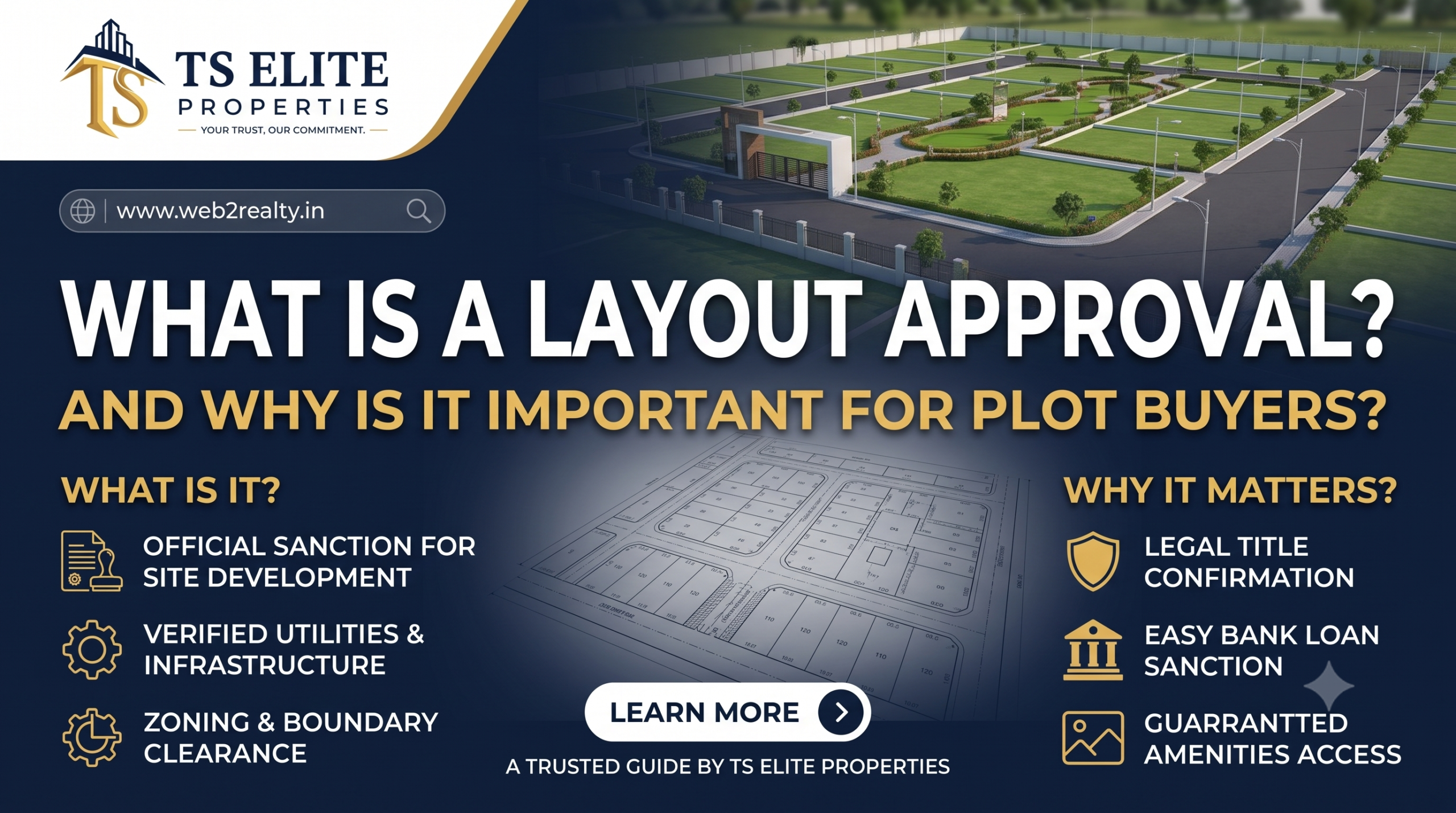
What Is a Layout Approval and Why Is It Important for Plot Buyers?

Best Approved Layout Plots

What Is a Layout Approval and Why Is It Important for Plot Buyers?

Buying land is one of the most significant financial milestones in an individual’s life. Whether you are purchasing a plot to build your dream home or looking for a secure long-term investment asset, real estate land offers an unparalleled sense of security and strong capital appreciation. However, entering the property market without adequate knowledge can turn a dream investment into a complex legal and financial headache. One of the most critical factors that determines whether a plot is safe, legal, and valuable is Layout Approval.


Many first-time land buyers fall into the trap of purchasing unapproved plots simply because they are offered at discounted rates. Unfortunately, these cheap plots often come with severe hidden costs: missing basic infrastructure, legal disputes, lack of bank loan approvals, and even risks of government demolition. To safeguard your investment, choosing best approved layout plots must be your absolute top priority.


In this comprehensive guide, we will unpack everything you need to know about layout approvals, why they are mandatory for plot buyers, how local planning authorities evaluate layouts, and how investing in best approved layout plots guarantees long-term peace of mind and high returns.


1. Understanding Layout Approval: What Does It Mean?

A Layout Approval is an official sanction granted by a government urban development authority (such as HMDA, DTCP, BDA, CMDA, or PMRDA) allowing a developer or landowner to divide a large tract of land into smaller residential or commercial plots.


Before a piece of raw agricultural land can be converted into a residential township, the master plan of the proposed layout must be submitted to the competent urban planning department. The authority examines the proposed layout to ensure it strictly complies with zoning regulations, environmental norms, road width requirements, public space allocations, and infrastructure connectivity.


When an authority approves a layout, it assigns a unique approval reference or permit number (e.g., LP Number). This stamp of approval confirms that the land has been legally converted for non-agricultural/residential use and that the developer is authorized to sell individual plots to buyers. Therefore, when searching for plot options, prioritizing the best approved layout plots ensures you are buying land that is 100% legal and recognized by municipal laws.


Crucial Fact: Simply having a registered sale deed or land conversion certificate does NOT mean the plot layout is approved. Land registration registers ownership, but Layout Approval legally permits the division and residential development of plots.


2. Key Components of an Approved Layout

When an urban planning authority approves a residential layout, it enforces strict design standards to ensure planned urban development. A layout is only granted approval when the developer allocates specific portions of the total land area for essential infrastructure and civic amenities:


  1. Internal Road Widths: Approved layouts mandate minimum road widths (typically 30 feet, 40 feet, 60 feet, or wider) to allow smooth two-way vehicular movement, fire tender access, and service utility laying.
  2. Open Space & Parks Reservation: Authorities mandate that 10% or more of the layout’s total area must be reserved for public parks, playgrounds, and green belts. This land is legally gifted to the local municipality.
  3. Civic Amenities Space: Layouts must reserve dedicated space for community centers, primary healthcare centers, utilities, and electricity sub-stations.
  4. Utility Lines & Underground Infrastructure: Plans must clearly demarcate drainage lines, sewage treatment setups, water supply mains, and underground electricity cabling layouts.

By opting for best approved layout plots, buyers automatically gain access to structured roads, open green spaces, and pre-planned utility connections that unapproved layouts completely lack.


3. Why Is Layout Approval Essential for Plot Buyers?

Investing in plot layouts that lack government sanction exposes buyers to severe legal, financial, and practical risks. Here is why layout approval is absolutely indispensable when purchasing land:


A. Complete Legal Safety & Title Protection

An approved layout undergoes rigorous title verification by urban planning lawyers and government engineers before sanction. This guarantees that the plot is free from government land claims, forest department reservations, or agricultural ceiling restrictions. Investing in best approved layout plots shields you against litigation, illegal encroachments, and title disputes.


B. Guaranteed Basic Amenities & Quality Infrastructure

Unapproved layouts often feature narrow 15-foot dirt paths, no street lighting, no storm-water drains, and no municipal water lines. In contrast, approved layout developers are legally bound to construct blacktop/concrete roads, drainage lines, streetlights, and water overhead tanks before handing over plots. When you choose best approved layout plots, you invest in a fully developed community rather than an isolated patch of land.


C. Easy Bank Loan Sanctions & Construction Financing

Leading public and private banks (such as SBI, HDFC, ICICI, and Axis Bank) perform strict due diligence on real estate projects. Financial institutions never extend plot loans or home construction loans for unapproved or unauthorized layouts. Buying best approved layout plots opens doors to easy home loans with competitive interest rates and seamless disbursement.


D. Hassle-Free Building Plan Approval

Purchasing a plot is usually the first step toward building your dream home. However, municipal authorities will strictly reject building permit applications if your plot is situated in an unapproved layout. In approved layouts, securing a building permission certificate is quick, standardized, and straightforward.


E. High Capital Appreciation and Superior Resale Value

Real estate markets favor secure assets. Approved layout plots appreciate at a significantly higher rate compared to unapproved land because future buyers and developers prioritize verified legal titles. When you invest in best approved layout plots, you ensure maximum return on investment (ROI) and excellent liquidity if you decide to sell in the future.


Key Takeaway for Investors: Unapproved plots may offer a lower upfront price, but they carry massive long-term financial liabilities. The premium paid for best approved layout plots is a direct investment in security, liquidity, and peace of mind.


4. Key Authorities Responsible for Layout Approvals

Depending on the geographical location of the land in India, different state urban planning bodies are responsible for evaluating and granting layout approvals:


  • Urban Development Authorities (UDAs): Bodies like HMDA (Hyderabad), BDA (Bengaluru), CMDA (Chennai), and PMRDA (Pune) govern metropolitan growth limits and approve urban layouts.


  • Directorate of Town and Country Planning (DTCP): Governs layout approvals outside major metro boundaries, covering tier-2 cities, towns, and rapidly expanding suburban corridors.


  • RERA (Real Estate Regulatory Authority): In addition to layout sanction, real estate layouts spanning over 500 sq. meters or more than 8 plots must be registered under RERA, ensuring developer accountability and timely project completion.


Note: Gram Panchayat approvals alone are NOT sufficient for urban residential layout conversion unless backed by DTCP or urban body sanctions. Always ensure your seller offers best approved layout plots with valid DTCP/HMDA/RERA approvals.


5. How to Check if a Plot Has Valid Layout Approval (Step-by-Step Guide)

Before making an advance payment or signing a sale agreement, follow this step-by-step verification process:


  1. Request the Layout Approval Permit (LP Number): Ask the developer for the official Layout Approval Certificate issued by the competent authority (DTCP/HMDA/BDA/CMDA).
  2. Examine the Approved Layout Map: Verify that the layout plan bears the official seal, signature, and approval number of the planning authority. Compare the plot number on the map with the plot offered to you.
  3. Cross-Check on Official Government Portals: Visit the official web portal of the relevant development authority or state RERA website to confirm that the LP number and layout details are active and authentic.
  4. Inspect the Encumbrance Certificate (EC): Obtain an EC for the last 30 years to verify that the property title is free from mortgages, legal claims, or court disputes.
  5. Verify RERA Registration Number: Ensure the project has an active RERA registration number displayed on marketing materials and official documentation.

6. Why You Should Invest in Best Approved Layout Plots with TS Elite Properties

At TS Elite Properties (featured on www.web2realty.in), we believe that transparency and legal perfection are the bedrock of real estate trust. Our core commitment “Your Trust. Our Commitment”  ensures that every property in our portfolio represents the highest standards of legal safety and modern urban planning.


When you explore layout projects with us, you are guaranteed access to the best approved layout plots featuring:


  • 100% DTCP / HMDA & RERA Approved Layouts: Verified clear marketable titles with zero legal complications.


  • World-Class Infrastructure: Wide BT/CC roads, underground drainage networks, water supply lines, and solar streetlights.


  • Eco-Friendly Living: Avenue plantations, landscaped green parks, and dedicated children’s play areas.


  • Bank Loan Eligibility: Pre-approved layout projects eligible for hassle-free loans from leading banks.


  • Prime Locations: Strategically selected along high-growth highways and industrial corridors for maximum return on investment.


Here are the most frequently asked questions (FAQs) regarding Layout Approval and buying plots on www.web2realty.in:


Frequently Asked Questions (FAQs)

Q1: What is the main difference between Land Registration and Layout Approval?

A: Land registration simply transfers ownership of a piece of land from the seller to the buyer at the government sub-registrar office. Layout Approval, granted by authorities like DTCP or HMDA, legally converts raw land into sanctioned residential plots, ensuring that roads, drainage, parks, and utility lines strictly comply with government norms. Registration guarantees ownership, but Layout Approval guarantees legality for residential construction.


Q2: Why is Gram Panchayat layout approval alone considered risky?

A: Local Gram Panchayats often do not have the legal authority to approve large urban residential layouts. Without master plan sanctions from major development authorities (such as DTCP, HMDA, or BDA), plots in Gram Panchayat layouts are treated as unapproved by municipal bodies, leading to loan rejections, lack of civic utilities, and building permission denials.


Q3: Is RERA registration mandatory for plot layout projects?

A: Yes. As per the Real Estate (Regulation and Development) Act, any residential or commercial layout project exceeding 500 square meters or containing more than 8 plots with common infrastructure must be registered under RERA before being advertised or sold.


Q4: Can I get a bank loan for a plot in an unapproved layout?

A: No. Leading nationalized and private banks (such as SBI, HDFC, ICICI, and Axis Bank) strictly require approved layout plans (LP numbers) and valid RERA registrations before approving plot or construction loans. Banks will reject loan applications for unapproved land to minimize financial risk.


Q5: How can I independently verify if a plot layout is approved?

A: You can verify layout approvals in 4 simple steps:


  • Check the LP (Layout Permit) Number: Request the sanction copy from the seller.


  • Cross-check Online: Visit the official website of the state urban planning body (e.g., HMDA, DTCP) or RERA portal.


  • Verify Layout Map: Ensure the specific plot number on-site matches the sanctioned layout plan.


  • Obtain Encumbrance Certificate (EC): Get an EC for the last 30 years from the sub-registrar’s office to confirm a clear, dispute-free title.


Q6: Why should I buy approved plots through TS Elite Properties on www.web2realty.in?

A: TS Elite Properties (“Your Trust. Our Commitment”) guarantees 100% legal safety:


  • Every listed plot features valid DTCP / HMDA and RERA approvals.


  • Full infrastructure guarantees: Wide asphalt/concrete roads, underground drainage, electricity, and water networks.


  • Immediate eligibility for bank loans from top financial institutions.


  • Located in prime growth corridors for high capital appreciation.


 Secure Your Dream Plot with 100% Legal Peace of Mind!

Don’t risk your hard-earned lifetime savings on unapproved or risky land investments. Explore verified, high-appreciation best approved layout plots with TS Elite Properties.


Have More Questions?


Visit www.web2realty.in today to view our latest DTCP & HMDA approved plot layouts or schedule an exclusive site visit!


 Contact TS Elite Properties: Your Trust. Our Commitment.


.

Related Post

What Is RERA and Why Does It Matter for Plot Buyers?

RERA approved plots

Buying a plot is a major financial decision. Whether you are planning to build your dream home, secure land for your family, or invest for the future, choosing the right property is important. But before paying an advance or signing an agreement, there are several things you should check.

One of the most important things to look for today is RERA approved plots.

RERA has brought more transparency and accountability into the real estate sector. For plot buyers, understanding RERA can help reduce risks and make the property-buying process more informed.

But what exactly is RERA? What does RERA registration mean for a plot project? And why should you consider RERA approved plots when looking for land?

Let us understand everything in simple terms.

What Is RERA?

RERA stands for the Real Estate (Regulation and Development) Act, 2016. The law was introduced to bring greater transparency, accountability, and discipline into the real estate sector.

In Telangana, the regulatory authority is the Telangana Real Estate Regulatory Authority (TG RERA).

The purpose of RERA is to protect the interests of property buyers and make real estate developers more accountable. It also provides a regulatory framework for registered real estate projects and a mechanism for addressing complaints.

For plot buyers, this is especially important because buying land involves a large amount of money and long-term planning.

According to TG RERA, eligible real estate projects involving plots can come under RERA. The Telangana authority also states that promoters generally cannot advertise, market, book, or sell plots in a real estate project covered by the Act without registering the project with TG RERA, subject to applicable exemptions.

This is why checking RERA registration should be an important part of your property research.

What Are RERA Approved Plots?

The phrase RERA approved plots is commonly used by property buyers and developers to describe plots that are part of a project registered with the relevant Real Estate Regulatory Authority.

However, buyers should understand one important point: RERA registration and layout approval are not the same thing.

RERA is mainly concerned with regulation, transparency, disclosure, and responsibilities of promoters. Layout permissions and planning approvals are separate matters handled by the relevant planning authorities.

Therefore, when purchasing a plot, do not check only whether the project has a RERA registration number.

You should also verify:

  • RERA registration details
  • Layout approval
  • Land ownership documents
  • Encumbrance details
  • Development permissions
  • Location and survey details
  • Agreement and sale documents
  • Applicable local approvals

A project having RERA registration does not mean that buyers should skip their own legal and document verification.

Why Does RERA Matter for Plot Buyers?

Buying land without proper verification can create unnecessary problems later. RERA helps create a more transparent system where buyers can access important project-related information.

Here are some reasons why RERA approved plots can be an important consideration.

1. Better Transparency

Transparency is one of the major objectives of RERA.

Buyers can check information relating to registered projects through the relevant RERA authority. TG RERA provides online access to registered project information and citizen services.

This gives buyers an opportunity to research a project before making a major financial commitment.

Instead of depending entirely on verbal promises, buyers can look for documented project information.

2. Helps Buyers Make Informed Decisions

A plot purchase should never be based only on attractive advertisements, low prices, or future appreciation promises.

Buyers should understand what they are purchasing.

When considering RERA approved plots, you can check the project’s registration details and compare them with the information provided by the promoter.

This can help you identify inconsistencies before moving ahead.

3. Greater Accountability for Promoters

RERA establishes responsibilities for promoters and provides a regulatory framework for real estate projects.

This encourages developers to follow proper procedures and provide relevant information to buyers.

For a plot buyer, dealing with a project operating within the applicable RERA framework can provide greater confidence than making a purchase based only on informal assurances.

4. Access to a Complaint Mechanism

Property-related disagreements can be stressful and expensive.

RERA provides a formal mechanism for eligible complaints relating to registered real estate projects. TG RERA states that an aggrieved person can file a complaint regarding violations or contraventions of the Act, rules, or regulations.

This regulatory mechanism is an important reason why buyers should pay attention to RERA registration when selecting a project.

5. Helps You Verify Project Information

One of the biggest advantages of buying property in a registered project is the ability to cross-check project information.

TG RERA guidance states that plot buyers can visit the TG RERA website to check whether a project is registered. It also notes that advertisements for covered projects must carry the applicable TG RERA registration number.

As a buyer, you should use this information instead of simply accepting a registration number shown in an advertisement.

RERA Registration vs Layout Approval: Know the Difference

This is one of the most important things to understand before purchasing a plot.

RERA registration is not the same as layout approval.

For example, a project may have a planning or layout approval from the applicable authority. RERA registration is a separate regulatory requirement where applicable.

Therefore, when searching for RERA approved plots, ask the seller or developer for both:

  1. RERA registration details

and

  1. Applicable layout approval details

You should verify both before making a decision.

Depending on the location and project, buyers may come across terms such as HMDA, DTCP, GHMC, or other relevant planning authorities. The applicable approval depends on the property’s location and development regulations.

This simple distinction can help you avoid confusion.

What Should You Check Before Buying RERA Approved Plots?

RERA registration is important, but it should not be the only thing you check.

Here is a practical checklist for plot buyers.

Check the RERA Registration Number

Ask for the project’s RERA registration number and verify it on the official RERA portal.

Make sure the project name, promoter details, location, and other information match the property being offered to you.

Verify Layout Approval

Ask for the approved layout plan and verify the relevant approval details.

Check whether your selected plot is actually part of the approved layout.

Check Land Ownership

Ownership is a critical part of land verification.

Ask for the relevant title documents and have them reviewed by an independent property lawyer.

Do not rely only on photocopies or verbal statements.

Check Encumbrance Details

An Encumbrance Certificate can help identify certain registered transactions or encumbrances relating to the property.

A legal professional can help you understand what the available records mean for your particular transaction.

Check the Plot Number and Measurements

Always confirm that the plot number, dimensions, survey details, and location mentioned in the documents match the actual plot shown to you.

A site visit is essential.

Understand the Agreement

Before making a substantial payment, carefully read the sale agreement and other relevant documents.

Understand the payment schedule, possession or development commitments, cancellation terms, registration process, and other conditions.

If you do not understand a legal clause, seek professional advice.

Are RERA Approved Plots a Good Investment?

Land has traditionally been considered a long-term investment option. However, no property investment comes with a guaranteed return.

The potential of a plot depends on several factors, including:

  • Location
  • Infrastructure development
  • Road connectivity
  • Nearby employment hubs
  • Population growth
  • Development activity
  • Demand in the area
  • Legal and documentation status
  • Purchase price

Therefore, RERA approved plots can offer an additional layer of regulatory transparency, but buyers should still evaluate the location and financial potential carefully.

A legally compliant and well-planned project in a developing location may be more attractive for long-term investors than a property selected only because it is cheap.

Why Location Still Matters

Even when buying RERA approved plots, location remains one of the most important factors.

A plot located near major roads, employment centres, educational institutions, hospitals, commercial areas, and planned infrastructure may have better long-term potential.

For buyers looking around Hyderabad and its developing corridors, it is useful to study current connectivity as well as planned infrastructure.

But remember: future development claims should always be verified through reliable sources. Do not make an investment decision solely because a salesperson says that a major project is “coming soon.”

Common Mistakes Plot Buyers Should Avoid

Many property buyers make mistakes because they rush into a purchase.

Here are some common mistakes to avoid:

Ignoring documents: Never buy land based only on brochures or advertisements.

Checking only the price: A low price does not automatically mean a good investment.

Not verifying RERA details: Always check the project’s registration details on the official authority portal where applicable.

Confusing RERA with layout approval: Remember that these are separate matters.

Skipping legal verification: A property lawyer can help identify issues that an ordinary buyer may miss.

Not visiting the site: Visit the actual property and verify its location and surroundings.

Believing guaranteed returns: Property appreciation depends on market conditions and location. No genuine investment should be treated as risk-free.

How to Verify RERA Approved Plots in Telangana

If you are planning to purchase a plot in Telangana, you can use the official TG RERA website to research registered projects.

Start by searching for the project using its name or registration details. Compare the information available on the portal with the information provided by the developer or seller.

Check:

  • Project name
  • Promoter name
  • Registration number
  • Project location
  • Project status
  • Relevant documents
  • Available updates
  • Any available complaints or orders

TG RERA also provides project-related updates and citizen services through its portal.

For your protection, always use the official regulatory website for verification rather than relying only on screenshots or forwarded documents.

Why RERA Matters in Today’s Property Market

Real estate transactions involve significant amounts of money. Buyers want confidence that their investment is being made in a properly documented and regulated project.

RERA has helped create a more structured real estate environment by promoting transparency and accountability.

For plot buyers, this means you can approach your purchase with better information.

Still, remember one simple rule:

RERA registration is important, but it is not a substitute for complete property due diligence.

A smart buyer checks RERA registration, layout approval, ownership documents, encumbrances, location, development status, and the agreement before investing.

Frequently Asked Questions About RERA Approved Plots

1. What are RERA approved plots?

RERA approved plots generally refers to plots that are part of a real estate project registered under RERA, where registration is applicable. Buyers should also verify layout approvals, title documents, encumbrance details, and other relevant permissions before purchasing.

2. Is RERA registration the same as layout approval?

No. RERA registration and layout approval are different. RERA focuses on regulating applicable real estate projects and promoting transparency, while layout approval relates to planning and development permissions from the relevant authority.

3. How can I check RERA approved plots in Telangana?

You can check the official Telangana RERA portal to search for registered projects. Verify the project name, promoter details, registration number, location, and other available project information before making a purchase.

4. Why should I choose RERA approved plots?

RERA registration can provide greater transparency and accountability for applicable real estate projects. It allows buyers to check project-related information and provides a regulatory framework for eligible complaints and disputes.

5. Are RERA approved plots a safe investment?

RERA registration can be an important factor when evaluating a plot project, but it does not guarantee investment returns or eliminate all risks. Buyers should also verify title, layout approval, location, development status, documents, and other legal details.

6. What documents should I check before buying a plot?

Buyers should check RERA registration details where applicable, layout approval, title documents, encumbrance records, survey and plot details, sale agreement, development permissions, and other relevant property documents. Professional legal advice is recommended before making a major investment.

7. Can I buy RERA approved plots in Hyderabad?

Yes, buyers can find projects in and around Hyderabad that are registered under RERA where applicable. Before purchasing, verify the project’s RERA details, applicable layout approval, ownership documents, location, and other legal records.

8. Is RERA registration enough to buy a plot?

No. RERA registration should not be the only factor in your decision. Buyers should also conduct proper legal and property due diligence, including checking title, layout approval, encumbrances, plot measurements, location, and the sale agreement.

9. What is TG RERA?

TG RERA refers to the Telangana Real Estate Regulatory Authority. It is the regulatory authority responsible for implementing RERA in Telangana and provides services related to registered real estate projects and eligible complaints.

10. Should I visit the site before buying a plot?

Yes. A site visit is highly recommended. It allows you to verify the actual location, access roads, surrounding development, plot dimensions, nearby infrastructure, and other factors before making a purchase decision.


Final Thoughts

Buying a plot can be a smart long-term decision when you choose the right location and verify the property properly.

Choosing RERA approved plots can be an important part of that process because RERA promotes transparency, accountability, and buyer protection within its applicable framework.

However, don’t stop at the RERA registration number. Check the layout approval, title documents, plot details, development status, and other legal records. Take professional legal advice when necessary.

If you are searching for RERA approved plots in and around Hyderabad, take your time, compare projects, visit the site, and verify every important document before making a payment.

Looking for RERA Approved Plots?

Ready to find a plot that matches your budget and future plans?

Explore verified property options, check the project details, visit the site, and make an informed investment decision.

 Contact us today to know more about RERA approved plots and available plot options.

 Book a site visit at www.web2realty.in today and take the first step toward owning your future piece of land!

Related Post

Complete Checklist Before Buying an Open Plot in Hyderabad.

Open Plot Buying Checklist in Hyderabad

Complete Checklist Before Buying an Open Plot in Hyderabad.

Investing in land around Hyderabad is one of the most reliable ways to grow wealth in Telangana’s expanding real estate market. From high tech growth corridors near the Outer Ring Road (ORR) to upcoming residential hubs along the Regional Ring Road (RRR), peripheral land appreciation continues to outpace many conventional investment channels. However, buying land also requires meticulous due diligence. Unlike buying an apartment, purchasing land involves evaluating title histories, layout approvals, government notifications, and physical infrastructure.


Using a comprehensive open plot buying checklist protects your savings, guarantees legal clarity, and ensures smooth property appreciation. Whether you are a first-time land buyer, an NRI investor, or planning your dream home, this guide outlines every verification step required before finalizing a land deal in Hyderabad.


Phase 1: Legal & Title Document Verification

Legal due diligence is the cornerstone of any property transaction. Never issue advance token money without verifying these foundational legal documents against government databases.


                    DOCUMENT VERIFICATION WORKFLOW

                                   |

    +——————————+——————————+

    |                              |                              |

TITLE DEED & LINK DOCS        ENCUMBRANCE (EC)          LAYOUT & REGISTRATION

  (30+ Year Chain)          (30-Year Clean Record)       (HMDA / DTCP / TG-RERA)

1. Title Deed & 30-Year Link Documents

  • Chain of Ownership: Obtain an unbroken sequence of registered title deeds spanning at least 30 years. Verify that every past transfer, whether through sale, inheritance, gift, or partition is legally recorded with no missing links.


  • Seller Identification: Match the seller’s name and photo with official identification (Aadhaar, PAN) and verify that the survey numbers on the sale deed match official revenue records.


2. Encumbrance Certificate (EC)

  • What to Look For: Request a 30-year Encumbrance Certificate through the Telangana Registration and Stamps portal or MeeSeva. A clean EC confirms that the land parcel is free from active mortgages, legal claims, court attachments, or secondary sales.


  • Bank Mortgages: In gated layout developments, developers often finance land purchases through bank or NBFC loans. If a mortgage appears on the EC, ensure the seller provides an official Release Deed or Bank No-Objection Certificate (NOC) before final registration.


3. Revenue Records & Land Conversion Status

  • NALA Conversion: If the plot was originally classified as agricultural land, verify the Non-Agricultural Land Assessment (NALA) conversion order. Non-agricultural conversion is legally mandatory before laying out residential plots.


  • Dharani / Bhu Bharati Portal Check: Cross-check the survey numbers on Telangana’s official land records portal (Dharani/Bhu Bharati) to confirm ownership, land classification, and ensure the parcel is not listed under prohibited properties (Section 22A).


Phase 2: Layout & Regulatory Approvals

Buying a plot in an unapproved or unauthorized layout carries heavy financial and legal risks, including refusal of building permissions, lack of municipal services, and potential demolition of unauthorized structures. Making authority verification part of your open plot buying checklist safeguards your property against regulatory action.


1. HMDA vs. DTCP Layout Permissions

  • HMDA (Hyderabad Metropolitan Development Authority): Mandated for layouts within the urban and suburban metropolitan limits. Verify the official Layout Permission (LP Number) on the HMDA DPMS portal.


  • DTCP (Directorate of Town and Country Planning): Applicable for growth zones located beyond HMDA limits, towards the Regional Ring Road belt. Confirm the layout plan on the DTCP Telangana website.


  • LP Number Status Check: Do not rely solely on layout sanction copies provided by real estate agents. Input the full LP number into the official government portal and check if the status reads “Active” rather than “In-Process”, “Under Review”, or “Lapsed”.


2. TG-RERA Registration

  • Mandatory Threshold: Residential layouts exceeding 500 square meters or involving more than 8 plots must be registered under the Telangana Real Estate Regulatory Authority (TG-RERA).


  • Verification Steps: Search the TG-RERA online portal using the project registration number. Confirm that the developer’s registered name, layout extent, sanctioned plot count, and promised completion timeline match what is being marketed.


Phase 3: Physical Site Inspection & Environmental Checks

A layout looks clean on a paper brochure, but a physical site visit is critical to verify actual ground conditions.


1. Survey Numbers & Boundaries

  • Land Demarcation: Verify that the plot number, dimensions, and survey boundaries marked on the layout plan correspond exactly with physical peg markings on the ground.


  • Independent Survey: Consider engaging a licensed private surveyor to measure the plot boundaries independently before signing the agreement of sale.


2. Water Bodies & Buffer Zones (HYDRAA Compliance)

  • FTL (Full Tank Level) & Buffer Zones: Ensure the plot does not fall within the FTL or buffer zones of lakes, ponds (Cheruvus), or natural streams (Nalas). Encroachments into water body buffer zones are strictly regulated by urban bodies like HYDRAA.


  • Revenue Maps: Cross-check the village revenue map to confirm that no government cart-tracks, canal lines, or forest boundaries intersect the plot.


3. Master Plan & Infrastructure Allocations

  • Road Widening Plans: Check the HMDA Master Plan to ensure the layout or plot does not overlap with proposed master plan roads, national highway extensions, or railway corridors.


  • Internal Layout Roads: Standard layout norms require internal blacktop or cement roads to be at least 30, 40, or 60 feet wide, with dedicated open spaces reserved for public parks and social infrastructure.


Phase 4: Financial & Valuation Checklist

Before transferring funds, establish complete financial clarity to avoid hidden fees or calculation errors during land registration.


                 TOTAL INVESTMENT COST CALCULATION

                                 |

  +———————-+——-+——-+———————-+

  |                      |               |                      |

BASE PLOT COST      STAMP DUTY & FEE   DEVELOPMENT CHARGES   LEGAL & LOAN FEES

(Per Sq. Yard)       (Govt. SRO Rates)  (Layout Dues/Amenities) (Lawyer Verification)

  1. Calculate Government Market Value vs. Actual Agreement Price: Stamp duty and registration charges in Telangana are calculated based on whichever is higher between the government valuation rate and the actual purchase price.
  2.  
  3. Verify Outstanding Dues & Taxes: Ensure the current owner has paid all pending property taxes, non-agricultural land taxes, and layout maintenance dues.
  4.  
  5. Bank Approval Check: If planning to secure a plot loan, verify whether major nationalized or private banks have approved the layout project. Bank panel lawyers conduct thorough title vetting, which serves as an additional layer of verification.
  6.  

Quick Reference: Open Plot Buying Checklist

Use this concise summary table as your fast-track open plot buying checklist during site visits and developer meetings:


Verification Parameter

Document / Authority

Key Verification Objective

Title Ownership

Registered Title Deed & Link Deeds

Establish clear 30-year ownership chain without gaps

Liabilities & Mortgages

Encumbrance Certificate (EC)

Confirm zero active encumbrances or court disputes

Land Classification

NALA Order / Dharani Portal

Ensure valid agricultural-to-residential land conversion

Layout Sanction

HMDA or DTCP Approval Order

Verify active LP Number directly on government portals

Regulatory Protection

TG-RERA Registration

Confirm developer credentials, plot counts, and timelines

Environmental Safety

Village Revenue Map / HYDRAA

Ensure plot is outside FTL lakes and stream buffer zones

Physical Demarcation

Site Visit & Boundary Inspection

Confirm plot boundaries, internal road widths, and utilities

Protect Your Investment with Legal Diligence

Purchasing an open plot in Hyderabad offers tremendous potential for high capital returns and multi-generational security. However, rushing into a land deal based on verbal promises or promotional flyers can expose you to avoidable financial risks. Following a systematic open plot buying checklist gives you total clarity over title ownership, layout sanctions, and statutory compliance allowing you to buy with complete confidence.


Always hire an experienced real estate advocate to review title documents and verify government portals independently before executing an agreement of sale.


Ready to Find Verified, High-Growth Open Plots in Hyderabad?

Take the risk out of land investment! Explore top-rated, legally clear, and fully approved HMDA and DTCP open plot projects along Hyderabad’s primary growth corridors.


  • Request Detailed Document Packs: Get certified copies of HMDA/DTCP permissions, RERA numbers, and EC statements upfront.
  •  
  • Book a Free Guided Site Visit: Inspect plot boundaries, road connections, and nearby infrastructure with our local real estate experts.

Frequently Asked Questions (FAQs) About Buying Open Plots in Hyderabad


1. What is the difference between HMDA and DTCP approvals?

HMDA (Hyderabad Metropolitan Development Authority) governs urban and suburban areas surrounding the city up to the Outer Ring Road (ORR) limits. DTCP (Directorate of Town and Country Planning) covers regions outside HMDA limits, extending toward the Regional Ring Road (RRR) and rural districts. Both bodies enforce strict planning standards, but HMDA plots are usually located closer to the core urban market and command higher per-square-yard rates.


2. How can I check if a plot in Hyderabad is legally clear?

To verify legal clarity, complete these mandatory checks:


  • Obtain a 30-year Encumbrance Certificate (EC) from the Telangana Registration Department.
  •  
  • Verify the 30-year link deeds and title ownership chain with a real estate legal advocate.
  •  
  • Confirm non-agricultural (NALA) land conversion status on the Dharani/Bhu Bharati revenue portal.
  •  
  • Cross-check the project’s Layout Permission (LP Number) on the HMDA or DTCP official portal to ensure active approval status.
  •  

3. Is GP (Gram Panchayat) layout approval safe for buying open plots?

Unapproved Gram Panchayat layouts without HMDA or DTCP sanctions carry significant legal and operational risks. Municipal bodies do not grant building permissions or issue water/electricity meters for unapproved GP layouts unless they are regularized through government schemes like LRS (Layout Regularization Scheme). It is always safer to purchase pre-approved HMDA or DTCP plots.


4. What is HYDRA, and why is it important when buying an open plot?

HYDRAA (Hyderabad Disaster Response and Assets Monitoring and Protection Agency) actively monitors urban lakes, water bodies (Cheruvus), natural drainage streams (Nalas), and government lands. Before finalizing a plot purchase, ensure the land parcel falls strictly outside Full Tank Level (FTL) boundaries and stream buffer zones to prevent future notices or enforcement actions.


5. Are bank loans available for open plots in Hyderabad?

Yes, major nationalized and private banks offer plot loans (land purchase loans) for HMDA and DTCP-approved layouts. Most lenders provide up to 70% to 80% of the property’s estimated market value. Unapproved layouts or plots lacking TG-RERA registration generally do not qualify for institutional bank loans.


Would you like a customized financial table estimating total stamp duty, registration fees, and legal charges for a specific plot budget in Hyderabad?


Contact www.web2realty.in Today to view our curated list of 100% verified open plots near Hyderabad!


Related Post

Top Locations to Buy Open Plots Near Hyderabad: Your Ultimate Investment Guide

Map of major investment corridors for open plots near Hyderabad"

Top Locations to Buy Open Plots Near Hyderabad: Your Ultimate Investment Guide

Finding the right place to invest your hard-earned money can feel overwhelming, but real estate consistently stands out as one of the safest and most lucrative options. In recent years, Hyderabad has emerged as one of India’s fastest-growing cities, driven by rapid industrialization, expanding IT infrastructure, world-class roads, and massive government-led developments.


While apartments and commercial spaces have their place, buying open plots near Hyderabad offers unmatched flexibility, higher capital appreciation, and complete control over your assets. Land does not depreciate over time; instead, as the city expands outward, suburban plot investments turn into high-value urban real estate.


Whether you are looking to build a custom dream home, secure a retirement villa, or build wealth through long-term land appreciation, this guide breaks down the top growth corridors, key locations, and crucial steps to safely buy open plots near Hyderabad.


Why Invest in Open Plots Near Hyderabad?

Before diving into specific locations, it helps to understand why the market for open plots near Hyderabad is experiencing unprecedented demand.


1. High Capital Appreciation

Land value around Hyderabad’s periphery has seen steady, compounding growth over the past decade. Key infrastructure catalysts such as the 158 km Outer Ring Road (ORR) and the upcoming Regional Ring Road (RRR) have turned rural stretches into prime residential and commercial zones practically overnight.


2. Low Entry Barrier with Flexible Budgets

Unlike central urban land in areas like Banjara Hills or Gachibowli, purchasing open plots near Hyderabad in emerging outskirts allows you to enter the real estate market at accessible price points while retaining immense upside potential.


3. Absolute Ownership and Zero Depreciation

Buildings age, require maintenance, and lose physical value over decades. Land, on the other hand, remains permanent. Buying open plots near Hyderabad allows you to hold the asset as long as you wish without recurring maintenance headaches or structural depreciation.


4. Custom Architectural Freedom

Purchasing an open plot gives you total creative control. You decide when to build, what layout to construct, how many floors to design, and whether to include private gardens or custom rental units.


Top Locations to Buy Open Plots Near Hyderabad

Hyderabad’s outward expansion is happening along key highway corridors and orbital ring roads. Below are the top growth corridors and exact micro-markets where buying open plots near Hyderabad yields maximum value.


                    HYDERABAD METROPOLITAN REGION

                                  |

    +—————–+———–+———–+—————–+

    |                 |                       |                 |

WEST CORRIDOR    SOUTH CORRIDOR          NORTH CORRIDOR    EAST CORRIDOR

(IT & Luxury)    (Future City & Airport) (Industrial & RRR)(Connectivity)

    |                 |                       |                 |

  • Shankarpally    • Tukkuguda             • Medchal         • Ghatkesar
  • Mokila          • Maheshwaram           • Kompally        • Bibinagar
  • Tellapur        • Shadnagar             • Patancheru      • Pocharam
  • Kollur          • Kadthal               • Sangareddy      • Yadadri Highway

1. The South Corridor: Srisailam Highway & Future City Belt

The southern corridor of Hyderabad has become one of the most talked-about investment destinations, primarily due to its proximity to the Rajiv Gandhi International Airport and major infrastructure megaprojects like the proposed Future City.


Key Micro-Locations:

  • Tukkuguda: Situated right at ORR Exit 14, Tukkuguda offers instant connectivity to both the airport and the Financial District. It is ideal for premium gated community plots and mid-to-long-term investments.
  •  
  • Maheshwaram: Known for expanding industrial parks, hardware hubs, and logistics corridors. It is a hotbed for HMDA-approved layout projects.
  •  
  • Kadthal: Located along the Srisailam Highway, Kadthal offers affordable entry prices for large open plot layouts, making it ideal for investors seeking high multi-year appreciation.
  •  
  • Shadnagar: A well-established satellite town connected via the Hyderabad-Bengaluru NH-44. With ongoing industrial expansion and RRR connectivity, Shadnagar remains a favorite for budget-friendly plot buyers.
  •  

Why Buy Here? High-density employment drivers, proximity to airport logistics, massive government infrastructure initiatives, and rapid development of educational institutes.


2. The West Corridor: Shankarpally, Mokila & Tellapur Belt

The western corridor is the undisputed tech engine of Hyderabad, home to HITEC City, Gachibowli, and the Financial District. As central western hubs hit price saturation, buyer interest has shifted slightly further west toward peaceful, green suburban zones.


Key Micro-Locations:

  • Tellapur & Kollur: Positioned right along the ORR, these locations offer rapid access to major IT parks. Plots here are highly sought after for luxury villa developments and high-end gated communities.
  •  
  • Mokila: Often dubbed the “villa capital” of western Hyderabad, Mokila offers serene surroundings, clean air, and spacious gated plot communities just 25–30 minutes from the Financial District.
  •  
  • Shankarpally: Nestled along the green belt with direct connectivity to IIT Hyderabad and the ORR, Shankarpally is ideal for buyers interested in weekend homes, farm plots, or holding land for long-term equity growth.
  •  

Why Buy Here? Tech professional spillover demand, high rental and resale liquidity, world-class international schools, and premium lifestyle amenities.


3. The North-West Corridor: Patancheru & Sangareddy Belt

Running along the Mumbai Highway (NH-65), the north-western stretch represents an industrial and educational powerhouse that is rapidly converting into planned residential layouts.


Key Micro-Locations:

  • Patancheru: Once purely an industrial hub, Patancheru has transformed into an active residential ecosystem with wide road expansions and direct access to the ORR.
  •  
  • Sangareddy: A district headquarters located along the upcoming Regional Ring Road route. Plots near Sangareddy offer strong long-term security backed by government infrastructure and industrial expansion.
  •  

Why Buy Here? Excellent highway connectivity, proximity to educational institutions like IIT Hyderabad, and steady employment-driven demand from industrial workers and engineers.


4. The East Corridor: Ghatkesar, Bibinagar & Warangal Highway

The eastern corridor offers some of the most budget-friendly opportunities for buyers looking to invest in open plots near Hyderabad.


Key Micro-Locations:

  • Ghatkesar & Pocharam: Driven by the presence of major IT parks (such as Infosys Raheja Mindspace) and outer ring road access.
  •  
  • Bibinagar: Famous for AIIMS Bibinagar, this town along the Warangal Highway (NH-163) is witnessing rapid residential growth as healthcare and educational hubs expand.
  •  
  • Yadadri Corridor: The spiritual development around the Yadadri Temple has triggered significant road widening and plotted venture developments all along this highway.
  •  

Why Buy Here? Highly affordable per-square-yard rates, strong healthcare/educational anchors, and easy rail and highway connectivity.


Comparing the Top Plot Investment Corridors

Corridor

Key Locations

Average Growth Drivers

Best Suited For

South Corridor

Tukkuguda, Maheshwaram, Kadthal, Shadnagar

Airport, Future City, Srisailam Highway, RRR

High long-term capital growth, future villa construction

West Corridor

Tellapur, Mokila, Shankarpally, Kollur

Financial District proximity, IT hubs, Luxury Villas

HNI investors, IT professionals, immediate home building

North-West Corridor

Patancheru, Sangareddy

NH-65 Mumbai Highway, IIT Hyderabad, RRR Junctions

Mid-budget buyers, 3–5 year appreciation targets

East Corridor

Ghatkesar, Bibinagar, Pocharam

Warangal Highway, AIIMS, Infosys Campus

First-time investors, budget plot buyers

Essential Checklist Before Buying Open Plots Near Hyderabad

Investing in land requires careful verification to ensure your investment remains safe and legal. Here is what you must check before purchasing open plots near Hyderabad:


1. Verify Layout Approvals (HMDA vs. DTCP)

  • HMDA (Hyderabad Metropolitan Development Authority): Covers urban and suburban zones closer to the Outer Ring Road. HMDA layouts follow strict infrastructure mandates, including wide internal roads, underground drainage, electricity lines, and water tanks.
  •  
  • DTCP (Directorate of Town and Country Planning): Covers regions beyond HMDA limits, extending toward the Regional Ring Road. DTCP plots are generally more affordable and offer higher percentage gains as urbanization spreads outward.
  •  

Always ensure the project has a clear approval number from either HMDA or DTCP.


2. Check RERA Registration

Make sure the plotted layout is registered with TG-RERA (Telangana Real Estate Regulatory Authority). RERA registration protects buyers against layout plan deviations, delayed delivery of promised amenities, and title disputes.


3. Conduct Title Search & Legal Due Diligence

Hire an independent legal advisor to conduct a 30-year Encumbrance Certificate (EC) search. Ensure the land is non-agricultural (converted for residential use), has clear single-owner title history, and is free from government acquisition proposals or ceiling disputes.


4. Inspect On-Site Infrastructure

Do not buy based solely on brochures. Visit the location in person to verify:


  • Underground drainage and water supply channels
  •  
  • Electricity connection availability and streetlights
  •  
  • Internal road widths (preferably minimum 30 to 40-foot blacktop or CC roads)
  •  
  • Proper boundary wall marking for individual plots
  •  


How to Choose the Right Plot Based on Your Budget

         IDENTIFY YOUR BUDGET & INVESTMENT HORIZON

                             |

    +————————+————————+

    |                                                 |

HIGH BUDGET (₹40k–₹1 Lakh+/sq.yd)         ENTRY/MID BUDGET (₹10k–₹35k/sq.y• Tellapur / Kollur / Mokila               • Shadnagar / Kadthal

  • Tukkuguda / Narsingi                     • Patancheru / Sangareddy
  • Immediate building / Near IT Hubs        • Bibinagar / Srisailam Highway
  1. Short-Term Goal (1–3 Years to Build): Focus on HMDA/RERA-approved layouts near Mokila, Tellapur, Kollur, or Tukkuguda. These areas already possess functional roads, schools, and utility lines.
  2.  
  3. Medium-Term Investment (3–5 Years): Look at emerging corridors like Patancheru, Maheshwaram, and Ghatkesar. Prices here are competitive, and incoming infrastructure will drive steady appreciation.
  4.  
  5. Long-Term Wealth Building (5–10 Years): Target growth zones along the Regional Ring Road (RRR) belt, such as Shadnagar, Kadthal, and Sangareddy. The entry price is low, allowing you to buy larger land parcels for maximum compound returns.
  6.  

Secure Your Financial Future Today

Land is a finite resource. As Hyderabad continues its transformation into a global mega-city, prime peripheral land is being acquired rapidly. Choosing to buy open plots near Hyderabad today ensures you lock in present-day prices before major infrastructure projects like the Regional Ring Road fully integrate these suburban belts into the main urban core.


Whether your priority is securing an HMDA-approved plot close to work, setting up a peaceful weekend retreat, or building a high-performing real estate portfolio, the locations highlighted in this guide offer the ideal starting point.


Ready to Find Your Ideal Open Plot Near Hyderabad?

Don’t wait for land prices to double before making your move. Take the first step toward smart, secure, and high-yielding land ownership today!


  • Get Handpicked Plot Listings: Connect with our verified real estate advisors to receive top HMDA & DTCP-approved layout options tailored to your exact budget.
  •  
  • Book a Free Site Visit: Experience the development, road connectivity, and location advantages firsthand.
  •  

Contact Us Today  to receive our exclusive 2026 Hyderabad Plot Buyer’s Guide & Price Trend Report straight to your inbox!

Related Post